
On Tuesday, 6 days into the Winter 26-27 season, we NESO issued an Electricity Margin Notice (“EMN”). Despite NESO repeatedly telling the market that EMNs are “routine tools” that do not signify a blackout, the following facts are notable:
- It was long: this EMN was initially issued for the period from 3pm to 11pm (later shortened to 4pm to 11pm). NESO described this on X as “the evening peak” – under no interpretation of the market does the evening peak last for 8 or even 7 hours. The length of this EMN was unusual.
- It was very early in winter: EMNs outside the peak of winter are unusual – to have one in what is still considered a shoulder month is not a good sign for the winter ahead.
- The initial response was negative: The first EMN came around midnight showing a shortfall of 1,840 MW. The update just before 7am showed an increased shortfall of 1,880 MW. This is highly unusual – an EMN is a signal to the market that more capacity is needed and it almost always results in additional capacity being available quickly – not necessarily enough to close the entire gap, but to see the shortfall increase after the market has been asked to respond is very rare.
While it is true that an EMN does not signal a blackout, if a capacity-related blackout were to occur it is likely to have been preceded by an EMN, so it is not true to suggest they are not linked. A capacity-related blackout would be one where there was not enough generation to meet demand, as opposed to a system outage triggered by a fault. If NESO didn’t anticipate a capacity-related blackout and had not issued an EMN beforehand it would not be doing its job properly.
NESO itself says system notices are usually associated with periods of higher winter electricity demand. Last winter there were no EMNs at all, while there was just one the winter before, on 8 January 2025. 2026 has been very different, with the first ever summer EMN in June, further notices during the summer and another on 28 September. Now, barely a week later, we have had another.
What actually happened on 6 October?
The first warning came just after midnight. NESO knew as the day began that the market would be short by a large amount for many hours. The current security standard requires NESO to hold enough reserves to cover the loss of the largest infeed which is currently 1,400 MW so this puts the size of the shortfall into context. The original notice also stated that 750 MW of generation was being excluded from the available system margin because of system constraints.
At 7am when the second EMN came, demand for the afternoon and evening was forecast by Amira Technologies to be 33.2 GW at 3pm, 33.9 GW at 7:30pm (Amira’s expected peak) and 25.8 GW at 11pm. I noted these down from the dashboard but unfortunately did not note down the equivalent BMRS forecast. Amira’s forecasts are generally regarded as being highly reliable and widely used as market indicators. BMRS forecasts which I checked in the afternoon had 7pm and the peak – I believe the actual peak was in the middle of the settlement period, around 7:15pm.
An update was issued at 12:53pm when the shortfall had fallen to 679 MW, and another at 2:16pm when it was down to 321 MW, being finally withdrawn at 3:51pm. In the end, there was no blackout (none had realistically been expected) and frequency remained stable through the peak.
NESO’s forecasts for the day were all over the place, highlighting the real issues NESO has with predicting both wind output and demand. Wind output was low at just 25% of this year’s average, and on 6 October it out-turned 1.4 GW below the day-ahead forecast. Luckily NESO also got its demand forecast for the peak wrong, with the peak demand being 921 MW lower than expected – bank error in your favour, collect £200! This meant the net error was only 480 MW rather than a potentially disastrous 2.3 GW had the demand been higher than expected by the same amount.
The day-ahead interconnector nominations indicated that for much of the shortfall period GB would be exporting. This being the case, it was expected that NESO would resolve its shortfall by buying electricity from neighbouring system operators to reduce or reverse these exports, or, where imports were expected, to increase them.
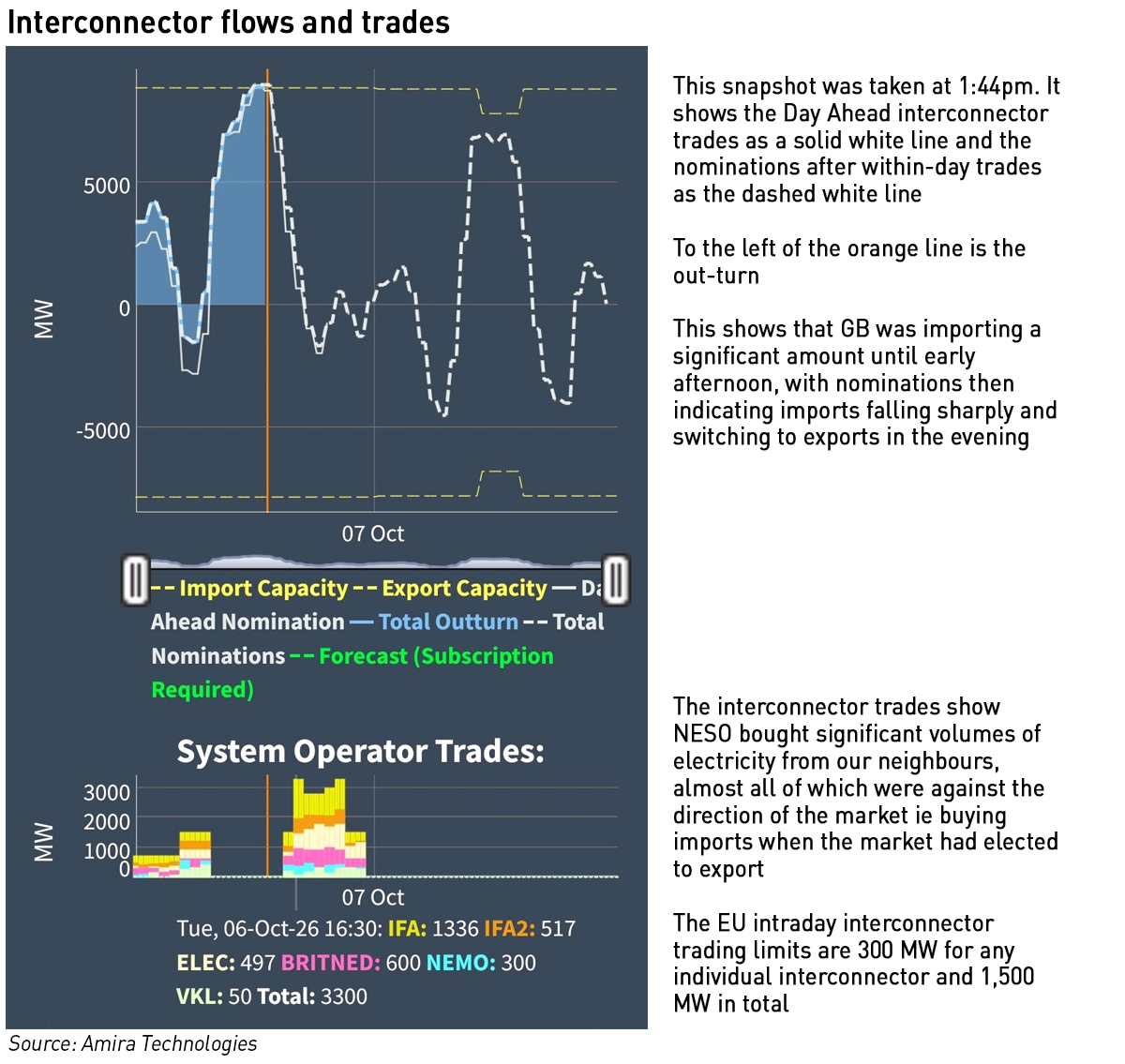
Since May the EU has restricted system operators in trading against the market, so if an interconnector is set to export, the system operator is restricted in the amount of electricity it can buy on that interconnector to 300 MW in any settlement period. Across all interconnectors the aggregate limit is 1,500 MW per settlement period.
As expected, NESO did lean heavily on imports. In its trades for 4:30 pm, IFA alone was set to import 1,336 MW. IFA2, ElecLink and BritNed were also above their respective 300 MW trading limits. These limits exist for a reason – European regulators believe that system operators trading against the market flow distorts the market and for this reason has decided to restrict them. However, over the summer, NESO repeatedly breached these limits as it struggled to balance the system during various heatwaves when wind output was very low. This can only be done with the agreement of the other TSOs.
It shows that normal market arrangements were not enough to resolve the EMN and NESO was forced to intervene on the interconnectors.
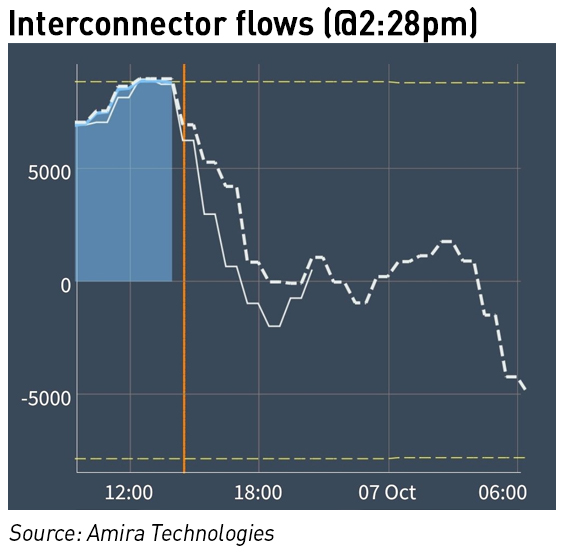
As we can see from this later snapshot, within day trades have increased imports, reduced exports and in some settlement periods, flipped the nominations from export to import.
But the interconnectors alone were not enough. At the same time, NESO was forced to pay high prices in the Balancing Mechanism (“BM”). Several units were bid up at prices approaching £1,000 /MWh against a day-ahead price of £275 /MWh in the peak.
By 7:30pm balancing costs for the day according to the LCP Enact dashboard had risen to £14.75 million against an average daily balancing cost of £2.3 million. Neither the full end-of-day balancing costs nor the price of NESO’s interconnector trades are yet known – NESO’s official daily balancing-cost dataset is updated weekly and at the time of writing has only been updated to 3 October.
But regardless of the eventual daily total, paying close to £1,000 /MWh for multiple balancing actions is hardly evidence of an electricity system awash with spare capacity.
The system worked but it was not comfortable
NESO will undoubtedly point out that electricity supplies remained secure throughout yesterday – it said the same about 23 June despite whistleblowers saying otherwise. The absence of a blackout is taken as proof the system is secure. I have compared this to saying that running in the road is safe because you did it a few times and weren’t hit by a car.
The 6 October did not see a blackout, nor was it a near-blackout. The grid was more secure than on 23 June, with frequency remaining inside the operational limits. But that should not obscure what actually happened, and how uncomfortable it was. We had a rare October EMN. We had an unusually long eight-hour EMN window. The margin shortfall initially increased rather than fell after the notice was issued. Wind output was around 1.4 GW below its day-ahead forecast, while demand was 921 MW below forecast – two very large forecasting errors which fortunately offset each other to a significant extent. Interconnector trading limits were breached. High prices were accepted in the BM.
All this happened in early October, with electricity demand nowhere near the levels we could see during a cold winter evening. The electricity system didn’t fail, but neither did it sail effortlessly through an routine autumn evening peak. NESO had to work hard to maintain its operating margin, and benefited from a large demand forecasting error in its favour – imagine if the error had been in the other direction.
NESO’s demand forecasts are getting worse. The day-ahead forecast error can be as high as 5.7 GW – an error that large on a day like 6 October would be disastrous.
To have an event like this so early in the winter is worrying. Peak demand was 35.0 GW (ITSDO – INDO was 32.9 GW). On a typical mid-winter day it would be around 45 GW, while the highest peak demand day last winter reached about 50 GW. On 6 October around 14 GW of biomass, gas, hydro and nuclear capacity was offline for maintenance, most of which would be expected to be available in mid-winter. Most but not all – it would be reasonable to expect 12 GW to be available, which would be helpful if demand was around 10 GW higher as it would be on a normal mid-winter’s day.
But it would not be enough to meet 50 GW of demand. For that we would need all interconnectors to be importing at maximum capacity, and for no large generators to be offline. Unfortunately, the type of weather that leads to 50 GW of GB demand these days would likely be cold and windless both here and in our neighbouring countries.
As my recent gas security report explains, low gas inventories in Europe coupled with low reservoir levels in Norway might make European electricity grids tight and their prices high. This could limit the availability of electricity imports for GB and could even drive exports. While NESO can restrict exports to protect domestic system security, it has no powers to compel imports.
The situation is likely to get much worse
The Government’s Clean Power 2030 Plan would see a greater reliance on wind and solar. Most of the existing nuclear capacity is retiring in March 2030 and March 2032 (following recent life extensions), but by then we may well see some CCGT retirements as 1990s-built plant reaches end of life. The existing biomass subsidies for Drax and Lynemouth are set to expire in March 2027, although there is a transitional extension to March 2031 – this may have to be renewed despite the controversy.
Earlier this year Drax “paused” its carbon capture project until state support can be agreed. I have always been doubtful that carbon capture equipment could be economically retrofitted onto such an old plant as Drax. More recently, the Government has decided not to extend the subsidies for small biomass plants which will all expire by April 2027. These are small units (10s of MW) but the loss of any dispatchable capacity is unhelpful.
By the early 2030s we could have much less dispatchable capacity on the grid. While Hinkley Point C unit 1 is currently scheduled to open in 2030, EDF has indicated this could be 2031 and the issues with the so-called “fish disco” could see it delayed further.
What 6 October shows us is both the value of flexible generation and the danger of assuming it will always be there when needed. Intermittent renewables depend on weather we cannot control while interconnector imports depend on countries we cannot control.
We are building a grid that is increasingly fragile, with market warnings now occurring year-round. It is essential that ministers get a grip on this situation. NESO needs to urgently improve its forecasting – it cannot be acceptable that errors in the GWs are being made. It is also vital that the Capacity Market is reformed to deliver new dispatchable generation even if that means unabated gas – Germany recently received EU state aid approval for 12 GW of new gas generation – and it also needs to be reformed to remove capacity that is not guaranteed such as interconnectors and unproven demand-side response.
Unless ministers address these problems, Britain risks reaching a point where electricity demand cannot reliably be met during periods of cold, still weather. At that stage, the question won’t be how much it costs to keep the lights on, but which consumers will have to be disconnected to prevent the system from failing.



Thanks to succesive incompetent governments, we all need to be fully prepared for a prolonged blackout. I am.
I simply cannot understand why the points you make, which would be perfectly comprehensible to a twelve year old, are beyond the wit of past and present politicians. I only have a few years left but God help my grandchildren.
I totally agree with you. I too worry about my grandchildren.
Given that our demand seems to vary between approx 35GW and 50GW a demand forecast error of about 5GW is always going to be problematic. That about 14GW is presently not available due to maintenance is hugely worrying. How can such a large proportion of our generating capacity be unavailable at the same time? I imagine that keeping an aging power station going will be challenging but we need to do better. Other countries face similar challenges so we can’t rely on imports. Given the (continued) delays at Hinckley, Government needs to swallow the 0 carbon nonsense and start getting some gas power stations built. Get the North sea going and sort Nordstream!
We are being forced to live through a make-believe fantasy based around mandated low-quality (low-ERoEI and inertia-less) energy supplies which are unsustainable without the heavy-lifting capabilities (in mining, mineral processing, steel and concrete production, shipping, …) of the very hydrocarbons they are supposed to replace. We are courting disaster by relying on international interconnectors we don’t control (cheatingly deemed to be “emissions-free”) and batteries whose grid-scale storage capacities are totally inadequate. We are subjected to the massive cheat of firing Drax and Lynemouth with biomass (wood pellets) whose CO2 emissions are higher than coal but have been designated “carbon neutral” by green blob connivance. We are subjected to the pretence that carbon capture and storage will confer benefits which justify its ruinously expensive costs.
The 95% grid decarbonisation “plan” is clearly unachievable without incurring regular rolling power cuts and ruinously high electricity prices yet nobody in authority challenges the roller-coaster to disaster we are being forced to ride with no exit other than crashing into the buffers.
More people need to read Richard Lyon’s excellent but scary new book “The Energy Trap”, available from Amazon. In concise, layman-friendly prose he describes the double-whammy of energy policy delusions by which we are sleepwalking into an economic catastrophe which will totally upend our society, namely mandating the use of Net Zero low-quality energy and sticking heads in the sand on the impending peak oil crisis.