
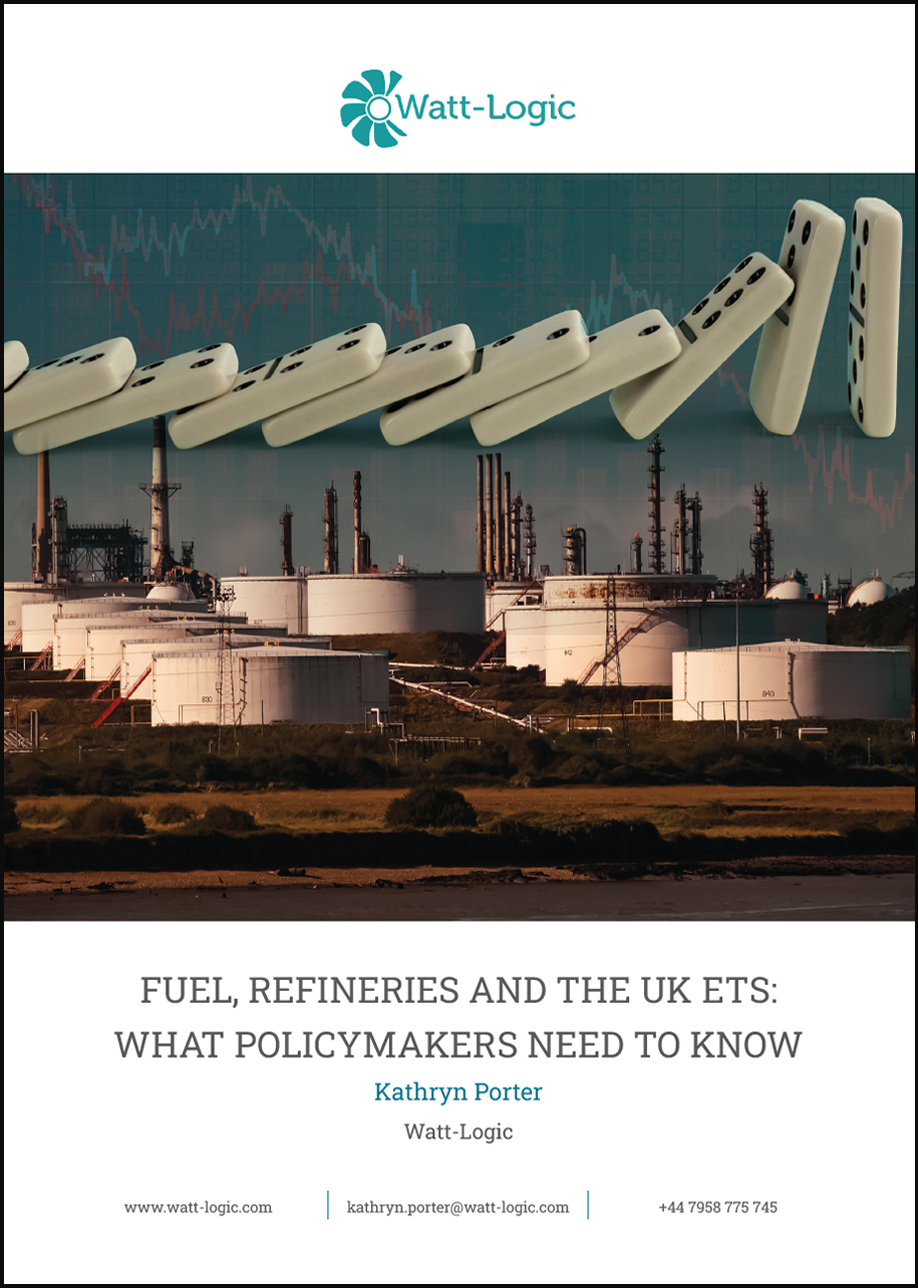
Today I have published a new report into the refineries sector: Fuel, refineries and the UK ETS: what policymakers need to know. In it I call for refineries to be excluded from the UK Emissions Trading Scheme (“ETS”) at the very least, and ideally for the ETS to be abolished altogether.
UK refineries are being killed off by high carbon costs
Britain lost two oil refineries last year – Grangemouth closed in April 2025 and Lindsey followed in August, leaving just four operating sites: Fawley, Humber, Pembroke and Stanlow. This matters far beyond the companies and workers involved because it increases Britain’s import dependency and undermines energy security.
Liquid fuels still provide 47% of UK final energy consumption with Britain now forced to import significant volumes of the diesel and jet fuel it uses. These fuels are essential for road freight, agriculture, construction and aviation and have no substitutes available at scale in the near term. In 2025, we imported 15.5 million tonnes more petroleum products than we exported, the largest deficit since Britain became a net importer in 2013.
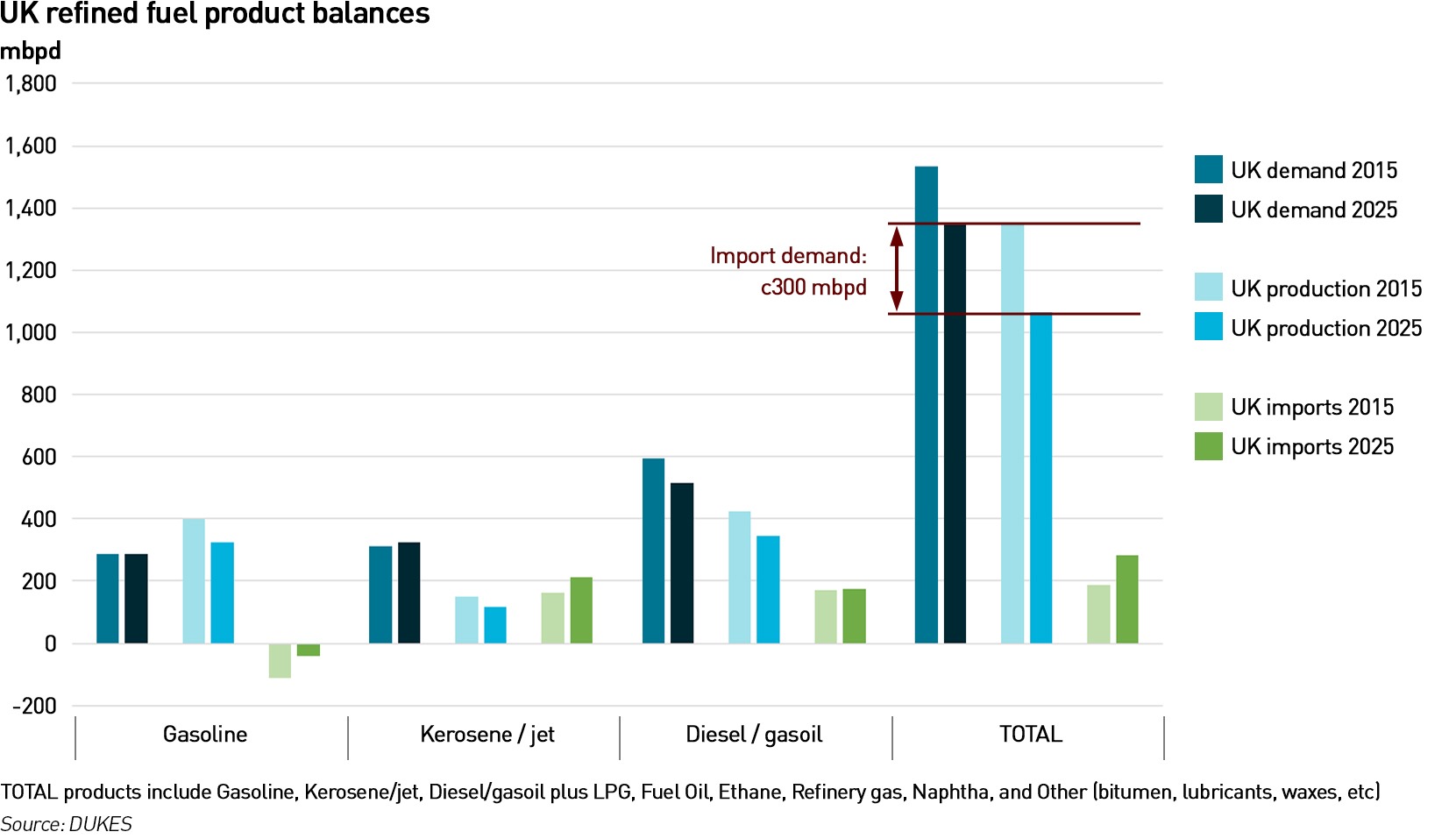
The closure of domestic refining capacity therefore doesn’t mean we stop consuming refined petroleum products, it just means we outsource the refining, and as with other manufacturing that has closed in the UK in recent years, that often comes with higher overall emissions.
Despite this, Government policy is actively making the situation worse because refineries are covered by the UK ETS, under which emitters of carbon dioxide must surrender allowances against their emissions. Energy-intensive industries receive some allowances for free to protect against “carbon leakage” although in practice leakage is not prevented because the costs remain uncompetitive.
Based on average carbon prices over the past year, my analysis suggests the four remaining UK refineries face a net ETS cash cost of around £200 million per year. Their gross carbon cost disadvantage relative to refiners outside carbon-pricing regimes is around £540 million per year.
This is particularly damaging because refining is an internationally competitive, relatively low-margin business. Refined products are widely traded and largely fungible which means British refineries can’t pass their carbon costs through to consumers in the way that electricity generators can. These costs directly hurt the profitability and viability of UK refineries.
The mainstream forecast for UK and European refined product demand is unambiguously negative, although market shocks following the Russian invasion of Ukraine and the Iran war have provided periods of relief. The dominant narrative is that this is driven by climate policies promoting the growth of renewables and electrification of transport. This framing ignores another factor that is, in the short to medium term, at least as significant: deindustrialisation.
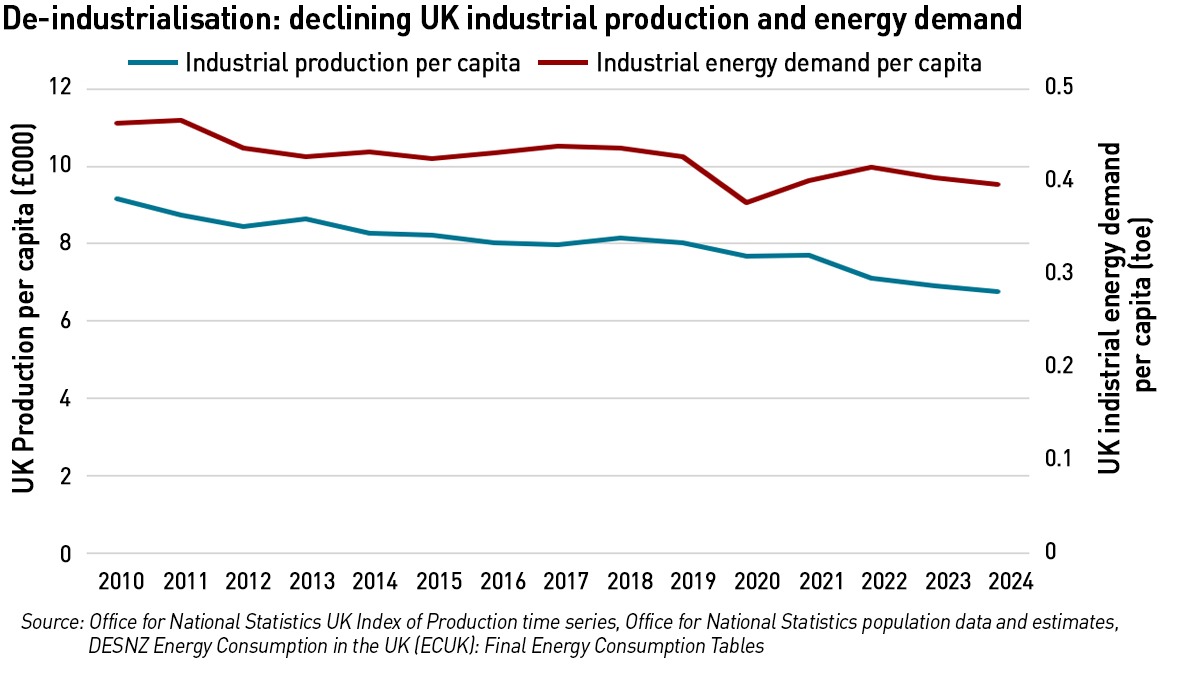
EU industrial energy consumption fell 8.1% between 2014 and 2024 and has been in structural decline since 1990. This trend incorporates efficiency improvements and a shift towards less energy-intensive sectors, but the period since 2022 has seen a sharp and rapid contraction in energy-intensive industrial output driven by high energy costs. This has destroyed demand for refined products in ways that have nothing to do with EVs or climate policy.
Wider deindustrialisation also has a significant effect on demand for refined products as industry is a major consumer of diesel for on-site logistics, mobile plant and backup power, and oil for process heating. Industrial closures remove both that direct consumption and the associated road freight demand from supply chains serving those facilities.
In addition to these domestic pressures, UK and European refineries face formidable competition from refineries in the US, Middle East and Asia, many of which are newer, larger and more sophisticated than Britain’s, whose original sites date from the 1950s and 1960s despite extensive subsequent investment. Some overseas refiners benefit from state support, preferential access to crude, cheaper labour and significantly cheaper energy.
“…since 2009, approximately 30 refineries have shut down continent-wide, leading to a 37% contraction in refining capacity over the past decade. Industry forecasts now indicate that 60% of Europe’s total refining capacity is at high risk… Estimates suggest that between 40 and 50 European refineries may cease operations by 2035… representing over 30% of Europe’s total capacity,”
– Blooming Trade Data, A New Era for Oil Refining and Chemicals as Three Major Forces Emerge
It would be hard for UK refineries to compete with them at the best of times, but we then handicap our refineries further by imposing carbon costs which many of their competitors don’t face.
The Carbon Border Adjustment Mechanism is supposed to protect domestic manufacturers from carbon leakage by applying an equivalent carbon price to imported goods. But the number of sectors included is very limited and refining isn’t one of them. There is no plan to make a tanker of diesel or jet fuel arriving from India, the Middle East or elsewhere bear the carbon cost imposed on the British refinery it competes with.
What exactly is the ETS supposed to achieve?
By imposing a cost to carbon dioxide emissions, the ETS is designed to encourage emitters to reduce their emissions. That sounds great in theory, but in practice does it actually work? Refining is extremely energy intensive so refiners have always had a strong commercial incentive to improve efficiency and thereby reduce emissions. European refineries have spent decades investing in heat integration, cogeneration and process optimisation because every unit of energy saved improves their margins. Significant efficiency improvements were being made long before emissions trading existed.
Beyond further incremental efficiency gains, there are few meaningful investments UK refiners can make to further reduce their emissions today. Neither carbon capture nor hydrogen schemes are viable without government support which have been discussed for years but not actually delivered.
The same argument can be made in other sectors. Energy intensive industries are large carbon dioxide emitters but they are also, by definition, large users of energy. So investments that reduce their energy consumption for reasonable upfront cost will be made. It may be argued that a marginal investment might become attractive when carbon costs are added, but are we really going to pin something that adds £billions per year to the costs faced by British businesses on some marginal investments?
“… we are currently paying £70 million to £80 million a year in CO2 costs. That will go up to £150 million in the next four or five years, and our competitors are not paying any. That is the cost delta that we are suffering versus our competition, and that is what is causing refineries to shutter in the UK. We have lost two recently. You are therefore effectively driving even more imports to come in, and they can compete against us because they are not paying the CO2 costs,”
– Paul Greenwood Managing Director, ExxonMobil UK
Because UK refineries cannot pass carbon costs through to consumers, the risk is that UK refineries close in favour of imported fuels. This is not hypothetical, it’s happening. It is also happening in other energy intensive industries which face competition from imports.
In other sectors such as power generation, the ETS is simply increasing costs to consumers. And there is also no meaningful decarbonisation in the power sector that the ETS can deliver – renewables require huge subsidies to be viable, and since the exit of coal, there is no other large-scale dispatchable generation available that could replace gas in the electricity mix today. Gas is still need when renewables output is low, and this is unlikely to change any time soon.
As with other manufacturers, if gas-fired generators had available investments to increase fuel efficiency they are already incentivised to make them. So the ETS does not reduce emissions, it only adds costs: over a fifth of the wholesale electricity prices are now due to carbon costs which impacts both household and business energy bills.
So what does the ETS achieve today? It makes refining in Britain more expensive. It makes manufacturing in Britain more expensive. It makes energy in Britain more expensive. And that’s it.
We are exporting emissions, not eliminating them
This exposes the central fiction of the ETS both in the UK and Europe. Our climate targets focus on territorial production emissions, which we can meet by closing domestic manufacturing and switching to imports. Emissions disappear from the UK’s carbon account, but British demand for diesel, petrol, jet kerosene and a wide range of other energy intensive goods does not disappear with it. They are just made somewhere else, and that somewhere else very often has a higher carbon footprint. To which the new emissions from shipping goods from that somewhere else to the UK must be added.
The emissions have not been eliminated – they have simply moved. That is not decarbonisation, it’s offshoring. In fact it’s greenwashing – our politicians celebrate emissions reductions in the UK ignoring the fact that they are not true reductions – on a global basis they are very often increases.
We can see the extent of this effect in the ETS registers. Of 1,702 UK installations on the EU ETS compliance register, 292 closed between 2008 and 2020. Since the UK ETS began in 2021, a further 183 sites out of 1,415 registered installations have closed, and these figures do not yet include Lindsey and Grangemouth.
Free allocations tell a similar story – total free allowances issued under the UK ETS fell from 37.8 million tonnes in 2021 to 23.6 million tonnes in 2026, a reduction of 38%. Importantly, this was not caused by the Government tightening the methodology used to calculate allocations because the calculation basis had not changed.
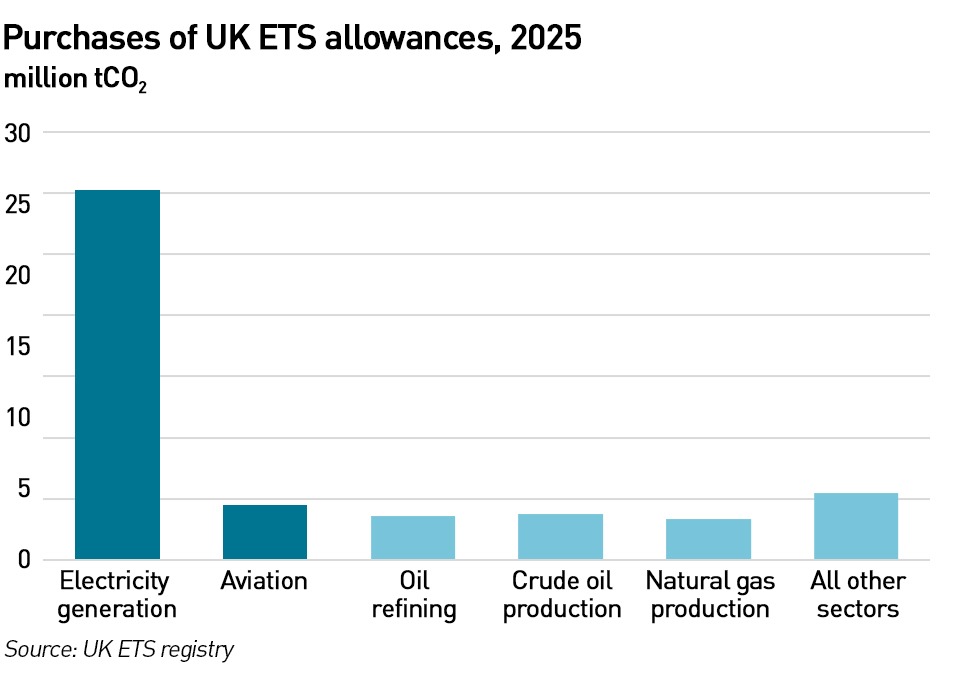
The fall therefore reflects lower production and plant closures. The largest recent reduction alone was 4.6 million allowances following the closure of the Port Talbot blast furnaces. Yet UK steel demand is increasing not falling, so obviously imports must rise when UK production declines.
The original economic logic behind carbon pricing is superficially attractive – put a price on emissions and businesses will have an incentive to invest in technologies which reduce them. The market can then discover the cheapest methods of decarbonisation rather than governments attempting to pick individual technologies. But this only works if businesses actually have real, viable decarbonisation choices available to them.
But where economically viable efficiency improvements exist, energy-intensive businesses already have strong incentives to pursue them because using less energy reduces their costs. Where commercially viable substitutes exist, businesses are already incentivised to adopt them. But where neither is available, increasing the carbon price doesn’t magically create them. It either forces UK producers out of business in the face of cheaper imports or it increases costs to UK consumers.
This benefits neither the climate nor the UK economy.
Worse, we tax an industry into near-oblivion and then, realising it’s actually an important industry, are forced to consider subsidising it to persuade it to stay open. That is utterly incoherent.
.
The UK needs to decide what it’s actually trying to achieve. Does it really want to reduce emissions in order to address the perceived “climate emergency” in which case it is global rather than domestic emissions that actually matter. Former Energy Secretary Ed Miliband was obsessed with the idea that if the UK lowers its emissions other countries will follow suit. There is no evidence that this neo-colonial strategy is working.
And surely it’s better to focus on the things we can control directly rather than pinning our hopes on second order effects that may never materialise. Particularly given the harm we are doing in the UK in the process.
UK industry is disappearing at an alarming rate – there is no room for complacency.
There are only four UK refineries left, and we are still imposing costs on them which many overseas competitors do not face, nor are we planning to protect them from this with the CBAM. Yet there are currently no major commercially viable decarbonisation investments they could reasonably make to further lower emissions regardless of the level of the carbon price.
The UK needs to stop confusing lower territorial emissions with decarbonisation. An environmental policy which exports emissions, destroys domestic industry, increases import dependence while raising global emissions is deeply irrational.
It’s time to abolish the ETS.
ABSTRACT
The UK Emissions Trading Scheme was designed to encourage decarbonisation, but after decades of energy efficiency investments by the industry there is little further meaningful decarbonisation that can be economically delivered in the refineries sector.
This means the ETS is now simply a tax, and one that cannot be passed through to consumers who can buy imported refined products that are exempt from carbon taxes. As there are no plans for the sector to be covered by the Carbon Border Adjustment Mechanism, the issue of carbon leakage will not be solved.
This is a material threat to the future of the remaining UK refineries and must be addressed as a policy priority if the sector is to survive.



Just how hard must we bang out heads against the wall before the “Green” Nimbys actually understand the profoundly stark and simple logic expressed in this article?
Very well put Kathryn. Having spent 37 years in the energy/oil/gas industry, 23 of those at one of the last 4 remaining UK refineries, I concur with the statement that energy intensive industries like refining have always had a large incentive to reduce energy use (hence emissions) because their major cost is energy. Hence, energy efficiency investments have always been made and all the low hanging fruit has already gone leaving huge capital intensive projects like major heat integration/reconfiguration etc the only things left.. Further taxes on emissions will not do anything to “persuade” refiners to pursue major capital projects in an uncertain industry given government policy. Rather, it will add costs to UK refining, making it uncompetitive, causing further UK industrial decline and increasing reliance on refined product imports and therefore harming our already weak energy security.
The UK used to have a vibrant heavy industrial base which supported good jobs, balance of trade and with extensive apprenticeship programs, developed large UK manpower skillset. Sadly, the government trying to meddle in apprenticeships because of the demise of graduate jobs to give youngsters an alternative to university will achieve nothing because there is no industry left to support the training. All we’ll get is apprenticeships in the likes of the public sector and retail.
Where do these taxes from the ETS go to ? Probably, ultimately into the great blackhole of government spending
Miatta Fahnbulleh welcomes your detailed report, however states please do not confuse me with facts, as my mind is made up, Carbon dioxide is very very bad.
Great report ,but our thick politicians are illiterate on basic economics, but they are good on bus fares!
Dear Kathryn, thank you for an amazing report.
The action is clear – as are the ‘interests’ of those who lobby HM Gov.
Add to this the comfortable fully detached world view from those who do not know where energy comes from, and we – the entire country – has a huge problem.
Instead the nation is supposed to follow the empty performative gestures of the elected officials, and watch as the administration carries on regardless.
It is this which has to be re-shaped.
The UK and California are the current leaders in the race to dissolve western civilization. We will be left with the agrarian society that was once proposed to be imposed on Germany at the end of WWII. Working as serfs for our Asian masters.
Hear, Hear!
I understand that in the UK we only produce about 20 to 25% of the medicines and plastics we consume but we should not forget that much / all of the raw feedstocks for those come from oil & natural methane.
Plus ca change Kathyrn. Back in November 2011, I helped write a report for the UK Petroleum Industry Association titled “Fuelling the UK’s Future- role of our refining and downstream oil industry”. We had 8 refineries then, now we have 4. The core messages were that the industry was at a competitive disadvantage due to legislative burdens like EU ETS; Renewables Obligation etc; that a variety of fuels and technologies would be needed as part of our future energy mix and that this transition takes time and needs a consistent, clear policy framework based on sound science and cost effectiveness. We have not had that in shape or form. The then Dept. of Energy thought it was fine to rely on imported finished products, with barely a thought as to security of supply. The report was ignored, despite the warning that the sector would be at risk without coherent policy direction which could have significant unintended consequences for energy supply and resilience. When refineries close, it puts at risk the associated infrastructure of connected cross country pipelines and storage. Effectively, we have exported our emissions.
We haven’t just exported our emissions, we have increased them by adding the global transport emissions into the equation. Emissions are far worse.
The problem with government is that they see tax as a good thing. Used as a blunt instrument to change behaviour. Subsidies for electric cars, carbon/energy taxes on fossil fuel use/manufacturing. They could just legislate for more economical cars, lower emissions, not taxing work and jobs, not giving handouts to foreign manufacturers. The way the economy is being run is beyond a joke. There appears to be no politician capable of looking at the damage that is being done.
One wonders how much tax they now get out of the oil and gas industry? Taxes on production, fuel duty and VAT. Is this why the American economy is booming and we’ve got productivity that’s just stuck, slowly losing the standard of living that we used to have.
Taxes to “reduce energy demand”. Well if you hit the end user with fuel duty, you hit the low income people as well. If you hit production, you hit the low income people as well. Now legislation to control the minimum fuel economy, only affects the rich, where they would be forced to use more economic means. The low income people are not adversely affected.
Why is it that politicians cannot see the adverse effects of their tax regimes? They have a very useful tool, called legislation, to change what can be manufactured. They didn’t need to create any new taxes at all.
If you look at industry they try their damnest to reduce costs to increase profits, yet the governments, yes, all of them, do the exact opposite, they add costs into the system, reducing profits, making business/industry unviable. Why is government so anti-business/anti-industry? Just think, without those taxes, we could be exporting.
I think the point about a Carbon Border Adjustment Mechanism is a good one. How else can we ensure fair trade between the UK and the rest of the world? If we are to have a carbon price at all, surely it should be levied on all imported goods?
Yes, there should be a shipping tax because the lack of local production instantly increases the carbon burn through transportation. The taxing of local production is counter-productive if they actually want to reduce emissions. If there were sailing ships with no fossil fuel burn, except for coming into port, or with solar power, then they could avoid the tax. That would encourage the development of energy efficient transport, and then perhaps we could have some jobs and manufacturing back in the UK, and not have students (who would be unemployed if they weren’t at university) taking out massive loans to pay for worthless degrees.
Globalisation has a lot to answer for in terms of increased emissions.
Another well presented paper explaining the facts of life in regards to what carbon taxes cost the UK Taxpayers for no tangible benefit.
Another great report.
Time this Labour Government woke up before it’s too late for the UK’s economy!
Many thanks for your latest email outlining your analysis of the flawed ETS tax and its damaging effect on the UK economy. You have an impressive command of the complexities of our energy supply system and an admirable, intelligent and common sense raft of recommendations for the energy policy makers. I only hope that our goverment listens and heeds the lessons derived from your extensive research.
Again many thanks for your hard work in this field.
When they’ve stopped oil, one wonders how all the roads will be maintained and resurfaced?
With bitumen and other finished products, we are moving our purchasing to the higher cost end of purchasing, and not having the manufacturing/jobs. It will be interesting to see how the borrowing keeps increasing as we stop creating added value from raw materials, and just buy the expensive finished products from abroad.
If governments only know how to tax businesses in this country and give subsidies for people to buy foreign made products, it won’t be much longer before the increased borrowing requirements of the country will force the government to start taxing foreign imports, and reduce taxation on businesses in this country to force growth. If they can’t tax businesses and people any more, there’s only the taxation of imports left to force the creation of more production in this country and thereby jobs and tax revenues.
Only time will tell if such tougher measures are required.
I find the article really useful. I agree with it all. Would it be possible to show as a best estimate how many net jobs have and will be lost by 2050 if we continue on this path and many other countries in the middle east and far east do not. A scenario of manufacturing in the uk by 2050 would be useful and its economic impact. AI will desimate service industry jobs so non service industries could become more important. I use AI and it is excellent within parameters so forward thinking of human involvement in an economy and how to fundothe public sector must come into government forecasting if they ever can get it close to being somewhat accurate.
Kathryn,
All entirely correct. The evidence that the refining sector will be wiped out is there for all to see in the deindustrilisation that has happened particularly in the UK but increasingly more widely in Europe.
The introduction of CBAM is parody beyond belief with a sequence that is broadly:-
1. Introduce EUETS (and many other unilateral tax measures);
2. Watch your domestic industries die – while you import the emissions in products you import (but these emissions aren’t counted) and
3. Introduce a CBAM to protect the industries that are already gone.
Staggering.
An interesting parallel with Rosebank Oil and Jackdaw Gas fields where environmental concerns for local production seem to be under pressure without consideration for necessarily imported material for refining and local gas fed consumption either as power or household heating?