

Today I have published a new report on the gas markets: Gas security: The foundation of energy security. In it I call for Britain to increase its domestic gas production, reduce its reliance on imported electricity and fundamentally rethink the way it plans for energy security. UK energy policy has long been undermined by a poor understanding of how gas markets actually work, leading to all sorts of false beliefs that result in very poor policy decisions.
My report makes six key recommendations:
Fix the broken understanding of how the gas market works. Policymakers should recognise that British gas production is not sold on global markets at a global price. The GB gas market uses marginal pricing and additional domestic production displaces more expensive LNG imports, thereby reducing British gas prices. The report argues that claims that additional UK production cannot affect domestic prices are simply wrong.
Increase UK Continental Shelf gas production. Domestic gas should be preferred to imports wherever possible. UKCS gas is both cheaper and cleaner than imported LNG and provides a secure source of supply directly connected to the British gas network.
Reduce reliance on electricity imports. Britain is increasingly depending on electricity imports during periods of low domestic renewable generation. However, highly correlated weather patterns mean low wind generation in Britain can coincide with shortages elsewhere. The report warns that Norway and France cannot be assumed to provide unlimited electricity to their neighbours during periods of stress.
Model gas and electricity security together. The gas grid transports far more energy than the electricity network. Electrifying heating will take decades while gas-fired generation will remain critical to electricity security for years to come. The report argues that planning should recognise the interdependencies of gas and electricity to a greater extent.
Focus on cheap energy. Rapidly rising network costs are overtaking fuel costs as the main driver of energy bills. The report calls for tighter control of network expenditure and for the suspension of the Connect & Manage regime, arguing that consumers should not be required to fund expensive infrastructure whose output is frequently constrained or wasted.
Treat energy security as national security. The government should subject energy policy to an explicit national-security test, prioritising resilience, diversity of supply, sufficient domestic energy capacity and the preservation of strategically important industrial capability alongside affordability and sustainability.
Policymakers must correct their misunderstandings about gas markets
British gas is not sold on some mythical global gas market at a global price. Gas markets are regional and constrained by physical infrastructure which means that price arbitrages persist because the infrastructure to move the volume of gas needed to equalise prices does not exist. North Sea gas is the cheapest source of gas available to Britain, and as almost all of it has nowhere else to go except the British gas grid, it lowers the cost of gas and therefore also of electricity.
Why? Because just like the British electricity market – and every other freely traded commodities market in the world – the British gas market uses marginal pricing. A bizarre myth has been allowed to develop whereby policymakers assume marginal pricing is a weird quirk of the UK electricity market. It is not. It is the default method of price formation in commodities markets absent state intervention.
So if the UK increases its production of cheap domestic gas, that gas enters the British gas grid and displaces more expensive LNG imports. The most expensive cargoes are displaced first, so as UKCS production increases, progressively cheaper LNG cargoes become marginal, lowering the British gas price.
The Jackdaw field is large enough to fully displace price-setting LNG for between two and four months of the year, which would have a meaningful impact on summer gas prices. (Some LNG may still be delivered, to meet contractual obligations or for operational reasons such as terminal cooling, but these would not be price-setting.)
Once this marginal pricing mechanism is understood, the case for maximising domestic production becomes obvious. North Sea gas is not only cheaper than imported LNG, it is also cleaner, so preferring it is a no-brainer for anyone not completely brain-washed by Just Stop Oil zealots. UKCS gas is also more secure than imported gas – it is directly connected to the National Transmission System (“NTS”), and, unlike an LNG cargo, it cannot just sail away when a buyer elsewhere in the world offers more money.
Declining UKCS production only makes Britain more dependent on imported gas – as I explain in the report, the UK is going to need gas for decades still. Even in the domestic heating sector, the only one with a firm electrification target, it will take decades to displace boilers with heat-pumps even if the target installation rate was met (which so far it isn’t).
Accelerating the decline of domestic gas production while domestic demand remains strong increases Britain’s energy-security risks while failing to deliver climate benefits due to the higher carbon footprint of imported LNG. A lose-lose position.
Gas prices are not global
Another myth is that the UK suffers from high energy prices because it is forced to pay expensive “international” prices for gas. In a recent LBC interview, Energy Secretary Miatta Fahnbulleh literally said “the reason why our energy bills are much higher than in other countries is because those costs are being driven by global fossil fuel markets”, failing to notice the lack of logic – surely everyone pays the same price if they are “global” so why would this make UK energy prices higher than in those other countries?
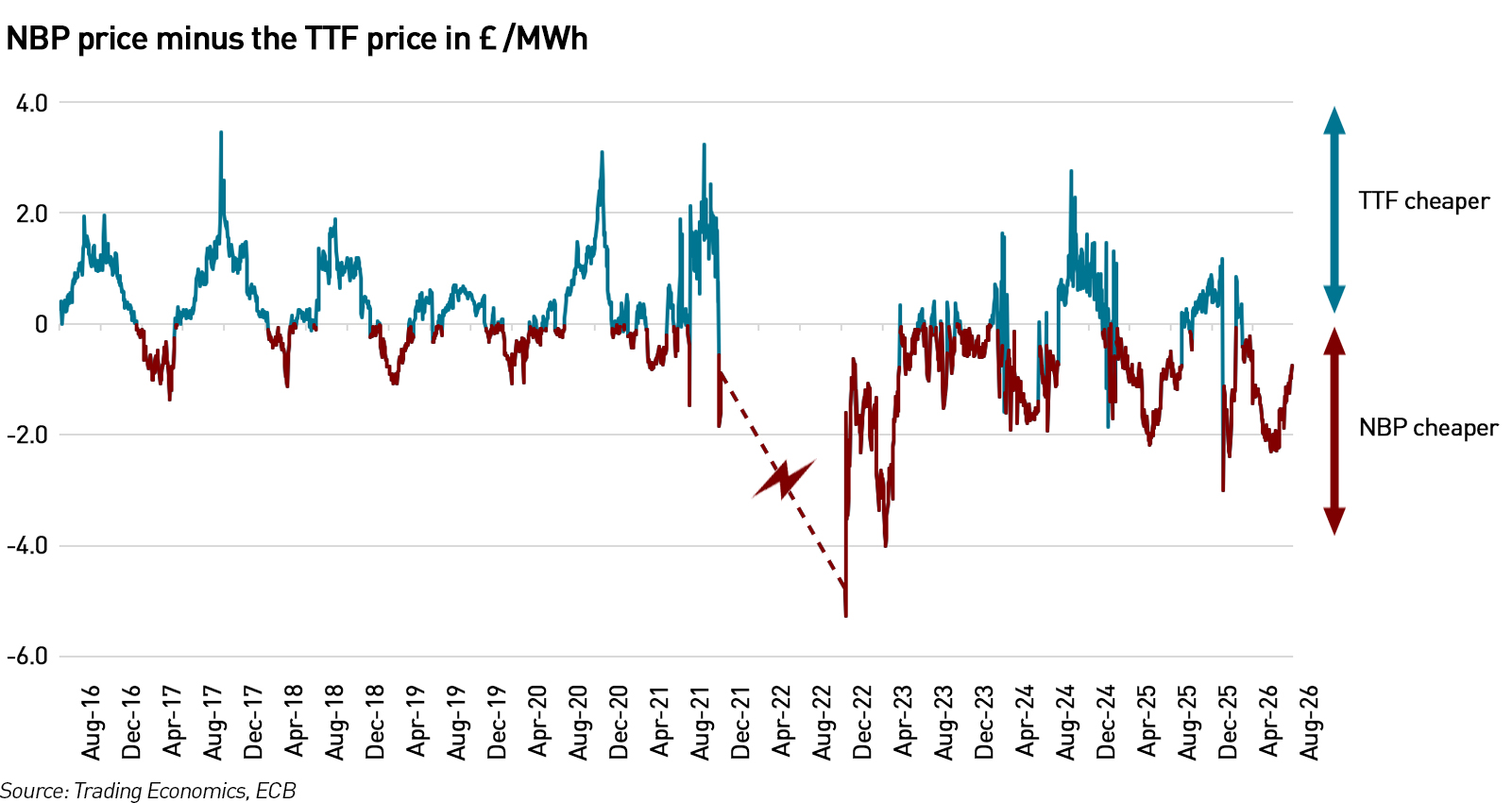
The truth is that there isn’t even a single European gas price, never mind a global gas price. How do we know this? Well, not only can we look at actual marker prices, we can also look at flows on the pipelines between GB and the EU. Gas flows from the cheaper market to the more expensive one. Historically, GB exported to Europe in the summer and imported in the winter, treating the Continent as a synthetic storage facility.
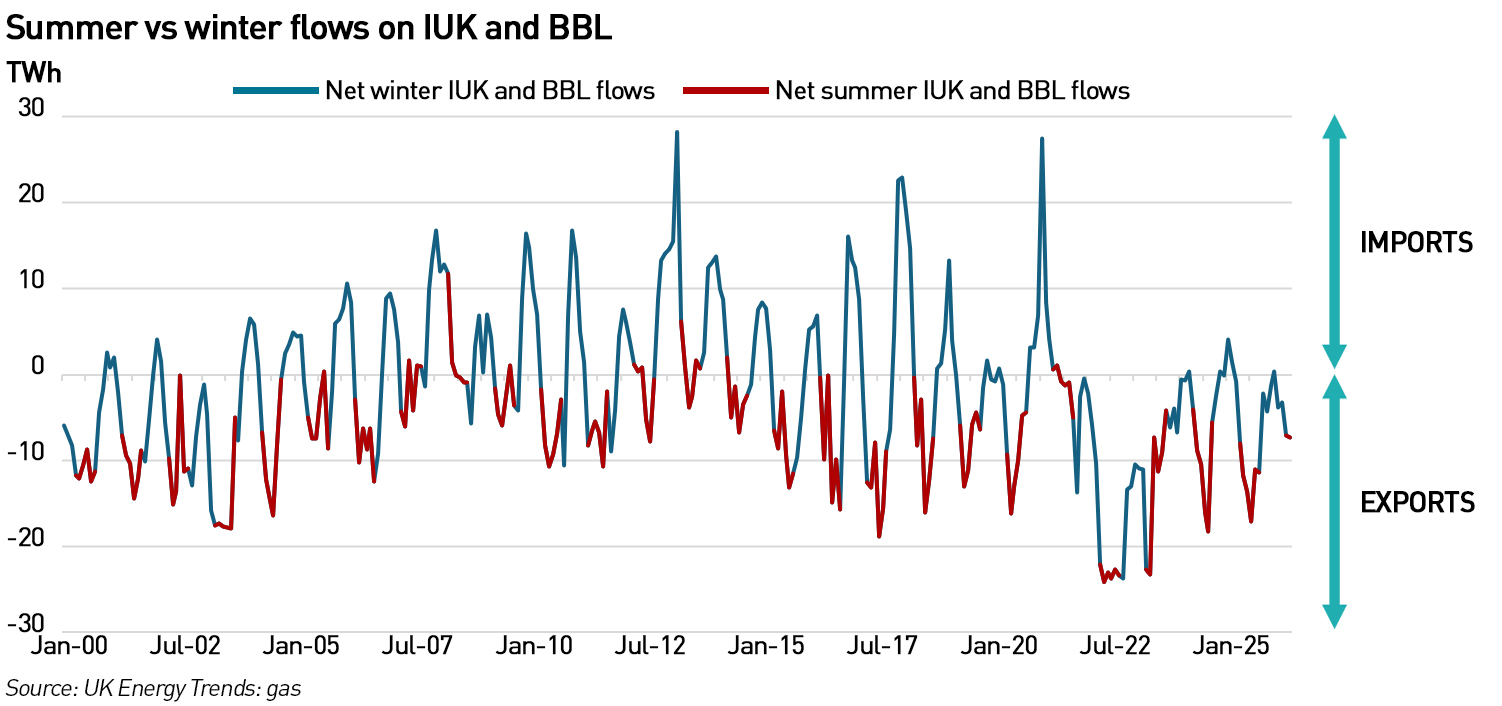
But since the summer of 2021 GB has imported almost no gas from the EU – the pipelines have been almost exclusively in export mode. While winter exports have been modest, summer exports have been high. The reason is that the cost structure of European gas changed with the loss of cheap Russian piped gas making it more expensive than NBP almost all of the time (and when it isn’t the premium has been too low to offset the transportation cost).
Market flows tell us that the UK has a strategic cost advantage given its domestic gas production, yet the Government seems determined not only to ignore this fact but to waste the benefits that the basin still has to offer.
The UKCS is not on its last legs – or it doesn’t need to be
UKCS production was 332 TWh in 2025, just a quarter of the 2000 level. In 2019, the then-Oil and Gas Authority projected that 6.5 billion barrels of oil equivalent could be recovered from the UKCS between 2025 and 2050, with a near-term challenge of reaching 1.3 million boe/d of production by 2030. NSTA’s current position puts total 2025-2050 recovery at just 3.8 billion boe, a fall of more than 40% from the 2019 figure, with the 2030 production target now more than halved, to 0.6 million boe/d. Every intervening revision has pointed the same way – downwards, driven by a hostile fiscal regime and a ban on new exploration drilling.
These forecasts are often used as “proof” that the UK’s gas resources are rapidly declining and that approving new production is largely futile. But this is to misunderstand what lies behind these forecasts – they are not a representation of total available gas, but a forecast of economically recoverable gas. If policy changes restrict drilling and make production less profitable, the amount of economically recoverable gas will fall regardless of the actual volume of gas reserves.
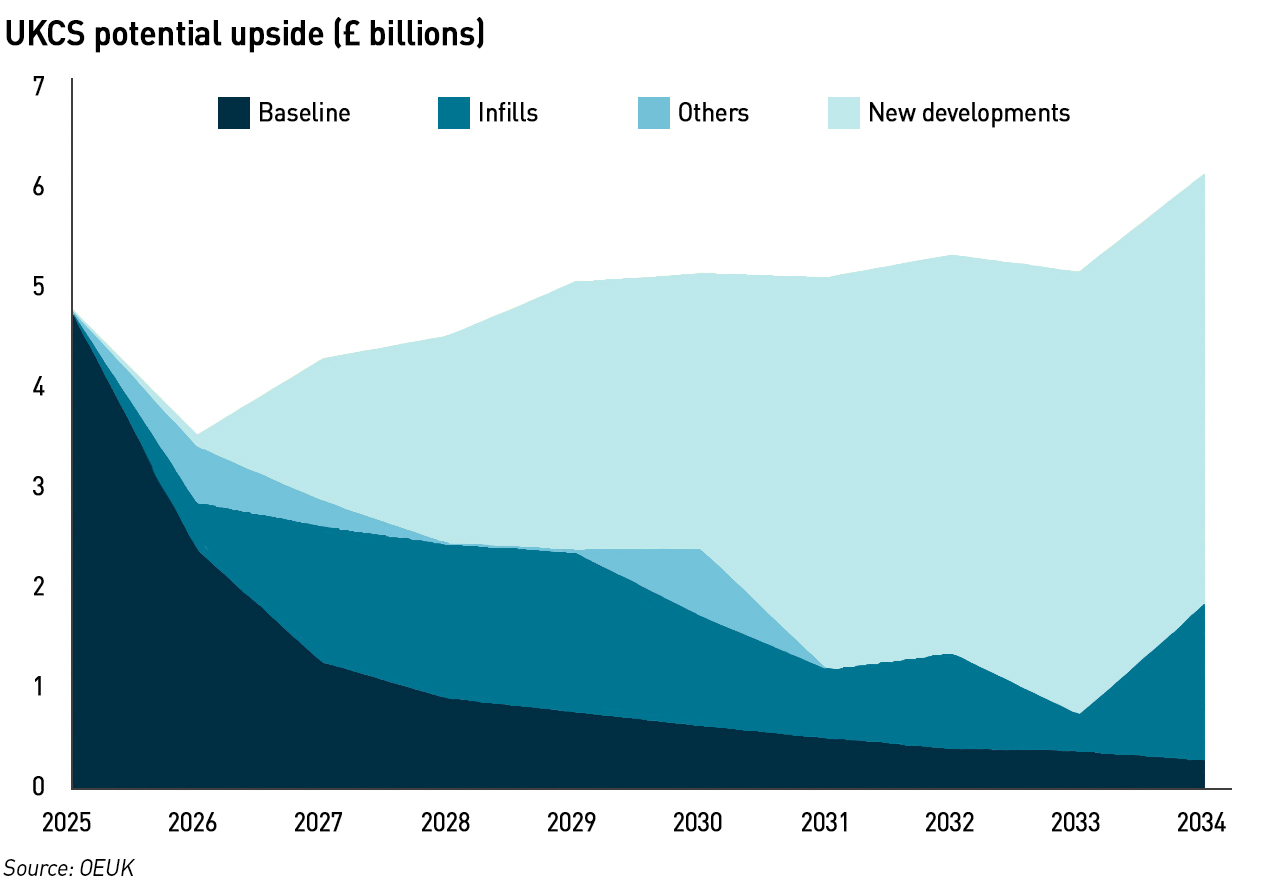
OEUK believes that recovery under a supportive fiscal and licensing regime could reach 7.5 billion boe, almost double the NSTA’s current projection, while under continued deterioration in investor sentiment it could fall as low as 2.6 billion boe. The equivalent range expressed in gas volumes specifically, rather than combined oil and gas, is comparably wide: OEUK’s modelling puts the NSTA’s November 2025 gas production projection for 2025-2035 at 176 bcm, against an OEUK “upside potential” of 288 bcm for the same period, rising to a cumulative 2025-2050 gap of 226 bcm (NSTA) against 456 bcm (OEUK upside).
It is clear from this analysis that under a less restrictive fiscal and regulatory regime far more gas could be recovered from the UKCS. Indeed, in the past year Norway has made material discoveries adjacent to the UKCS, some of which may well extend into our side of the median line – except our ban on drilling prevents us from verifying this. We are deliberately choosing not to explore the potential of the UKCS and then using the difficult economic environment created by the Government as “proof” the UKCS is in terminal decline and no longer worth bothering with.
This is both dishonest and stupid.
Gas security is fundamental to energy security and national security
If we are going to need gas for decades to come, policy should focus on making sure we have access to affordable and reliable gas supplies. Yet policy is tilted towards a gas-free world policymakers dream of, rather than the real world where gas will be integral for many more years.
There is some recognition that if gas is treated as a dying market the investment needed to ensure security will not materialise, leading the Government to explore support mechanisms for storage or floating regas terminals. But the Government’s consultation on this misses key market developments such as the structural change in the relationship between British and European gas prices described above.
Gas security is impossible to separate from energy security. It’s not a subordinate or transitional concern to be addressed once the “more pressing” work of decarbonisation is complete. And energy security cannot be separated from national security. A country which is unable to reliably power and heat itself, maintain essential services or sustain its industrial base is inherently vulnerable. Every major energy-policy decision should be subjected to a national-security test.
The objective of energy policy should be to provide consumers with secure, affordable energy. Instead, we risk asking them to pay increasingly high costs for a system which is less resilient and increasingly dependent on other countries being willing and able to export energy to us.
Gas is not going away because policymakers would like it to. We need to plan for the energy system Britain will actually have, rather than the one we might hope to have. Britain needs an integrated energy-security strategy which recognises the continuing importance of gas, maximises economically viable domestic production, reduces dependence on electricity imports and puts affordability and resilience at the centre of energy policy.
Anything less is irresponsible.
ABSTRACT
Britain’s gas system is more fragile, and gas’s role in the energy system more enduring, than current policy assumes. UK gas prices are set locally, not internationally, so domestic production directly affects what consumers pay. Gas is no longer the primary driver of rising bills, having been overtaken by network costs, and declining UKCS production outlook now threatens the viability of the pipeline infrastructure that carries it.
Britain’s growing reliance on electricity imports compounds this risk, resting on an interconnector regime and neighbouring systems that cannot be assumed reliable under stress. With storage weak on both sides of the Channel and gas set to remain structurally necessary for decades, gas security is energy security and energy policy must treat it as such.




At last – logic and an appreciation for CH4.
It’s a Primary Energy Source within reach, a low hanging fruit in terms of our existing infrastructure!
Electricity imports. Unfortunately it’s not just during periods of stress that we import mainland EU electricity. Imports were 44 TWh in 2025 vs.4 TWh of exports, and (at 15% of annual grid supply) look more like an additional baseload source these days. Look at EnergyDashboard.co.uk (or similar) for a disturbing graphical representation of the Elexon data.
Worse, the 4 TWh isn’t just dumping cheap surplus GB renewables. I was looking on the the Elexon site at 23 June (for example). Unsurprisingly, a lot of import during the daytime, but at night someone is simultaneously purchasing EU electricity and selling it to the EU. I don’t know what proportion of our heroic 4 TWh this activity represents. Still, it’s all good news for National Grid.
A well considered and excellent summary of the UK energy market in relation to the global market
Can I just add that government policy is trying to drive a revolutionary change in how we obtain and use our energy. This is in itself the most expensive and unpredictable method of progress
Revolutionary change has far greater unknowns in the pathway than evolutionary methods. As such the risks of going wrong or failing are very much higher. We can see this consequence directly in the device rollout program with targets being substantially missed despite heavy grants and subsidies
Government Policy also fails to take into account affordability. Grants for heat pumps for example represent some 50% of the total system installation and upgrade costs. This is unsustainable. Remove the Grants and the program collapses
As a product designer I have to look at the situation from the consumers perspective and affordability. The current government policy doesn’t provide an affordable solution to reliable low emissions progress nor secure energy supplies. These options do however exist when looked carefully
Much of what this “revolution” seeks to do is flawed and its implementation is very poor as the National Audit Office pointed out in its recent report – cost control for network expenditure is very weak / non-existent because the costs are added to bills and not collected as part of the state budget
The first issue is the public has never consented to this revolution, nor has it ever been told how the costs compare with any benefits.
The second is that the costs are out of control.
The third is that many of the ambitions are idiotic such as CP2030 – it is unachievable but in trying NESO/DESNZ/Ofgem are operating as a cartel with a single objective and forgetting about important things like system security – that NESO and DESNZ seem not to have noticed the material change in IUK and BBL flows in the past few years is disgraceful but not surprising
This is the problem with top down policy formulation. It’s like putting a non driver in charge of vehicle design at Jaguar. It’s setting ourselves up to fail
Cost control: Unfortunately the UK government sees all economic activity as growth or GDP, and they want as much as possible, even though it’s increasing the price of electricity. They don’t understand when you need to make things cheaper, i.e. electricity cheaper to push for real growth in the rest of the economy, you have to find a way to spend less overall on that electricity.
We have a government hell bent on spending significant sums of money, ending up on our bills, and not asking what the overall effect is.
Energy security: They’ve made several “schoolboy” errors, all for the drive to net zero.
With different fuels, you can increase storage capacity, and having diversity of fuel supply and burn capability helps when you get one supply curtailed.
The closing of the last coal plants for generating electricity is the one act of complete madness that was built on Net Zero zealotry that could be the undoing of this country.
Imagine a future when, yes, North Sea supply is risky due to mine laying/bomb planting foreign powers, including the wind farms, and sea transport is curtailed with other countries demanding LNG, or the ships/North Sea infrastructure are being targeted by drone strikes.
If we only had a few coal plants still available. Perhaps Drax could still be a saviour of our electricity supply, where it could still be run on either wood or coal?
I still have a fireplace, so I can burn wood or coal instead of gas, and not depend on national grid electricity. If the nation doesn’t do energy security properly, then we have to do it for ourselves.
It’s why you want solar PV, possibly a CHP unit that can run on mains gas or bottled LPG, and a wood burner stove or fireplace, and a camping stove. Solar PV for year-round electricity that you can cut down to basics like just lighting and communication (TV + Internet + mobile phone) and hot water immersion heating in summer; CHP unit to generate heat and electricity with a decent fuel reserve; and when that runs out, back to basics heating (burning wood or coal) and a camping stove for cooking/heating water for washing.
You can add in a few heat pumps for specific individual rooms, very cheaply.
Of course you want your house to be as well insulated as possible, such that you can eek out any constrained winter supplies as much as possible.
Gas security doesn’t have to be the foundation of our own energy security at a personal level.
What I am amazed at is that the most efficient way to generate electricity, and cheapest, is also the most resilient, with maximum energy security.
Thanks Kathryn, another illuminating report.
A few observations, if I may:
1. “ Rapidly rising network costs are overtaking fuel costs as the main driver of energy bills. ….”
Surely ‘ Rapidly rising ELECTRICITY network costs are overtaking fuel costs as the main driver of ELECTRICITY bills.”
2. “ UKCS (gas) production was 332 TWh in 2025 …..”, so for perspective, more than UK electricity demand, which July 2026 DUKES informs was 323 TWh in 2025.
https://assets.publishing.service.gov.uk/media/6a6a35c50ddb7e4831c629ed/DUKES_2026_Chapter_5.pdf
3. “(UKCS) The equivalent range expressed in gas volumes specifically, rather than combined oil and gas … “, for perspective, 1bcm being approx 11.1TWh.
Rising gas grid costs are now appearing:
To enable the grid to transport hydrogen at least in parts;
Because they are planning accelerated depreciation on the basis that gas use will be increasingly deprecated for heat pumps etc.: Macquarie has the deal to make a fortune out of charging for this.
They are still replacing old mains with new polythene.
Gas demand is actually falling because of industry closure, reduced power station offtake and consumer economy in the face of high prices, so cost must be spread over fewer therms.
IDAU said “Gas demand is actually falling because of industry closure, reduced power station offtake and consumer economy in the face of high prices, so cost must be spread over fewer therms.”
During the switch from gas to electricity the cost of the gas infrastructure does indeed have to be spread over a smaller quantity of gas. However, the costs of the electricity infrastructure can then be spread over a far larger quantity of electricity (because EV charging is displacing oil, not gas). There are indeed additional costs of this transition, but a lot of the new electricity load is highly flexible (Data Centre AI training load, EV smart charging, EAF operation, heat pumps to some extent – you can likely avoid most peak hour operation, though not much more). So the higher flexibility smooths demand and allows more efficient use of existing and new infrastructure.
In other words, swings and roundabouts.
“However, the costs of the electricity infrastructure can then be spread over a far larger quantity of electricity ….”
However, that electricity infrastructure must be sized and designed against maximum power flow – exacerbated by those additional millions of peak winter demand heat pumps, plus winter day/night EV charging – but is amortised over renewables’ reduced annual capacity factor (e.g. 22GW of solar at 10%CF). Additionally, a significant proportion of that additional renewables generating capacity has been and is, added at the (Northern & Eastern) extremities of our existing grid. THAT affects the majority of our grid.
Renewables greatly lower average grid utilisation as their penetration rises. Power grid costs are expected to soar, even before Burnham’s new wheeze to make them even higher through badly implemented partial nationalisation. We will be adding rapidly growing curtailment to the bills too, meaning that the real cost of marginal useful output becomes a multiple of LCOE. No sign of rapid growth in power demand.
Far too sensible. This is the first time I have seen the world gas price claim refuted; it has been a long time coming. One your piece has gone through the dogma strainer nothing will change. at the moment ‘clean energy’ is in Labour’s mind a vote winner it is a Piddington mindset sensitivity issue. The eco argument was tolerated for too long and has taken on a baseline level of understanding, We have manufactured a race of people who cry and rant at the camera so deeply has the understanding embedded. The only way out of our dilemma is a national strike, no violence no language that can be construed as criminal just stop fuelling errant policy through our industry our work. The lying down movement in China has stood up to authoritarianism quietly, without confrontation. That is the model for objecting to a police state..
Sincere thanks for your outstanding work!
Kathryn,
A very well structured report focusing primarily on security and cost with a brief mention of the emissions impact of LNG v UKCS piped gas. I’d like to think that any sane person reading this report would immediately understand the folly of the current ideologically driven labour government net zero energy policy. Alas, I believe that there are many groups of people and left/liberal politicians who have blind ideology and ignore the cost and security issues and in the case of left/liberal politicians actually deliberately lie about the impact of the policy on security and cost.
Hence, in addition to giving these folks a dose of reality of their policy’s impact on security and cost, a more vociferous and targeted attack on the emissions impact of the policy (the actual thing they are trying to achieve) would I’m sure help. For example:
– If our North sea fiscal regime had been supportive of North Sea E&P and not constrained by climate zealots, how much less CO2 would we have emitted as a country by displacing some LNG imports. The policy therefore has had a direct impact of adding XX tones of CO2. Or, looking to the future, if we don’t change policy, and based on our projected next decade gas use, the policy directly adds XX tonne CO2.
– DRAX – enough said
– Offshoring industry due to high energy cost – got to be a few good specific examples here – steel, specific chemicals – XX tonnes CO@ due to dirtier supply and transport to the UK
– Carbon capture. In the absence of reliable “despatchable” renewable power (doesnt exist in large enough quantity) and base load nuclear generation, and hence our grids reliance on CCGT despatchable power is this white elephant going to emit more CO2 than it captures given we cant differentiate a renewable generated KWh from a fossil fuel generated KWh in our grid.
I’d like to see Milliband or his new equally incompetent replacement asked the question on mainstream TV: “Given your opposition to North Sea E&P and your determination to impose a draconian fiscal regime do you realise that you have been directly responsible for an increase of XX tonnes of CO2 for the UK.
Keep up the great work.
Thank you Kathryn. I look forward to reading your articles as they cover aspects of the UK energy market presented in a way that is well reasoned rather than propoganda.
As an ordinary member of the public, your expert views often chime with my more “gut feel” on the subjects you cover.
On the subject of gas and National security it is hard to see what is behind the goverments’ obstinancy. It seems almost like a “winter of discontent” is being stage managed. I have had fully electric domestic heating using thermal storage and off peak tariffs for 46 years and EVs for 12 years so am dependent on a constant supply of electricity. This is the first year since the early 2000s that I have decided to fill my coal bunker. Just a “gut feel” again. You also touch on the miserable uptake of Heat Pumps to date and that electrification by 2050 is beyond normal expectation. Even those off the gas grid where I live and who use oil are very reluctant to change even with the massive subsidies. Just one house out of over 100 in the 1970s estate where I live.
Energy security is very important to me, so I often wonder where you stand on long term hydrogen storage as outlined in the Royal Society report. This would seem to me to be something worth trialing now.
It makes so much sense. It makes me weep. I listened to This is money podcast 28th September, with an Economist who is into goble warming and even he had to admit that there was a case for gas exploration north sea.
Great analysis, as usual, Kathryn. I’m hoping that one day we might get a Government who act in the interests of the British people.
I’d also like to see a project to properly identify how practical it is to extract onshore gas safely.
I’d also like to see our Energy Security being controlled by Engineers such as Kathryn.
Kathryn for Energy Minister ?
Wonderful common sense based on knowledge and experience. Hopefully read and understood by a Department of Energy currently governed by obsession. One other thing. Our gas pipelines are vulnerable and the same government should increase the naval funding and commitment to protecting them before it is too late. Four innocuous boats fitted with rov’s laying timed explosives could create havoc. The question that need asking is, could current measures prevent it?
As ever a concise and valuable report that highlights the ignorance of the current UK Government’s around energy and the energy markets. I worked for a large international oil company which developed the NW Shelf gas fields in Australia. Many years were spent exploring and then developing the fields but none of that could happen until long term contracts were developed with countries suck as Japan. There was no international market and therefore no global price.
How can the UK Government appoint a minister responsible for energy who is clearly ignorant and unable to educate herself.
Have you been invited to any select committees to discuss this? How can your report profile be pushed to ordinary people rather than just the green lobby to poo poo it? What are conservative and reforms views and can your report be harnessed by them. Any possibility of TV and social media advertising to the masses? I wish labour politicians would refute your report with their own and the arguments should then open up. Labour are frightened of the left and activists what a way to run a country. We all want cleaner energy at an affordable price but only a strong economy and innovation can deliver this. All I want is a pragmatic approach rather than a deadline approach.
KP said “Policymakers should recognise that British gas production is not sold on global markets at a global price. The GB gas market uses marginal pricing and additional domestic production displaces more expensive LNG imports, thereby reducing British gas prices. The report argues that claims that additional UK production cannot affect domestic prices are simply wrong.”
There are two flaws with this argument.
Firstly, no one who has ever glanced at gas pricing and flows ever calls it a “global” market. It isn’t. But UK+EU do form a “regional” market. The difference is that regional gas markets normally have sufficient gas pipeline transmission capability that gas price differences within the region are effectively constrained to the cost of transmission between various parts of the region.
Secondly, the pipeline transmission costs between UK and TTF are around €2/MWh. So, in Kathryn’s charts showing the difference, the price differences are normally constrained to that figure.
There are exceptional times – such as 2022, when UK (and Spain?) had plenty of LNG regasification capacity, the rest of the EU was short of it, and there was a requirement for rapid filling of EU gas storage to ensure sufficient, given the reduction in pipeline gas from Russia (to avoid financing Putin’s military in its invasion of Ukraine). So UK ended up with a surplus of gas and UK NBP market prices were much lower than TTF market prices. But that finished when Germany hired some portable regas ships.
Given that Jackdaw gas production would not be sufficient to move the TTF market price, it is unlikely that permitting Jackdaw development would make any significant difference to UK NBP prices vs TTF prices. Likely they would show a very similar profile to the charts above – UK exporting gas in summer when the EU storage (UK has almost no storage) requires filling, then importing gas in winter, all the while constrained by the €2/MWh NBP/TTF transmission charges. Rosebank seems to be mainly an oil play.
Further, UK domestic gas use is almost non-existent in summer and almost entirely concentrated in winter. Winter is when UK imports. Kathryn is claiming benefits from Jackdaw in summer only (though I doubt that, as explained above). It is difficult to see any benefit to consumers at all from approval of Jackdaw.
Personally, I don’t think it matters whether Jackdaw is approved or not – as the evidence is that it will make no difference at all to UK CONSUMER energy costs either way. Perhaps the government should approve it purely to “demonstrate pragmatism”.
The case for Rosebank seems weaker, as the global switch to BEVs is likely to reduce oil consumption faster than gas consumption. Oil demand reductions will be led by China’s >60% BEV + PHEV local sales in July+August 2026, likely becoming 90%+ by 2030. Even UK is already at 44% BEV (30%) + PHEV (14%) sales for July+August 2026, maybe 80% by 2030, 18-24 months behind China. So there is more chance Rosebank will end up as a stranded asset than there is for Jackdaw – while grid gas use will tumble by 2030, gas boiler to heat pump replacements are likely a 20 year cycle.
“… UK has almost no (natural gas) storage …”
1. We’ve (England!) ~47,500GWh of natural gas storage capacity – that’s over 1,000 times more than our grid-electricity storage capacity.
2. Since we have multiple *direct* pipeline connections to UKCS and other fields (i.e. ignoring interconnectors with other countries), the capacity of onshore underground storage is of far less importance to us than many would try to have the public believe.
https://www.entsog.eu/sites/default/files/2026-01/ENTSOG_GIE_SYSCAP_2026_1600x1200_FULL_016_FLAT.pdf
Clearly argued with incisive logic as always – thank you! https://ibb.co/k2SCn8Jk