
The ongoing drama about GB electricity grid security on 23 June is exposing much wider problems than expected.
To recap, on 23 June, the grid experienced periods of low frequency which was below the safe operating limit for extended periods. NESO was forced to cut exports to recover it – initially by an Emergency Instruction on Britned which means the reduction was mandatory, without the agreement of TenneT, and later Emergency Assistance from France, which is with agreement (although I suspect it might have been an “agree, or else” situation).
I wrote about this and submitted an FOI request for additional information. So far there has been no reply – the statutory response period expires on Friday. At the same time, Richard Tice of Reform wrote to NESO asking for information about events of 23 June, but has apparently received no response to date.
Within days, whistleblowers within the NESO control room approached Shadow Secretary of State for Energy Security and Net Zero, Claire Coutinho with complaints that the grid was insecure on 23 June and that NESO was hiding this fact. She raised this in Parliament on 7 July and again on 15 July with an Urgent Question (Coutinho’s comments to the House can be seen here). Coutinho asked the Information Commissioner to investigate allegations of a cover-up and that NESO engineers were instructed to work in “live” documents to avoid an FOI paper trail (draft documents are not disclosable under FOI rules). The ICO has declined to investigate on the basis that other investigations have been launched.
On 10 July Coutinho wrote to NESO following further whistleblower revelations. There has been extensive coverage in the media with control room engineers going directly to the press to share their concerns.
On 17 July the Times reported that an internal NESO report showed that five separate transmissions constraints were breached on 23 June, with the largest breach reaching 700 MW. The report said these breaches occurred with “no available pre or post-action mitigation options”. A second report seen by the Times, described as a “NESO Significant Event Report” written hours after the low frequency events on 23 June, states: “During the incident, system constraints were breached and system security was compromised.”
NESO confirmed the reports were genuine, but described them as preliminary documents produced quickly after the event that did not represent its final assessment. I find this hard to believe, but to a certain extent it’s irrelevant because what it implies is just as bad – if the immediate post event reports say the constraints were breached this means the control room in real time thought the constraints were breached and the grid was being operated in what engineers thought at the time was an insecure basis. It also would mean, if true, that the control room tools are completely inadequate.
The whistleblower also said:
“We had not 1 MW left to instruct, frequency response was depleted due to the prolonged unsafe low frequency and one fault on the transmission network or generation side would then cause a full blackout. It was unprecedented,”
– NESO control room engineer
Also on 17 July the Telegraph published covert recordings of NESO CEO Fintan Slye telling a staff meeting that the allegations were all false, and Director of Operations Craig Dyke expressing disappointment in the whistleblowers.
On 26 July the Times carried two stories. In the first it reported on a study by Cornwall Insight disclosed to it by a whistleblower, which revealed NESO “cannot accurately model the modern power system as the government pursues a drive towards renewable energy sources” and quoted the whistleblower saying NESO is “flying blind” in its ability to forecast supply and demand. According to Cornwall Insight, inaccurate forecasts create risks that NESO will be unable to keep the network stable to safely maintain security of supply.
In the same article, the Times reported the whistleblowers telling it that “the engineers have been raising these issues for two years” but did not feel heard.
“We don’t have an opinion on net zero, we just want the system to be safe, but the execs are too scared politically to say renewables are making the system unsafe. It will get worse week by week because we are connecting more things that we cannot model,”
– NESO control room engineers
Further details on the Cornwall report were covered by the Times here.
On 26 July the Mail on Sunday reported it had been contacted by a group of engineers which wrote a letter outlining concerns. The letter says
“We the engineers have asked Ofgem to investigate and ensure the system is safe for two years now. That is simply done by asking for proof that Neso can always work out how much energy is required. And they won’t do that and they won’t investigate. So we have told the world. June 23 was simply another day. We don’t have control of the system. We have tried our best. It’s now over to the public and the regulator. Please help,”
– NESO control room engineers
One NESO whistleblower told the Mail that a major blackout, is “an engineering certainty”. Worryingly they also claimed that NESO colleagues are now “re-running the models” to try to alter data and calculations to present a secure version of the grid on June 23.
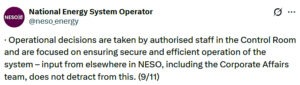
NESO announced on 13 July that law firm Eversheds will investigate the allegations of inappropriate document handing and that the Corporate Affairs team inappropriately influenced control room decisions on 23 June. NESO has admitted in this post on X that Corporate Affairs has “input” into operational decisions which strikes me as deeply inappropriate.
On 17 July Ofgem announced if was essentially taking over this investigation, cutting NESO executives out of the regular updates, and instigating its own investigation into the security of supply concerns. Unfortunately, the Terms of Reference state that the initial fact finding will be carried out by NESO which will report to Ofgem on its compliance with its transmission licence over the latter part of June, and Ofgem will only investigate further if it thinks it’s necessary.
This strikes me as being completely inadequate given the allegations that NESO is being dishonest about the events of 23 June. Not only is a NESO-led investigation unlikely to report accurately IF the allegations of dishonesty are true, but it will be impossible for the public to have confidence in it.
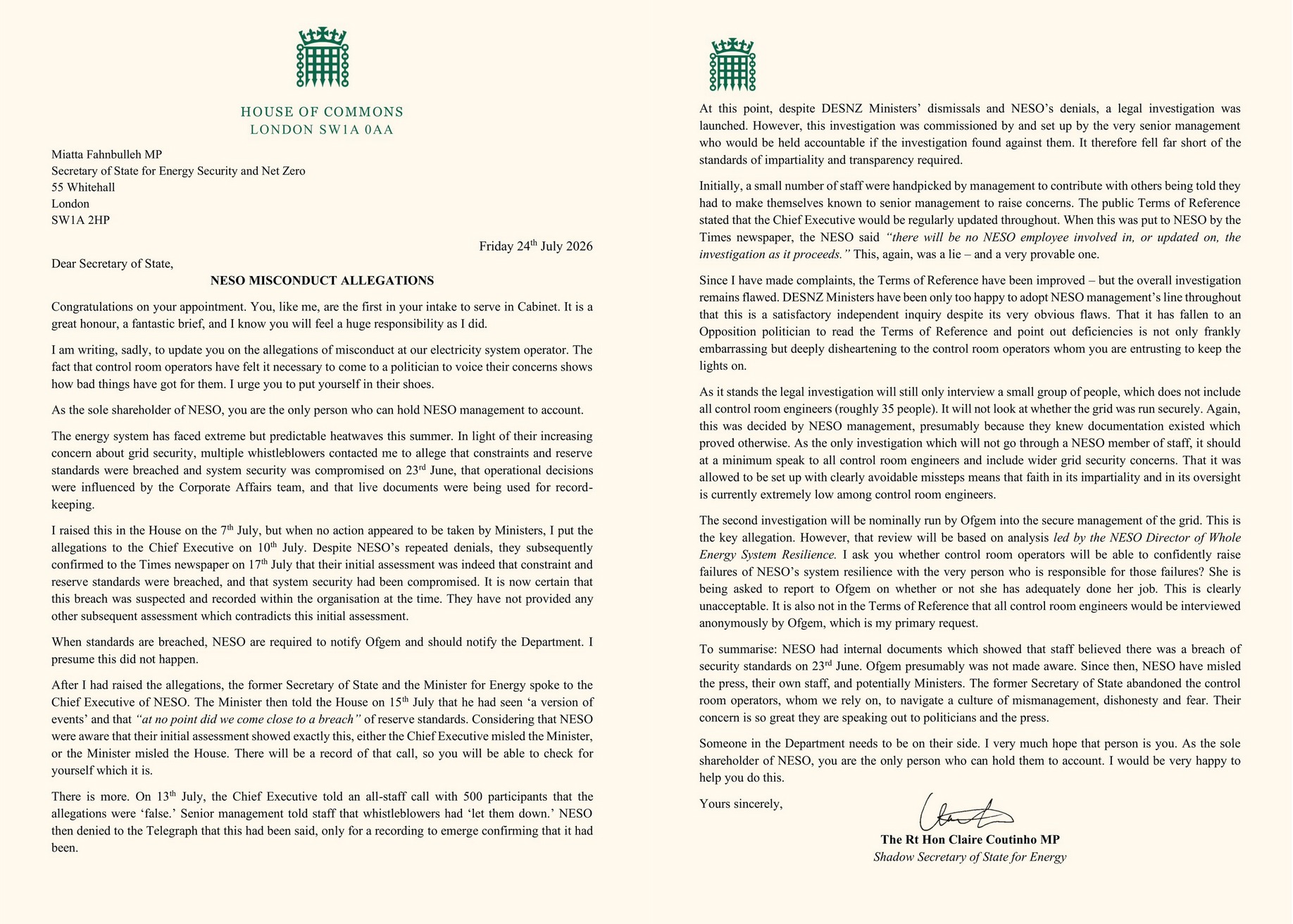
So now Claire Coutinho has written to the new Secretary of State at DESNZ, Miatta Fahnbulleh, asking her to launch an independent inquiry, citing clear evidence that NESO has misled the public and potentially also ministers:
“Despite NESO’s repeated denials, they subsequently confirmed to The Times newspaper on 17th July that their initial assessment was indeed that constraint and reserve standards were breached, and that system security had been compromised. It is now certain that this breach was suspected and recorded within the organisation at the time. They have not provided any other subsequent assessment which contradicts this initial assessment.
When standards are breached, NESO are required to notify Ofgem and should notify the Department. I presume this did not happen.
After I had raised the allegations, the former Secretary of State and the Minister for Energy spoke to the Chief Executive of NESO. The Minister then told the House on 15th July that he had seen ‘a version of events’ and that “at no point did we come close to a breach” of reserve standards. Considering that NESO were aware that their initial assessment showed exactly this, either the Chief Executive misled the Minister, or the Minister misled the House. There will be a record of that call, so you will be able to check for yourself which it is.
There is more. On 13th July, the Chief Executive told an all-staff call with 500 participants that the allegations were ‘false.’ Senior management told staff that whistleblowers had ‘let them down.’ NESO then denied to The Telegraph that this had been said, only for a recording to emerge confirming that it had been.
…To summarise: NESO had internal documents which showed that staff believed there was a breach of security standards on 23rd June. Ofgem presumably was not made aware. Since then, NESO have misled the press, their own staff, and potentially Ministers,”
– Rt Hon Claire Coutinho MP, Shadow Secretary of State for Energy Security and Net Zero
All of the evidence now points towards the grid having indeed been insecure on 23 June, and that NESO executives have repeatedly made misleading claims to the contrary. However, rather than having to piece this together from disparate sources and anonymous whistleblower allegations, a properly independent investigation which allows control room engineers to speak freely to qualified (in engineering) investigators is necessary.
Is Ofgem now failing in its own statutory duties?
Ofgem does not have an express statutory duty to “maintain public confidence” in the energy system, but that doesn’t make public confidence irrelevant, nor does it allow the regulator to sit back and accept assurances from the organisations it’s supposed to oversee. Ofgem’s principal statutory objective under the Electricity Act 1989 is to protect the interests of existing and future consumers. Those interests expressly include security of electricity supplies.
In carrying out its functions, Ofgem must also act in the manner it considers best calculated to protect the public from dangers arising from the generation, transmission, distribution or supply of electricity. It must regulate transparently, accountably, proportionately and consistently, targeting action where it is needed.
Ofgem’s purpose is not just to process licence modifications, approve expenditure and receive compliance reports, it’s supposed to determine whether regulated firms are actually meeting their obligations, and to intervene when there’s credible evidence they aren’t.
Ofgem says it regulates energy markets by: issuing licences and setting licence conditions, providing guidance for energy companies, managing changes to industry codes, making sure that energy companies are following the rules, and taking action if not. In relation to security of supply, it says companies that own and operate gas and electricity networks must manage security of supply as part of their licence. They must also comply with relevant regulations and industry codes, including the Security and Quality of Supply Standard (“SQSS”).
Yet when serious concerns are raised about the operation of the electricity system, Ofgem’s approach seems to be to ask the regulated body whether everything is OK, accept the response and consider the matter to be closed. That’s not independent regulation, and it’s not how other bodies regulate their sectors.
Businesses (except the smallest ones) are not allowed to self-report on their financial health, they must be independently audited. Water companies may not self-report on tap water safety – it’s subject to independent testing. Pharmaceutical companies do not self-certify the safety of new medications, they must be reviewed and licenced by the Medicines and Healthcare products Regulatory Agency and approved for use in the NHS by the National Institute for Health and Care Excellence. Aircraft makers cannot asset their aeroplanes are safe, they are certified by the Civil Aviation Authority (or relevant overseas regulator such as the European Union Aviation Safety Agency or the US Federal Aviation Administration).
So why does Ofgem think it’s acceptable to allow NESO to self-certify?
If credible allegations are made that operational data are incomplete or misleading, that systems are being operated outside safe limits, that significant incidents are being downplayed, and/or that staff who raise concerns are being pursued rather than heard, Ofgem cannot discharge its responsibilities by simply asking the organisation concerned to respond.
The regulator must establish for itself what happened. In this case, that means obtaining the underlying operational records, system logs, control-room instructions, incident reports and internal communications, and interviewing control room engineers without management being present or knowing who is being interviewed, to protect whistleblowers and test whether the official account is consistent with raw data. This may necessitate the instruction of independent engineers with the appropriate operational expertise to conduct a review.
Public confidence will not be preserved by refusing to investigate uncomfortable claims. And suggestions that scrutiny itself may alarm the public hold no water. Confidence is earned through transparency and accountability, and where credible concerns arise, through thorough independent investigatation with the findings made public.
If the allegations are unfounded, an independent investigation will establish that and allow NESO to be cleared, while if they turn out to be true, the investigation will expose that and (hopefully) lead to improvements that will prevent a serious future failure.
There’s a tendency in the energy establishment to treat the physical operation of the grid as too technical for meaningful external scrutiny. Questions are answered with reference to procedures, modelling standards, governance structures and internal controls, and the absence of a blackout to date is taken as irrefutable evidence of grid security.
The Government’s own recent review of Ofgem concludes that “Ofgem’s current structure, tools and capabilities are no longer sufficient for a more complex and fast-changing energy system”, going on to say that it “needs clearer responsibilities, stronger and more agile enforcement, and enhanced organisational capability to anticipate risks and act decisively”. The review expressly argues for regulation that is more outcomes-based rather than focusing on procedure.
Permitting NESO to self-report on energy security, particularly when it’s accused of hiding and manipulating data, is unlikely to deliver the outcomes expected either by Parliament or the public. In no other sector where public safety is at risk does the regulator take such a laissez-faire approach. Ofgem is not simply an economic regulator, it has a duty to act in the best interests of consumers having regard to security of supply.
Allowing consumers to be exposed to the risk of blackouts or critical equipment failures is not consistent with those duties. If the alleged constraint breaches involved transmission assets being operated beyond safe thermal or other operational limits, that would raise an obvious public-safety concern.
Given both the seriousness of the allegations and the evidence now in the public domain, Ofgem is putting itself at risk of breaching its own statutory duties if it continues to rely on NESO’s assurances rather than independently establishing the facts.
I encourage it to think again, and now, finally institute a properly independent investigation into the events of late June. Public confidence, and safety, depend on it.
All thiw is true but the solution is to make the grid use batteries in cars.
Please tell me of any car made today which is electric and does not have sat nav?
There is none. The point about sat nav is that the signals from the satellites are extremely accurate in frequency. Well beyond what the grid needs.
The solution is to enable the huge battery power in cars to over come the dips and surges that the grid might encounter by using the huge storage that say1 million evs might be able to provide.
A typical ev has a battery around 70kwh today, but obviously on average they are only half full. So only 35Gwh of power.
Problem solved.
As per usual the grid folks are looking in history for the solution to the modern wirld, when the new world has an answer
Not really relevant to grid frequency control/support.
There have been and are trials under way on V2G (Vehicle to Grid). For example, I participated in a trial 5 years ago using a Nissan Leaf, whose CHADEMO (fast charge DC connection) was specifically designed (because of the problem Japan had with flooding of Nuclear Power station) to allow bi directional power flows. It still required a very expensive wall mounted inverter though. At the time this was the only Vehicle capable of V2G operation in the UK. Subsequently, although the European DC connection can now be used in theory, most work is on using the cars onboard inverter to provide AC out (as cheaper to implement). Athough many EVs now have adapters to provide local power (kettle etc), to make a grid connection the cars inverter needs to be certified (most are not) and the house holder needs the local connection approved with the DNO – not trivial, for example mine has a G100 export limitation. Then to be useful, not only does the Vehicle need to be plugged in, it needs to be remotely controlled by a competent authority. GPS is completely irrelevant, the inverter at the connection to the grid is not allowed to be grid forming, it can only be grid following (same rule as for solar inverters), so unless grid frequency is almost exactly 50Hz, and the voltage within bounds, the system won’t connect. So practically you can see V2G providing local grid voltage support, but not direct active grid frequency support. In fact there’s a risk if you get a frequency dip, that V2G systems will give a cascade failure effect as they will disconnect.
And each person to have pedalled generators in their home for emergencies.
TF:
There can be nothing less secure than putting all our energy eggs into one basket, electrification, when all the generating, infrastructure and devices are supplied by China, a state described by our security services as “hostile” and subsidised by coal power, slave labour and ignoring all the environmental damage caused by mining and toxic manufacturing tailing lakes. Anyone thinking all this product is not fitted with kill switches is deluded. Read the article by Richard Dearlove, a former head of the British Secret Intelligence Service (MI6):
https://www.climateskeptic.org/p/britains-national-security-must-not
The difficulty is that Ofgem is not the referee here, it is one of the parties. The engineers’ own letter says so: they have asked Ofgem to investigate and ensure the system is safe for two years, and Ofgem would not do it. If that is right, then any honest inquiry into 23 June has to establish what Ofgem did with two years of warnings and who inside Ofgem received them. Ofgem is running the inquiry.
It gets harder when you look at the individuals rather than the institution. Tim Jarvis has been Ofgem’s interim chief executive since March, and he joined Ofgem in September 2023 as Director General for Markets, which places him in the senior leadership across the whole of the period the engineers are describing. He is now the man deciding how hard his own organisation looks at its own conduct. Akshay Kaul, the Director General whose directorate regulates the system operator, sits on the panel receiving the Eversheds material, so the part of Ofgem responsible for NESO’s regulation is helping judge whether NESO was properly regulated. And Jonathan Brearley, who ran Ofgem for all but the last weeks of that period, left in March to become Permanent Secretary at DESNZ, the department that owns NESO outright.
None of that requires anybody to behave badly. It only requires people to be human about an investigation whose worst available finding is that they should have acted two years ago. That is why the Terms of Reference read as they do. An organisation asked to work out whether it was itself asleep will reliably choose the version of the exercise that begins by inviting the other party to explain itself.
So I would put your question slightly differently. Ofgem is not failing its duties through inattention. It is failing them because it cannot discharge them and investigate its own conduct at the same time, and the investigation therefore has to sit somewhere else.
Ofgem has failed this long time. Whether in liberalisation of gas suppliers or failure to identify the most basic failing of wind supply – that of turbine installation without offtake capacity, Ofgem has failed its basic role to protect consumers. Competency and conflict of interest issues primarily.
Live documents are today’s out-of-caucus discussion. It’s where all the big (as in sneaky) decisions are made. You can absolutely bank it that management ordered it.
It’s all quite alarming, yet highly predictable. Also interesting that Milliband has side stepped out of his job, just as the consequences of his dogma-driven policy look to be exposed. He is doing what Roadrunner did, stepping out of the lift just before it hits the ground.
Excellent summary. Many of us engineers/physicist have been saying for years that the system is becoming more insecure as more uncontrollable renewables are added to the transmission and distribution grid.
The denials and “nothing to see here” and “it’s all political scaremongering” rhetoric make me incredibly suspicious.
It’s as if the scandals of the Post Office and any number of NHS Trust failures haven’t happened.
It’s not about politics and facts.
Systemic failures occur and when all the low probability events come together at once – and if the probability of those low probability events is getting higher I’d like to know that they have been properly assessed.
OFGEM and lawyers won’t do this.
For example. If our protection is to cut off an interconnector then there is a very credible risk that it will happen the other way – likely when Europe is stressed. I’ve always thought treating interconnectors in any way as Firm Capacity is ridiculous
Regulation adn Oversight across all UK sectors is at best mediocre
It is now a religious matter. Questioning “net zero” is heresy and blasphemy, and anyone who does completely and enthusiastically support all of the narrative will be burned at the stake. Management knows this. But thevpeople who actually do the work to make it happen see that it is a fantasy.
There are now too many people and too much money at risk to allow the fantasy to be revealed. Only a real blackout will get the kind of attention that is needed. And the chattering classes will blame it all on the wreckers, and Trump.
Well written, hard hitting. Excellent journalism. Thank you.
I’m fast coming to the conclusion that the only thing that will stir the State (not Parliament) into action on this problem is a major blackout. From a macabre point of view, at least a Summer blackout would result in fewer deaths. You just know that whoever is responsible will not suffer in the slightest & will be asked to ‘retire’ with no loss for the damage caused to the nation.
I call this “The Goldilocks” event – a blackout severe enough to sensitise the population enough to understand the danger we are in and to generate the political support for ending it, and not so severe that it produces a mass casualty event.
I’m fast coming to the conclusion that the only thing that will stir the State (not Parliament) into action on this problem is a major blackout. From a macabre point of view, at least a Summer blackout would result in fewer deaths. You just know that whoever is responsible will not suffer in the slightest & will be asked to ‘retire’ with no loss for the damage caused to the nation.
Great piece and reveals the degree of obfuscation in government. Never admit you’re wrong. But there are other serious threats to UK energy. I warned of the previous LNG crisis that cost the UK £76bn, no action and didn’t even receive an acknowledgement so is it worth it. Please see below.
Facts you need to know.
1 In winter five times more energy transmitted around the UK by the gas grid than electricity grid. Lose that and the UK has had it!!
2 How can we lose it. Easy …. If someone wanted to, cost about £400,000.
3 How? Three boats sailing around the UK equipped with ROV’s (remotely operated vehicles) each with 10 explosive devices that are placed on pipelines or cables. (all our gas comes from offshore).
All laid well in advance, boats disappear, devices go off in January.
Result: UK loses gas supplies. 23million customers told to turn off gas. All try to use electricity instead. Electricity network overwhelmed and shuts down
Uk is destroyed.
Undersea pipes take up to six months to fix because you have to empty them of sea water and dry them.
Who would engineer this? MI5 have been warning of sabotage by state sponsored proxies for ages. If gas demand and prices rocket, it’s a bonanza. for some. Also, a UK without power can’t manufacture drones and neither can a UK economy that is broke, sponsor anything.
So big win for some and a total denial of who did it, and the cost, a fraction of the cost of a jet fighter. So very simple.
Fact. No surveillance of UK undersea infrastructure and UK has pathetic gas reserves, relying on multiple pipeline supplies which have just disappeared.
Peter Marsden BSC C ENG FIGEM MIChemE Former Council Member and Consultant to IGEM and Editor Gas International.
Peter,
Absolutely. I spent years arguing the issue of heat.
There is an obsession about electricity – and it’s important.
But frankly the heat problem is enormous and has will be essential for the next 30 years.
Langeled is utterly crucial to our supply – Nordstream on steroids.
Andrew
A great, very scary comment.
You may be aware that the establishment’s Net Zero project has been severely criticised in an article published recently by former MI6 chief Richard Dearlove saying that Britain’s Net Zero policy has become a national security liability. Mr Dearlove retired in 2004, well before the UK Climate Change Act had even passed into law, but even so, it is very unusual for an MI6 officer not to be totally supportive of official government policy.
The Dearlove article is here: https://www.climateskeptic.org/p/britains-national-security-must-not.
Yes, we know it, just like the off-shore wind. In WW2, all power generation/fuel supply was onshore, with AA batteries and significant air cover. Hidden/unmarked locations were used for some strategic facilities.
I guess if we are that short of money, they aren’t as picky as they used to be about anything any more really.
It’s almost as if there isn’t a plan, on a wing and a prayer. Just get ready for the “Beeching cuts” for the electricity system in the future, when various “assets” come to be seen as liabilities.
Although, one advantage of the 30ish year lifespan of most centralised renewable installations, is that the system/positioning can slowly be reconfigured overtime as they wake up to the other issues that also need to be considered………….perhaps.
Careful, anyone who doesn’t know anything about WW2 will think you are suggesting AA batteries as the energy storage solution ! 😉
Wouldn’t it be sensible policy to try to have good relations with the biggest gas supplier close to us, that is desperate to have a good trading relationship, built a huge pipeline to supply Europe and sold it’s gas at long term contract prices? I am meaning Russia of course. Except we are facilitating if not outright firing ourselves missiles at it’s infrastructure and sponsoring a corrupt Nazi dictatorship that engages in terrorism against Russia. We have pitiful armed forces and are extremely vulnerable as you describe – I just don’t see the logic of this course of action and can only foresee disaster.
It’s clear that the growth of wind and solar has not been managed correctly. Connecting those sources to the part of the grid which controllers cannot see is a situation that should never have been countenanced for an individual site, let alone been allowed to become the norm for all of them. I cannot see our electricity supply becoming more stable in the future as we simultaneously increase our unpredictable generation and our unpredictable consumption from more ASHPs and EVs. At some point it will all come tumbling down, by which time those responsible will be safely ensconced in the House of Lords and able to vote down any inquiry.
” The letter says
‘We the engineers have asked Ofgem to investigate and ensure the system is safe for two years now. That is simply done by asking for proof that Neso can always work out how much energy is required. And they won’t do that and they won’t investigate. So we have told the world. June 23 was simply another day. We don’t have control of the system. We have tried our best. It’s now over to the public and the regulator. Please help, ”
” …. how much ENERGY is required…”??
Surely, NESO *engineers* would realise that it’s POWER that’s required?
NESO could easily “see” domestic PV generation, if they put the effort in.
Octopus Energy and Axle VPP already do this (I know because I’m signed up to them). Amazon’s Alexa home automation can do it too. The APIs required to access the near real-time data that Internet connected PV inverters supply are openly published, and the hardware suppliers cooperate actively.
The system owner would have to give permission, under the hood this means supplying a cryptographic key, but the grid could easily mandate this. I can’t imagine this would upset anyone, unless perhaps they were growing cannabis, as they supply usage data anyway via their meter.
My system can be controlled remotely too, I allow Axle to export from my battery during grid “events”. That would be more contentious than just monitoring import and export but, if necessary, it could be done.
Having said all that is this really needed? The MCI database lists all domestic PV installations so their locations are known. Real-time measurement of solar insolation, not rocket science, by region will give a pretty good indication of domestic export.
(Declaration: just an engineer, not an electricity professional, and not even a Ph.D. But I have two domestic PV arrays plus a home battery and an interest in how they work.)
NESO have a proposal to require all units >1MW vice 100MW have to be registered in the balancing mechanism although you can register now if you wish but it requires higher metering standards and reporting which is why majority dont bother.
No, because they are not allowed to. DNOs and suppliers can see LV meter data. NESO cannot
The MCI database is not a reliable up to date source. I was shocked to discover the estimate of embedded solar generation capacity that NESO recorded for second half of 2025 as I downloaded after the turn of the year: it was flat, except for a couple of weeks where they chopped it by about 1.5 GW. You can’t have a reliable system based on unreliable data.
Thank you Kathryn for yet another clear and cogent summary regarding the dire state of our country’s energy system. Rather than just exposing Ofgem, it is further proof of their politicization to faux climate agenda. It seems certain that I will be living through yet another “3 day week” scenario and until it happens I cant see the clowns at Westminster changing their tune. I was always happy to see Clair Coutinho eviscerating Red Ed and the westminster muppets – I could see her as the next Margaret Thatcher if she wanted it. Westminster desperately needs professional, competent and properly qualified experts like you if we are ever to regain any semblance of order and common sense.
Tony Field is incorrect.
Do you really think if the Grid could drain car batteries that EV owners would leave them connected ?
Dream on.
And even if they did, this ultra distributed generation source would just add to the problem of forecasting, and not solve anything in real time.
It seems to me that a lot of people here and in the press are barking up the wrong tree here.
The claims here include that the system breached its N-1 reserve rules on 23 June. However, a detailed analysis of the publicly available NESO and Elexon data by Aoife Foley of Manchester University comes up with an interim conclusion that this was not the case – there was at least 4 GW available at all times. See
https://www.linkedin.com/posts/aoifemfoley_working-report-on-23-june-on-system-event-ugcPost-7484180241314316288-8KpO/
The accusation here is that the system was close to a system wide blackout, yet there is no evidence for this. There was plenty of reserve and plenty of inertia and the voltage was not dropping.
It doesn’t sound like any of the legal regulations was broken. But there may be a case for reform, because the legalities don’t necessarily cover the OPERABILITY of the system.
However, the system was certainly showing a lower frequency than the normal operational bound. Aoife says this is due to the network constraints meaning power was available, but not necessarily in the right place, and the transmission links to get it there were approaching long-duration limits.
But, had anything gone seriously wrong somewhere, that should have meant that any power cuts would have been restricted to one area, not nationwide. More scaremongering here.
Solar PV output hit 14 GW around solar noon (1 pm in British Summer Time), and then reduced to zero in more or less a straight line (it should, perhaps, have been a little more sinusoidal) by 9 pm. That would presumably have involved the control room switching around the supply completely from one source to another over an 8 hour period, and the local implications may have required a lot of control room operator interventions.
So it was an operability incident, which would NOT have occurred had there been more wind power on the system, which would have ensured more reserves in each area.
It sounds like the control room did a terrific job to match supply to demand at each major node. The question in my mind is whether the computer systems are up to the job of fully supporting them when the system is stressed by high rates of change. There has to be a set of digital twin computer models of the network, fed with different weather forecasts (in this case cloud cover would be the key element as it directly affects local solar PV output).
Kathryn said “Not only is a NESO-led investigation unlikely to report accurately IF the allegations of dishonesty are true, but it will be impossible for the public to have confidence in it.”
The issue here is that, to see how the operability really was going, investigators would need access to the commercial balancing bids and other information available at each stage, and they are presumably confidential. Further, there are going to be very limited skills available to do this analysis outside the NESO itself. Ofgem won’t necessarily have the skills.
Likely, only the NESO itself can establish the facts as to what went on, and whether it broke any NESO regulations. Not someone else. Once that is established, someone else can indeed check whether anyone lied. But you have to be very careful here about accusing someone of lying about breaching reserve rules, which likely didn’t get breached in the first place, just because there were operability issues.
The Times reported on an internal NESO report saying “an internal NESO report showed that five separate transmissions constraints were breached on 23 June, with the largest breach reaching 700 MW. ”
Of course the anti-Clean Power Plan lobby will try to make the most capital it can out of such a statement. But let us look at the details needed to see if it is a valid criticism.
Firstly, the power which can safely be transmitted through transmission line wires depends on:-
– the ambient temperature (lower ambient temperatures cool the line better)
– the wind (more wind provides more cooling – 5 m/s wind allows ~2x the current and 4x the power vs no wind at 20-30 degrees C)
– the reactive power in the line (if the current and voltage are not in phase, though they are normally pretty close in normal operation
– if the line is overloaded, how long does that last (it takes time for a line to warm up such that damage might occur or the conductors might sag).
The Times hasn’t seen fit to leak to us the conditions under which the nominal line constraints were exceeded – just a raw top level statement, which is worthless on its own. One reason for this could be because the nice salacious issue it has identified would then go away!!
For a 400 kV dual circuit supergrid line, the rated capacity is 7 GW (7,000 MW). A 700 MW overload is thus a 10% overload. Likely that could be safely sustained for a number of minutes.
There are two categories of transmission line monitoring in the UK. Lines with static maximum loads are not monitored, but some lines have DLR “Dynamic Line Rating” in which temperatures (ambient and conductor), wind speeds and sag are monitored closely to determine a dynamic maximum capacity. On some lines, drones are flown up and down to monitor the actual sag
DLR on the lines from Scotland to England seems to have been a priority, because of the cost of constraint payments for surplus Scottish wind which can’t be transmitted to England. However, there wasn’t much wind power available on 23rd June (but plenty of solar), so the important line constraints were more likely to be classed as static, and outside the Scotland/England border. Nevertheless, these lines can be overloaded for short periods of time, especially if you know from weather maps that the wind is blowing to provide more cooling than the static limit is based on.
So the “breaches” on line constraints may have been significant, or they may not have been significant. The Times has not supplied the detailed information needed to work that out. Hopefully the NESO investigation will comment on this. My guess would be that the NESO would have used judgement if breaching the nominal capacity of a supergrid line by up to 10%, knowing how long the overload would last for. So, again, there is probably nothing to see here, which won’t stop the right wing press moaning, while not explaining the details to their readers when their criticism turns out not to be justified.
I saw that analysis but it does not correspond to the allegations of the engineers, the public data are incomplete and this doesn’t explain the extended low frequency.
“But, had anything gone seriously wrong somewhere, that should have meant that any power cuts would have been restricted to one area, not nationwide. More scaremongering here.”
I don’t think that is correct. It is quite clear that the B9 boudary in the Midlands was thermally constrained, with generation in Megawatt Valley cranked up to try to supply the SE and interconnector export demand via IFA1, Eleclink, BritNed and NEMO. There are 4 main transmission lines to carry the load: if one of those was already overloaded by 700MW and had tripped out, its load would have been immediately shared to the other 3, overloading them in turn and causing them to trip out. The result would have been disconnection of major demand from major supply, and a very widespread if not national blackout. Comparable events are the US NE/Ontario blackout of 2003 and the European blackout of 2006.
“
Kathryn is big into scaremongering. Being a doomsayer has much to say for itself, because if it turns out that way you can say “I told you so” and if it doesn’t, either no-one will notice or you can say “Well it would have, if it hadn’t been for me.”
A lot of good stuff but I do find the relentlessly negative stuff draining. One day she will suggest something vaguely achievable that will actually help.
I’ve suggested plenty of mitigations starting with an independent investigation. I’m struggling to understand why people aren’t on board with that – if the allegations are disproved it would reassure the public and if they are proved we can move on to fixing the problems
They might if they got paid.
I let Axle VPP draw power from my home battery because they pay me £1/kWh for the privilege, most recently between 8pm and 9pm last night. Sunlight turned into money, although you can also arbitrage by buying cheap and exporting high.
I imagine that if such a scheme were rolled out for EVs you would be able to limit the amount of discharge, leaving you with some miles in the tank.
A bigger problem would be installing bi-directional chargers in homes. Last time I looked they are about £5k a pop.
Try less than £700 for the Humax MX7 V2G / V2H 7.4 kW single phase charger, according to the Humax web site. They used to be £5k or more, but not now.
Realistically, the software integration and vehicle V2G enabling is more of a speed bump than a bidirectional charger.
They pay you by charging poor people more. People who can’t afford flexible assets pay more so that people who can afford flexible assets get paid to deliver that flexibility. It’s a value transfer from less to more affluent people and has some real ethical issues IMO
What a rickety Heath Robinson shambles our grid has become and our Net Zero obsessed authorities are spinning and twisting to hide the inconvenient truth. Ofgem and Ofcom are both propaganda arms of the establishment.
The latest damning revelation is the warning that the thousands of batteries being deployed to stabilise Britain’s electricity networks could bring down the grid, covered in a post by Paul Homewood who summarises the madness very well:
“The problem is that, just as with embedded wind and solar power, NESO have absolutely no control over battery charging/discharging. Worse still, it is not even visible to them. If a gas plant broke down, they would immediately know and be able to take corrective action.
But if lots of batteries start charging simultaneously, they would just see it as an increase in demand, which they had not forecast.
As each chapter of this looming debacle is unveiled, we see that they are all inter-related and the direct consequence of the ill-thought out dash to intermittent, weather dependent energy.
Wind and solar power is not dependable, so the “answer” is to build more. But building more leads to massive surpluses at times, while still not addressing the underlying problem of supplying electricity when the wind does not blow and the sun does not shine.
So, we must build lots of battery storage. Which in turn destabilise the grid even further!
This is what happens when you let politicians and Net Zero zealots design an energy system.”
Paul also points out that the current UK deployment of battery storage would only last 10 minutes if powering the grid on its own.
I think you have one of the current problems in a nutshell.
But what should have been done? Should we have told folk to not have batteries, or solar? What would you have said to a regulator that insisted on that?
We are where we are. What *should* we do next? Everyone can moan on about the problems…
To my mind NESO have screwed themselves up here as all they had to do was come clean about the challenges and say we need learn lessons about managing renewables centric grid. The fact they went into denial mode says something about the culture at the top of NESO and its relationships with DESNZ and OFGEM. Hopefully our the new Secretary of State will be more open minded about having broad conversation with the public here to restore confidence.
The innediate problems in late June suggest that the whole ediface of regulation and planning needs review.
Take the claim that there wasn’t a spare MW to dispatch. Spare MWs in the South would have reduced the overload on the transmission lines from Megawatt Valley towards the London area and the exporting interconnectors in the SE – spare capcaity to generate at Peterhead does not solve that. Capacity location and availability (many units were out for maintenance, while other transmission constraints tightened by the hot weather and work on the transmission system meant that capacity was unable to resolve local shortages elsewhere) are all part of capacity adequacy. The most recent panel review of NESO’s calculation methodologies for the Capacity Market hint at significant shortcomings, albeit with some being addressed with plans for new methods:
https://assets.publishing.service.gov.uk/media/6a5e1a5013cf36b2315a5e6e/panel-of-technical-experts-report-on-the-NESO-electricity-capacity-report-2026.pdf
Yet after a lengthy discussion of the complexities of assessing interconnector reliability that managed to exclude mention of the Norway risks (this year low hydro reservoir levels may limit Norway’s exports, threatending not only NSL supply, but also supply from DK and NL and soon DE that connect to Norway, plus Norway is threatening to limit exports because of the impact on prices) they conclude that the Capacity Market should assume around 70% of interconnector capacity is available for imports. On 23rd June when the crunch came we were exporting over 3GW, with only Norway supplying – and we had to cut off or ask for reduction in export demand. Clearly the assumption is nonsense when faced with reality, and it led to under-procurement of domestic dispatchable capacity that would have avoided the problems.
The problems with thermal derating of transmission lines, and maintenance schedules allowing too much capacity offline at once (interestingly also a problem in Texas in Feb 2021) never got even a cursory mention in NESO’s Summer Outlook which concentrated on the problems with low demand due to high levels of solar output. Yet an overloaded transmission line tripping out leads to the load being shared by its neighbours, in turn overloading them. A rapidly cascading blackout can soon follow as demand and supply are disconnected. These conditions are technically – no – really a breach of the SQSS N-1 criterion that requires the grid operation to be resilient against the loss of any key asset – including transmission lines.
At the end of May the SQSS Panel approved on a vote of 4 out of 7 members allowing NESO to reduce minimum system inertia from 120GVAs initially to 110GVAs for a period of at least 10 weeks followed by a review before a further reduction to 102GVAs. I’ve checked back, and duing the year from 1 April 2025, NESO breached the 120GVAs minimum on 18 days, including the inertia provided by Pathfinders (in practice, synchronous condensers). Just before permission to lower the level was published data on inertia started disappearing almost every other day: that extended through June before NESO halted publication of their “outturn inertia” (which isn’t “outturn” at all because it excludes the Pathfinders that have been providing 7-11GVAs over the period. But the real shocker was that even on days where data is available there were 4 days in June where the inertia(including Pathfinders) fell substantially below the new mandate at 110GVAs, in one case as low as 91GVAs – and that is ignoring 1st June where the recorded data are almost certainly 100GVAs too low. This suggests a highly cavalier approach to SQSS standards motivated by attempting to run the system with zero carbon with scant regard for system security. There was evidence of experimenting with the Pathfinder provision too.
SQSS covers a number of other parameters – many without a clear definition beyond “the grid better not collapse due to this potential problem”. Yet it fails to capture the realities of the current grid with its high dependence on interconnectors, renewable generation often located far from demand, and high ramp rates as renewables output rises and falls with chaging weather and time of day. These are compounded by lack of information on their outputs unless they are connected at transmission level voltages. It seems extraordinary that Elexon has devoted considerable effort to trying to secure meter readings every half hour from consumption meters delivered remotely – all supposedly in aid of trying to persuade consumers to trim electricity use to available renewables generation – while apparently ignoring the desperate need to understand the levels of embedded generation in the system and the operation of batteries. It is plainly highly problematic for the Control Room, as it can become difficult to guess how much demand will emerge from distribution networks at which Grid Supply Point (GSP – major substations interfacing between tranmission level voltages and distribution), since this depends on flows in the distribution network that aren’t covered in transmission level modelling. If a weather front moves over the local geography, wind and solar output may vary significantly, requiring extra supply in particular areas. Power flows may reconfigure in unexpected ways, including throwing up surpluses of embedded generation. If we add in the complications of smart charging of batteries and solar panels responding to price signals the difficulties of forecasting multiply. These can provoke system instability: part of the blame for the Spanish apagon was placed by Red Electrica on sudden switching of solar farms in response to price flipping negative – probably far more effective at destabilisation than a passing cloud.
These complexities are multiplied across Europe – NESO is not the only TSO facing difficult problems with system balancing. Interconnectors flip from import to export, requiring reconfiguration of grid operation. Ramp rates can be high and destabilising. The whole system needs a redesign with the aim of restoring resilient operation, greatly increased reliability of forecasts of demand and supply, eliminating the uncertainties caused by the split between distribution and transmission, and by renewables intermittency. A grid dominated by large generators located close to demand is much more robust. Balancing flows tend to be small, and trips are consequently much more easily handled. The system comes with built in almost automatic correction via strong inertia and droop control that prevents unstable oscillations in output in response to events on the system. New system design needs to include naturally stabilising behaviours to handle renewables – which will probably entail higher levels of curtailment to avoid the swings between feast and famine, or shapr price motivated behaviours.
Perhaps even more fundamentally, system design needs reappraisal. The idea that remote wind farms can be plonked down and require to be connected to distant demand whatever the cost must surely go. Not only is this extremely costly, but also it adds to the problems of system operation, attempting to accommodate large flows in different directions according to the weather. As capacity is added the flows become surplus to local demand, requiring more grid capacity to try to deliver to some market that might take them at a low or negative price. It’s a crazy system. The high grid costs and system instabilities can be sharply reduced by having a strong network of nuclear generation located not too far from demand centres, eliminating the need for lots of distant wind farms or plastering the SW in solar, and restoring the underlying lower cost grid. It’s quite evident that grid spending has concentrated on new projects at the expense of maintenance of the existing system, and that renewables connection demand is getting completely out of hand. We’ve seen the Alverdiscott substation in Devon demand that local solar farms switch off over the summer because it can’t handle their output – a classic case of poor system management that should have limted the capcity connected in the first place.
Of course, curtailment readily makes the news as an identifiable cost, especially when apparently combined with turnup of CCGT closer to demand. But the cost of “solving” the problem is truly horrendous, with all the extra grid investment in low utilisation lines that are only pressed into service on windy days, the extra stabilisation kit required, and then delivering to a distant interconnector at a highly subsidised export price if it can be sold at all – the alternative being a question of which facilities get curtailed anyway. In practice, a very large element of the the CCGT turnup provides additional ancillary services (inertia, reactive power, short circuit current etc.) that would need to be procured – but the system fails to record that, defaulting to considering it as solely motivated by the need to provide energy locally. The problem is that NESO originated in National Grid, and has always had a planning bias towards expanding grid investment inherited from its origins. Planning needs to be stripped away from them and placed in a new body that includes representation from wider interests: consumers wanting low cost reliability, generators that can provide that (including nuclear), and networks that take pride in cost effective systems that offer greater reliability through simplicity.
It’s not just a fix to ensure that NESO adheres to the existing SQSS standards and devlops a few additional tools to assist in gird management, but a fundamental review of the whole that is needed.
To make matters worse, HS2 Phase 1 will need about 300 MW
Official – HS2 will need a half a nuclear reactor to power it. – STOP HS2 – The national campaign against High Speed Rail 2
Both the CEO and Executive Director of System Operations at NESO have professional engineering qualifications and experience in power grid transmission and distribution. OFGEM employs an Engineering and Technology Director which has a Chief Engineering oversight role. As professional engineers and members of accredited institutions, these people have a duty of candour and so the question to ask is why are they risking their reputations since there is much at stake with these serious allegations?
This comment was not made by me.
There is little comment on demand disconnection. Was this not the essential purpose of smart metering? This would anticipate low frequency tripping. No word of lowering 3% of voltage supplies? There is much information we cannot know but the bottom line is the experiment of renewable power.
This comment was not made by me either.
Would some of the current problems be solved by requiring all generators attached to the grid to be able to provide dispatchable, firm power and hence organise and pay for their own backup and grid stability devices etc. necessary as suggested by Sir Dieter Helm in his Cost of Energy Review? Plus nothing is connected to the national and/or local grids without prior authorisation by the grid operator?
OMG I’m going to buy a backup diesel generator. If you look at how the water companies have been regulated in England this can only end in catastrophe.
In Ireland (north and south), there is a thing called the Integrated Single Electricity Market. Supply. It often depends on interconnectors to the UK, (EWIC and Moyle). In a situation like this where exports are stopped, could Ireland have rolling black outs (potentially political dynamite) or even a black start scenario?
The reference to the Medical Healthcare product Regulatory Authority is more instructive than the author might think.
Since the days of its now-former CEO June Rayne, the MHRA has considered itself publicly as an “enabling regulator”. Co-incident with that is a pile of Yellow Card data relating to adverse reactions to vaccines. The MRHA has done whatever it can to avoid understanding the Yellow Card data, or even publishing it in an open and honest manner. “Enabling” indeed. “Enabling” what, precisely?
The misconduct of NESO and Ofgem strike me as the same pattern of behaviour.
This does not smell like a cock-up. This smells like a plan.
And I’ll bet that the mysterious training organisation Common Purpose is behind a lot of it.
Hi, i dont expect this is very relevant but a new partially user funded solar park, Derril Water Solar, originally via Ripple, has been unable to export during its first summer of operation the reason given is; “National Grid Electricity Distribution (NGED) have confirmed the distribution and transmission network operators have been aware of potential voltage issues on the North Devon network since 2023. The risk of voltage issues has increased as Langage gas power station, which was being used to control volage levels, is off-line for maintenance for 2 years.
To mitigate this, the National Energy System Operator (NESO) commissioned a voltage compensation generator at Taunton and a refurbished generator at Exeter which were due to be installed by the end of 2025. However, implementation of these generators was delayed and they are now due to complete in September 2026. NGED have confirmed the works are currently on track but tests will still be required once they are commissioned
NESO became concerned about imminent voltage rise risk on the transmission network in May this year. Until the delayed voltage compensation generators are installed and tested, the only solution available to NESO to control voltage levels was to instruct National Grid Electricity Transmission (NGET) to switch off a super grid transformer (SGT) at Alverdiscott near Barnstaple.
With the SGT at Alverdiscott switched off, the local 132kV distribution network has reduced capacity and security and is vulnerable to thermal overload. To manage this risk and ensure safe operation of the distribution network, NGED have curtailed a number of generators connected to the 132kV ‘K-line’ between Alverdiscott and Indian Queens in Cornwall, including Derril Water Solar to 0kW export.
NGED were given no warning of the shut down. NGED then shut down Derril Water Solar and other generators on the K-line with no warning.
A planned Active Network Management (ANM) scheme would mean generators could be controlled on a real-time rather than shut down entirely. NGED recently informed us that the ANM system is now ready to deploy and may allow Derril Water Solar to begin partial export in August. Even with the ANM scheme live, high levels of curtailment are expected.”
So just for information, hopefully its useful.
Many thanks.
Peter
Fail to plan, plan to fail. One would have thought that monitoring where the power is required and arranging for renewable resources to be added in those locations would have been straightforward. The strategic positioning of individual or a few wind turbines to supply a town or city, the roofs of factories to act as solar farms. The prioritisation of appropriately positioned resources, where grid upgrades can be minimised.
It’s a whole different problem, if suddenly we’ve got to upgrade the whole grid in Scotland and the whole of the grid from there to get the huge amount of power being generated down into England.
Could we have bought more solar panels and turbines for the money spent on grid upgrades if they were just located where they are needed? £1 Billion per GW output? Just how many £ Billions are we spending on grid upgrades?
One would think that with the government banging on about AI, that this would be an ideal use of it to optimise the arrangement of renewable resources.
But with all the dispatchable generation, did we just need to ensure that it was fit to be used as synchronous condensers when it wasn’t being used for power generation? If we’ve added in separate stabilization services that are unrelated to the dispatchable generation, then the industry will be ideal for rationalisation in the future.
But why waste the money now and make the electricity more expensive now?
The big problem about putting generation close to demand, is that a lot of the demand, is in dense city areas. For example, where would you put enough generation to localise the demand from all the data-centres in west London?
Land is some of the most expensive in the country, and Karn wouldn’t allow large energy developments, if it meant causing disruption to Londoners.
He wants the tax revenue, so wants housing development, but doesn’t want the infrastructure that goes with it, to be disruptive.
It’s the same with water – they are running-out, in the South-East. One proposal was to “Build a pipe, and take it from the midlands” – as if Londoners are entitled to just take resources from another region, rather than building their-own.