

US President Donald Trump is considering restrictions on diesel exports in an attempt to bring down record fuel prices for American consumers. The US is the world’s largest exporter of diesel, so preventing some or all of those exports should leave more diesel for the domestic market, allowing inventories to build and prices to fall. Trump has publicly said “let’s not send out the diesel”, while other Republicans, including Iowa Senator Chuck Grassley, have backed restrictions as a way of helping farmers and other diesel-intensive businesses.
But there is significant opposition within the US administration and the refining industry, because the market for refined products does not work quite as simply as the proposal suggests. Energy Secretary Chris Wright has described a blanket export ban as a “blunt tool”, while the American Petroleum Institute and American Fuel and Petrochemical Manufacturers have warned that restricting exports could ultimately reduce refinery production.
There has been no formal announcement of a ban, and the White House has denied reports that a 90-day blanket prohibition has been decided. Discussions have also included voluntary restrictions or arrangements under which refiners would reserve more diesel for the domestic market.
What would a ban mean for the UK?
The UK’s dependence on imported diesel has risen significantly as domestic refining capacity has fallen. Fuels Industry UK says the UK now imports about 55% of the road diesel it consumes, compared with just 14% in 2003, while the US supplied 31% of UK diesel imports in 2025 and was the largest individual supplier to the UK. On that basis, American diesel directly accounted for roughly 17% of UK road-diesel consumption – about one litre in every six.
This dependence has increased as Britain’s refinery fleet has shrunk: the closure of Grangemouth and Lindsey in 2025 removed almost a quarter of the country’s remaining refining capacity, leaving only Fawley, Humber, Pembroke and Stanlow operating. The UK is therefore far more exposed to disruption in international product markets than it was twenty years ago. The timing of the proposed US diesel export ban is particularly poor for the UK as Fawley, the country’s largest refinery, has just begun a turnaround (major maintenance outage) which will continue until December.
A US diesel export ban would remove around 1.5 million barrels per day (bbl /day) of diesel from the global market, forcing buyers to compete for diesel produced elsewhere. Europe is particularly vulnerable because it has lost much of its former Russian supply while Middle Eastern availability has collapsed due to the war with Iran. Middle Eastern diesel exports to Europe fell to around 110,000 bbl /day in September, their lowest level since 2020, compared with 191,000 bbl /day in August.
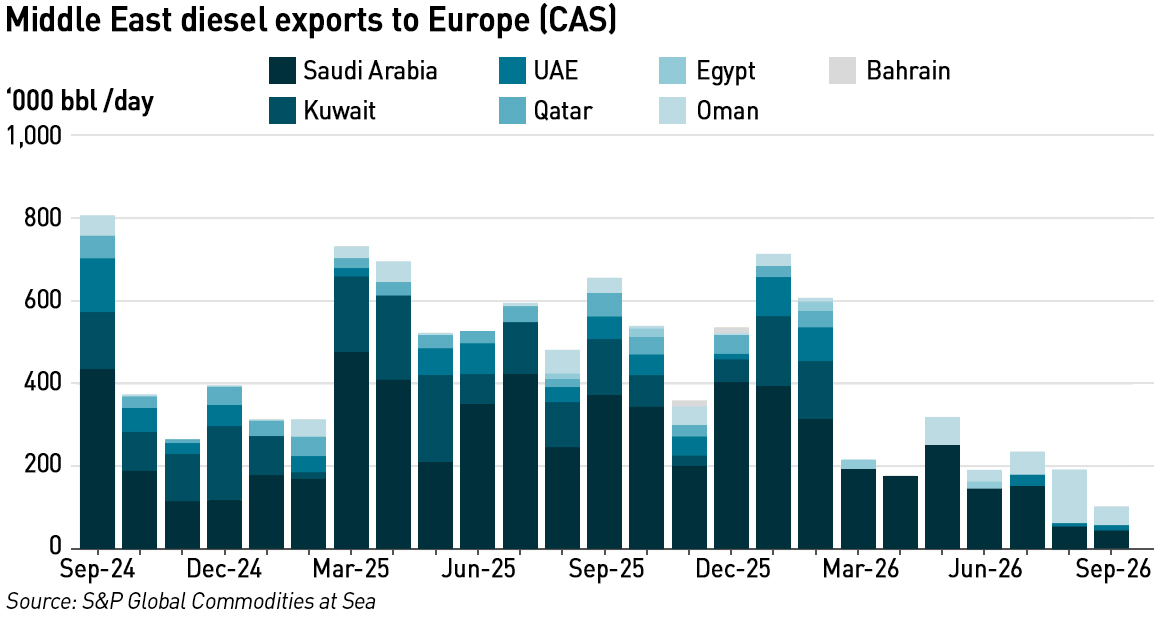
European buyers have increasingly turned to the US to fill that gap – S&P Global estimates that the US supplied around 360,000 bbl /day to Europe during Q3 2026 compared with around 250,000 bbl /day before the Iran war. In August, US barrels accounted for 62–72% of diesel imports into the UK and Netherlands. No other exporter is capable of replacing US volumes of this magnitude quickly. India is an important supplier, but its exports are less than half of US volumes. According to Wood Mackenzie China is currently the only country with enough spare refining capacity to make a significant difference but there is no guarantee it would choose to increase exports.
Wood Mackenzie estimates that northwest European diesel cracks could increase by around 27% or 80 cents per gallon following a US export ban. This prospect has alarmed European governments with French President Emmanuel Macron urging President Trump not to impose a ban, saying a ban would be bad “not just for the rest of the world, but for the US economy as well”.
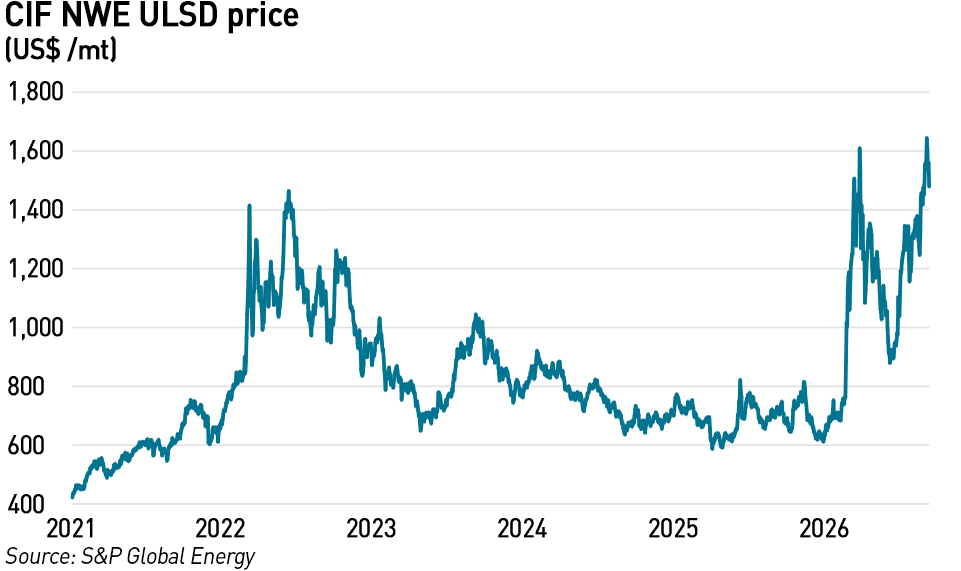
Diesel prices are already rising with UK prices reaching their highest ever levels of 199.18p /litre, exceeding the previous record of 199.09p set in June 2022. Petrol is significantly cheaper at 174.13p /litre. It’s a similar story in Europe. Platts assessed northwest European 10 ppm diesel at US$ 1,642.25 /tonne on 15 September, compared with US$ 752.25 /t immediately before the current conflict in the Middle East.
How much further prices could rise depends on both the form and length of any US export restrictions. Goldman Sachs estimates that a full US export ban would initially increase European wholesale diesel prices by about US$3 /barrel, or roughly 2%, for every week the restrictions remained in place, although releases from European strategic stocks could offset around half of that initial effect. That suggests that an export ban lasting only a couple of weeks would have a relatively modest price impact in Europe, however a ban lasting for months would see inventories falling and buyers increasingly competing for replacement cargoes. Wood Mackenzie estimates that the northwest European diesel crack would increase by 27% under its full-ban scenario.
Starting from diesel at around £2 /litre in the UK, this suggests that £2.10 – £2.25 /litre would be plausible if significant restrictions persisted. Prices could move higher in a more severe scenario involving a prolonged full ban combined with continuing Middle Eastern disruption, depleted European inventories and reduced global refinery runs, but claims that diesel could reach £3 /litre are likely overblown.
How likely is a ban?
Fuel export bans are nothing new – Russia banned diesel exports in July, in response to Ukrainian drone attacks on its refineries, while China cut petroleum product exports in March, and although those restrictions have since been eased, it still has a quota system in place for international sales. How likely the US is to impose a ban depends on how the impact of any ban is assessed.
Those arguing for a ban believe that if diesel is kept within the US market it will lower prices through simple supply and demand dynamics – if you increase supply relative to demand, prices should fall. But this assumes the US can absorb the additional volumes that typically go for export.
Initially it could, as any surplus volumes would be diverted into storage and prices would likely fall. Goldman Sachs estimates that US diesel prices could initially fall by around 25 cents per gallon for every week of a ban, equivalent to roughly 4% of the current price of about US$ 6.50 /gallon. That would provide meaningful short-term relief to farmers, hauliers and other large diesel users, and explains why politicians from agricultural states are keen on the proposal.
But within weeks the storage facilities would be full, creating a surplus of around 700,000 bbl /day of diesel and gasoil in the Gulf Coast region (“GC”) according to Wood Mackenzie, which would ultimately require around 2.7 million bbl /day of refinery run cuts. Other analysts suggest a 1.9 million bbl /day cut representing 12% of US crude runs.
“Restricting US diesel exports would actually increase fuel costs for most Americans quite significantly,”
– Wood Mackenzie
But cuts in refinery production would not be limited to diesel – they would affect every part of the barrel. Gasoline production would also fall. Wood Mackenzie estimates that diesel and gasoil production would fall about 800,000 bbl /day, and gasoline production would drop about 70,000 bbl /day which would increase gasoline prices on the US east coast by around 15%. That translates to an increase of about 26 US cents per gallon, and would push US gasoline prices towards record highs. Goldman Sachs estimates that US retail petrol prices could rise by around 30 cents per gallon for each additional week of any ban once storage is constrained. This would be even less popular with US drivers than high diesel prices.
“The irony of a US diesel export ban is that it would likely increase costs for American consumers. A policy designed to bring relief at the diesel pump could end up driving prices higher at the gasoline pump,”
– Alan Gelder, Wood Mackenzie’s SVP for Refining, Chemicals and Oil Markets
The other problem is that the US is not a single, frictionless fuel market. The Gulf Coast has a huge refining system and excellent access to export terminals, which is one reason it exports so much fuel in the first place, but other markets have a fuel deficit. California’s fuel market is geographically isolated from the GC pipeline network and has specialised fuel specifications, while declining in-state refining capacity has increased its reliance on marine imports.
An export restriction could depress Gulf Coast diesel prices while increasing Californian prices as it’s forced to import foreign diesel priced at international levels that would increase in response to the US export ban.
“The blunt tool of banning diesel exports definitely doesn’t work…If you can’t export the diesel that comes out of our refineries, you run out of places to store it, and you have to reduce US refining, which would put upward pressure on gasoline prices and jet fuel prices,”
– Chris Wright, US Energy Secretary
For these reasons, Energy Secretary Chris Wright and other leading industry figures oppose the ban, preferring to work with the refining industry to increase the supply of US diesel in a “simpler, voluntary, cooperative fashion, without using blunt instruments that would reduce refining throughput”.
Alternatives to a diesel export ban
As things stand, no export ban has been announced. The debate is being framed in the media as Republican senators representing states with significant agriculture, led by Iowa senator Chuck Grassley, worried that high fuel prices will hurt them in the upcoming mid-term elections, versus oil companies wanting to protect their profits. This is a somewhat crude (pun intended) framing.
Of course high diesel prices are hurting both farmers and truckers, but an export ban will simply transfer the problem to gasoline creating a different and potentially larger political headache. There are better solutions to the problem of temporarily high fuel prices. An obvious solution would be to extend waivers of the Jones Act, to allow easier shipping between US ports – the US could “export” diesel to itself.
The Jones Act requires goods moved by sea between US ports to be carried on US-built, US-owned, US-flagged and predominantly US-crewed vessels. The difficulty is that there is relatively little qualifying tanker capacity for fuel which significantly limits the amount of US fuel that can be transported by sea to states without pipeline supplies. (There are actually no qualifying LNG tankers which is a very big problem for northeastern states such as Massachusetts which are not well served by gas pipelines.)
The lack of Jones Act-qualified petroleum tankers makes it harder and more expensive to move surplus diesel, petrol and jet fuel from the Gulf Coast refineries to deficit regions such as California and the east coast. The Trump administration issued a limited Jones Act waiver in March, subsequently extending it twice, with the current 90-day extension running until 15 November. The effect has been significant – according to the EIA, Gulf Coast petroleum shipments to the west coast more than quadrupled year-on-year in April and May after the waiver was introduced. The latest waiver is narrower and requires foreign-flagged voyages to be approved individually, but it still covers energy products including diesel.
Diverting GC diesel to California and the east coast rather than the international markets would reduce the need for production cuts, protecting the gasoline markets, and would also avoid removing US diesel supplies from the global market since the fuels that would have been imported by California and the east coast states would be available to other countries.
Other strategies could potentially involve providing temporary tax relief either at state or federal level for diesel consumers and relaxing rules on cheaper dyed diesel reserved for off-road vehicles such as tractors. Of course a resolution to the conflict with Iran that led to a re-opening of the Strait of Hormuz is the ideal longer-term solution. Shipments of oil from the Gulf have risen in recent weeks but remain well below their prewar level, when around 20% of global oil supplies passed through the strait.
What can the UK do to limit the impact of any US export ban?
For Britain, the episode highlights three distinct policy questions:
- What should we do about security of fuel supplies?
- What can we do about high fuel prices?
- What can be done to protect UK refineries so we do not increase vulnerability to such market shocks?
The Government insists that Britain has adequate fuel stocks, with Chancellor John Healey saying this week that “we’ve got the stocks that we need”, but the reality is less comfortable. Britain reportedly has around 40 days of diesel reserves, one of the lowest levels in Europe. The UK is formally required by its membership of the International Energy Agency to maintain emergency oil stocks equivalent to at least 90 days of net oil imports – the Government says it complies with that obligation.
However, this is not a requirement to hold 90 days of diesel consumption, but to hold crude oil and other petroleum products covering 90 days of net imports rather than consumption. Having crude oil inventories will not help if there isn’t enough capacity to refine it. The IEA requirement can also be met with stocks held overseas, which might be vulnerable in a supply shock. The UK should look at whether its individual stocks of diesel and jet kerosene are sufficient (petrol is less of a concern as the market is better supplied with gasoline).
In terms of prices, there is actually a lot the Government can do. The largest component of pump prices in the UK isn’t the cost of crude oil or the energy costs of refining, it’s tax. The UK imposes a significant fuel duty on petrol and diesel and then levies VAT on top – we pay tax on tax every time we fill our cars. Because of this leveraging effect, a 1p reduction in fuel duty would reduce the pump price by around 1.2p if passed on in full.
In relation to the competitiveness of Britain’s remaining refineries, the obvious move, as I described in my recent report, is to abolish the UK Emissions Trading Scheme which imposes a significant carbon cost on domestic refiners not borne by many overseas competitors. Removing the ETS cost would not translate directly or immediately into lower pump prices, but it would support refinery economics, lowering the risks of further closures and greater reliance on imports.
What the current crisis demonstrates beyond doubt is the value of domestic refining capacity. Britain has gone from importing 14% of its road diesel in 2003 to importing about 55% today. 17% of the diesel we consume comes from US refineries. The UK lost almost a quarter of its refining capacity in 2025 with the closure of Grangemouth and Lindsey. Diesel remains essential to road freight, agriculture, construction and many other parts of the economy – allowing domestic refineries to close increases reliance on imports.
Theoretically, liquid fuels are globally traded commodities and Britain can buy whatever it needs on international markets. This is true, but at what cost – during supply shocks prices go up and countries must compete for limited supplies. Britain can afford to outbid many countries to secure the volumes it needs but it will have to pay a high price, which feeds though to pump prices and drives inflation.
Retaining domestic refining capacity and maximising domestic crude oil production reduces our dependence on imported energy in a world of growing energy nationalism. Britain should formulate its energy policy on the assumption that other countries will act in their own national interests, and start doing the same.




As ever, Kathryn Porter hits the nail squarely on the head.
We are in a “fine” mess because we have chosen to deindustrialise and rely entirely on the World being happy to trade with us, offshoring our CO2 emissions in the name of our new God- Net Zero.
Well guess what, in a free trading economy, being “fair” means supplying your product to the most needy market at the highest price, after all, as the manufacturer, in this case refiner, you have a £billion+ investment and if a customer, let’s say the U.K., has effectively closed off their ability to produce/refine their own diesel or petrol, then in a demand market the price rises.
This has been the whole weakness of the CCC and Net Zero Zealots demand to get to zero- no thought about where everything we manufactured, refined, built would come from when we had fully deindustrialised- importing everything leaves you totally beholding to whoever has what you desperately require. The four pillars of Life, economic and social are- Steel, Cement, Plastics and Ammonia- due to our World Leading drive to Net Zero perfection, the Nirvana of Green Zealotry, our steel industry is now a White Elephant producing nothing due to high energy costs but a taxpayer funded black hole, cement is energy intensive and with costs rising, the U.K. producers have cut back, plastics a byproduct of refining are no longer available and are now fully imported, and ammonia is at a price that means food production either ceases or costs rise by a minimum of 20%- yes the U.K. is a World Leader and is showing how to take a barely efficient country producing just about what was needed to a subsistence economy where the nation will be split unequally in those who have Nothing, and those who have a Little.
On the subject of tax, both fuel duty and VAT, it would be so much better if the retailers of Petrol and Diesel made one small change to their till receipts issued to the victims of Government imposed taxation at the pump- state clearly that your bill is as follows- total price, fuel duty, VAT, retailers margin, suppliers margin, the figures are staggering- £100 of diesel for instance- Fuel Duty approx £38.00, VAT approx £17.00, Merchant margin approx £3-5.00, Refining, distribution, storage approx £40- £42.
Now let’s ask the simple question – how high will the price of Net Zero and its required de industrialisation drive the cost of surviving- and as each round of poverty inducing increases comes around, the pleas for State help increase and new and innovative ways of handing benefits are constructed, the tax burden will rise exponentially.
And all because our new God, Net Zero has to be seen to be saving the planet from a natural plant food gas.
It is a pyrrhic victory and leaves little satisfaction to know that one was right that the neglect of the British energy industry in the ideological helter skelter to net zero has, for example resulted in a near doubling of the price of diesel fuel. With all this knock on effects.
100% true, accurate and correct as always Kathryn. If only the numpties we keep electing to run the country were listening…
With regard to our “experts” only one thing is crystal clear, they must be Eco Zealots, it matters not if they know anything, just have Net Zero as their God is sufficient. And that is why Kathryn Porter and other qualified, knowledgeable individuals are not on the CCC, they know the dangers, they know the weaknesses and for that reason, they are “just NOT the sort of individuals we desperately need”.
As and when the system fails, the excuses are ready- we did NOT go fast enough, we did NOT invest enough, if we had MORE Wind, More Solar, then failure would never have been an option.
Zealots seek the company of zealots, just as drunks seek other drunks.
Ayn Rand’s model of capitalism comes home to roost for Americans: restrict exports and USA refiners will produce less! Mock Trump as so many do, but this is what he has to deal with.
With burnham becoming pm with no election or mandate, could we, the general public, remove the westminster clownshow regarding national energy and install you to implement whatever ideas you have in order to begin to restore our industries, with cheaper and more reliable energy?
Hi Kathryn-
I am happy to see you getting more and more prominence in the media and public space. Your voice of reason is getting louder in the lunatic cacophony of Net Zero ideology.
Do you have an estimate of the cost to the taxpayer of the implementation of carbon taxes & offsets?
So the gov is clueless, not surprising as they understand nothing about economics
Hi Kathryn,
A great article, thank you.
I would suggest that Australia’s diesel fuel storage level predicament is equal to or worse than the UK. Immediately prior to the Iran conflict, Australia’s diesel fuel stocks were down to 32 days and that total included shipments in transit and stocks held in overseas storage facilities. This is despite the Australian Government paying around $2million GBP per annum to maintain membership of the IEA, which (as you point out) recommends 90 days storage levels (excluding shipments in transit). An incomprehensible policy when you consider that Australia (due to it’s geographic isolation, physical distances and low population) has one of the world’s largest diesel fuel consumption rates on a per capita basis.
The Australian Government has since sought to extract itself from this predicament by wading into the global diesel market and (via use of taxpayer underwritten funding) purchased diesel stocks, overseas storage capacity and vessel space. Funnily enough, the Australian Government won’t disclose how much taxpayer funding has been spent on this exercise!
Prior to the Iran conflict, Australia’s diesel fuel refining and storage capacity had been allowed to atrophy in anticipation of Australia becoming the “renewable energy superpower”, now the Australian Government is calling for proposals to build and maintain diesel fuel storage capacity in Australia, underwritten once again by the Australian taxpayer.
Australia’s diesel fuel storage levels have now increased to 41 days, but meanwhile, the average Australian is reduced to waiting for the Australian Government Climate Change and Energy Minister’s weekly “ships and days storage report” as a means to gauge Australia’s overall diesel fuel security levels.