
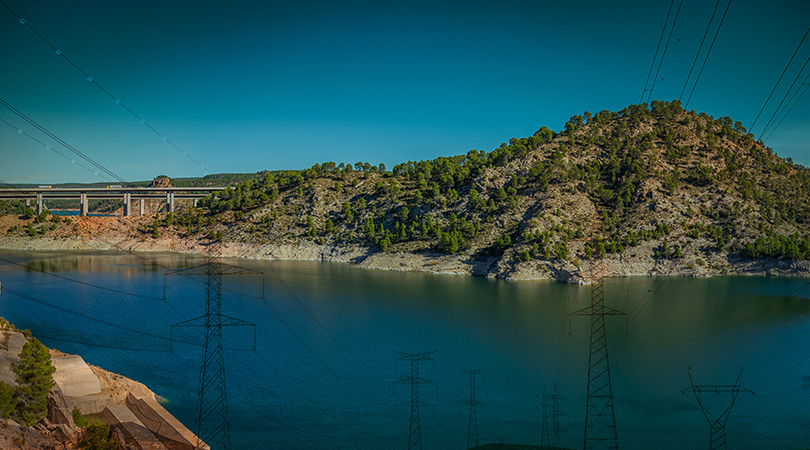
Here is a transcript of a speech on grid stability that I gave to the International Energy Credit Association in Valencia on 16 June 2026…
……………………………
Good morning, and thank you for inviting me to speak here today.
This is a risk audience, so I want to begin with a few risk manager’s questions: what can go wrong, how fast can it go wrong, who bears the loss when it does go wrong, and have we priced that loss properly?
In electricity, the traditional answer has been: make sure there is enough generation to meet demand. Make sure the market clears. Make sure counterparties can perform. Make sure fuel is available. And make sure there’s enough capacity margin.
All of that still matters, but it’s no longer enough.
In a power system increasingly dominated by wind, solar and batteries, the central risk question is changing. It’s not simply whether we have enough megawatts, it’s whether the system can remain stable while those megawatts are being delivered?
That distinction is crucial. A system can have plenty of installed capacity, plenty of renewable generation, and even a healthy-looking market position, while still being vulnerable to fast-moving physical instability.
The Iberian blackout of April 2025 should be understood in precisely that way. The final ENTSO-E expert panel report described the event as the result of interacting factors, including oscillations, gaps in voltage and reactive power control, rapid output reductions and generator disconnections, leading to fast voltage increases and cascading disconnections in Spain and Portugal.
That’s not a conventional fuel-supply problem. It’s not a simple “there wasn’t enough generation” problem. It’s a power-system stability problem.
Which also makes it a credit problem, a collateral problem, a contract problem, a regulatory problem, an insurance problem and an asset-valuation problem.
The physical event and the financial event are not separate. A voltage problem can become a settlement problem, a collateral problem, a performance problem and a disputes problem within minutes. When protection systems trip, generation disappears, imbalance positions change, interconnector flows change and prices can move in ways that standard base-case models rarely capture. So the question isn’t just whether the engineering works, it’s whether the commercial architecture assumes that the engineering will always work.
The difficulty is that many of the most important stability services in a power system have historically been invisible to markets because they were bundled with conventional power stations. Coal, oil, gas, nuclear and hydro generators connected to the grid, are heavy rotating equipment, which have both physical and electromagnetic coupling with the grid, delivering inertia, voltage support and fault current. The market paid for electricity, but it received grid stability more or less for free.
But that bundle is now being unpicked because inverter-based resources – wind, solar and batteries work differently. They produce direct rather than alternating current and they are not coupled to the grid in the same way that conventional generation is.
Their only resource is current, so while they can provide grid services, they can only do that by using some of the current that would otherwise power loads. This means they become less useful as a generation source and they have to be paid to provide services conventional generators provide for free.
And on top of that, current power electronics fall far short of what conventional generators provide – they are passive, and experiments with more active inverters show they often revert to passive behaviours under fault conditions.
Worse, not only do they fail to provide the same level of grid strength that conventional generators do, under some conditions they may actively undermine grid stability.
Unlike synchronous machines, inverters can inject harmonics, flicker and voltage unbalance into the power system. Where synchronous generators act like a sink for some harmonics, including significant ones such as the second harmonic, grid-forming inverters typically emit rather than dampen harmonics. The commercially available inverters in use today should not be assumed to behave like large synchronous machines.
One of the most dangerous assumptions in current electricity policy is that power system security is mostly about having enough megawatts, particularly in the presence of weather-related intermittency. The Iberian blackout showed very clearly that this isn’t true.
You can have plenty of installed capacity, plenty of renewable generation, and still experience a fast-moving, system-wide failure if voltage control and system stability are not properly managed.
Renewables dominated grids are fundamentally more fragile than conventional power grids. But unfortunately, policy continues to lag behind engineering reality — often assuming a false sense of security.
I’m not going to give you a lecture in electrical engineering, but there are three ideas we need to keep in mind.
The first is frequency. Frequency is the system’s heartbeat. Most European grids operate at 50 hertz – that is voltage and current go through 50 complete cycles per second. If supply and demand are in balance, frequency stays close to that value, but if demand is greater than supply, frequency falls, and if supply is greater than demand, frequency rises.
Equipment is designed to tolerate only limited deviations, so if frequency moves too far, protection systems disconnect machines to prevent damage. This means that even relatively modest frequency deviations can lead to blackouts.
Because stable frequency is linked to a maintaining a balance between supply and demand, it stands to reason that sources of generation that involve rapid variations such as gusts of wind and clouds passing in front of the sun make that balance harder and more expensive to maintain.
The second idea is voltage. Voltage is often described as electrical pressure which pushes current through the network. Unlike frequency, which is broadly the same everywhere on the grid, absent fault conditions, voltage varies with location. This is because they type of equipment connected to the grid affects the voltage – capacitive and inductive loads affect voltage differently.
Grid operators cannot control what types of machines people use and therefore they cannot control the underlying voltage characteristics of the grid. They can only respond the changes in the voltage and try to keep it stable.
The third idea is inertia, although it’s a concept that is not always used correctly. People often use inertia as if it’s a single number, but in practice, it’s a shorthand for a broader set of stabilising properties provided by synchronous machines. Their physical mass resists rapid changes in speed – this is physical inertia and the most conventional application of the term.
But conventional generators also have electromagnetic inertia – their electromagnetic coupling with the grid helps hold the voltage waveform together and supports local voltage, and their fault current helps protection systems identify and isolate faults.
Replacing these inherent properties of synchronous generators in a grid dominated by intermittent renewables is not automatic. It’s not costless, and it’s not risk-free.
As wind and solar replace conventional generators, these stabilising properties are lost, and grids become less stable. They are more prone to faults, and the faults are more difficult to dampen when they occur.
Synchronous machines respond instantly to fault conditions due to their physical and electromagnetic coupling to the grid. But inverters have to measure, interpret and act through software and controls.
That difference may sound academic but it’s not.
A grid does not fail in the average condition. It fails at the edge. Much like the way that financial failures rarely have a single cause but emerge from correlated assumptions. They emerge when everyone believes their own exposure is hedged, only to discover that the hedge depends on the same stressed liquidity as everyone else’s hedge. Or when models assume normal conditions and ignore the dynamics of stress. Or when compliance becomes a paperwork exercise rather than evidence of real-world performance.
Last year’s Iberian blackout showed is that when the physical system changes faster than the operating model, the market model and the compliance model, hidden risks accumulate.
Red Eléctrica’s own report said the incident was caused by cumulative circumstances that exceeded the N-1 safety criterion and led to an overvoltage problem and cascading generation shutdowns.
Generation subject to Spain’s dynamic voltage regulation procedure did not comply with its obligations to absorb reactive power, while the system operator had assumed compliance when making its calculations.
And large amounts of wind and solar generation failed to operate when frequency fell, failing to meet grid code fault ride-through obligations. That compliance failure was ultimately what brought down the grid, leading to eleven direct deaths and as many as 165 excess deaths over the two days affected by the outage.
The grid operator assumed compliance. But compliance was patchy at best.
In finance, we know how dangerous that can be. We know the difference between a covenant and a covenant that is monitored, between a margin model and a margin model tested under stress and between a legal obligation and a counterparty that can actually perform under market volatility.
It was also apparent that voltage and frequency oscillations are often observed both on the Spanish grid and across Europe, and are now considered to be normal. This sounds a lot like the normalisation of deviance.
Diane Vaughan used that phrase in her analysis of the Challenger disaster to describe how organisations can become complacent about warning signs because nothing bad happened yet.
Behaviour that should be treated as abnormal becomes accepted as normal, and the absence of catastrophe is mistaken for evidence of safety. This can be applied directly to the Iberian blackout and the acceptance of these deviations by the official reports suggests the danger remains.
Persistent oscillations, poor damping and inverter-based resources failing to respond correctly were warning signs, even if the system was still operating notionally within its parameters. Until obviously it wasn’t and the blackout happened.
In a changing electricity system, yesterday’s normal operating range may not be a reliable guide to tomorrow’s risk. Repeated small disturbances are not necessarily proof that the system is resilient. They may be proof that the system is tolerating abnormal conditions. Assuming that tolerance will continue or we know what the boundary conditions are is not risk management, it’s hope.
The normalisation of deviance is not a theoretical concept – it’s visible in every sector. In electricity, examples might include frequent voltage oscillations, repeated constraint actions, increasing system redispatch with growing reliance on emergency redispatch, greater volumes of curtailment, untested black-start assumptions, repeated delays in grid reinforcement, grid-code non-compliance treated as administrative issues, or dependence on a small number of ageing synchronous machines for local stability.
Individually, any one of those may be manageable, but together, they may indicate a system drifting toward fragility, and one we lack the tools to manage.
Unfortunately, decades of strong grids led system operators to focus almost exclusively on frequency control. Voltage stability was taken for granted. Now they are re-discovering the local nature of voltage. REE is concerned about voltage control in the south of Spain after allowing too many conventional generators to close. Scotland faces similar challenges being down to just two large synchronous generators.
I hear politicians talking up the huge surpluses in wind generation that Scotland has with absolutely no understanding that if the grid is unable to operate because there are no synchronous generators it won’t matter. It will be like trying to play jump rope with no rope.
The British system operator is experimenting with alternative technologies but no grid the size of Scotland has ever been operated on that basis, without large synchronous generators.
It’s an unsanctioned experiment that Scottish politicians don’t even realise is being set up on their patch. It may well fail which will mean the Scottish grid will stop working. Not having electricity will be the norm rather than the exception unless new synchronous generation can be built quickly. But with long lead times for equipment, that’s very hard to deliver.
Of course, if a regional grid becomes non functioning, the knock-on effects will be severe. Lives will be at risk. Businesses will be unable to function. Assets will lose value. Law and order may even break down.
Even if the outcomes are less extreme, unstable grids that experience periodic outages have wide-ranging consequences.
It will affect asset value. A renewable project connected in a weak part of the grid may face curtailment, constraint costs, additional connection requirements, changing grid-code obligations or retrofit costs. A battery may earn revenue from arbitrage in one model, but be required to reserve headroom for grid services in another. A thermal plant may appear uneconomic on an energy-only basis, but become valuable because the system needs its stability services.
It affects counterparty performance. If a generator has a grid-code obligation to provide voltage support or ride through a fault, does it actually have that capability? Has it been tested? Are the settings correct? Is the obligation enforceable? What happens if it fails? Does the offtaker bear imbalance costs? Does the lender bear availability risk? Does the insurer treat the event as mechanical failure, grid failure, force majeure or operator error?
It affects liquidity and collateral. Blackouts and major grid disturbances are not only physical events. They create price spikes, imbalance charges, settlement disputes, margin calls and operational disruption. If a region experiences system stress, the commercial impact may not be evenly distributed. Some parties may gain from volatility while others face sudden collateral calls. Some contracts perform as expected but others will reveal ambiguous drafting and end up in protracted disputes.
It affects regulatory risk. As system operators learn more about operating low-synchronous grids, rules will change. Grid codes will tighten and testing will become more intrusive. Dynamic voltage control may become mandatory for more assets. Fault ride-through requirements may be enforced more seriously. Connection studies may become more conservative. The cost of compliance will rise, especially for assets built under older assumptions.
It also affects contract interpretation. A power purchase agreement, balancing-services contract or tolling agreement may use familiar terms such as availability, outage, force majeure, change in law and prudent operating practice. In a weak-grid event those words become contested. Was the plant unavailable, or was the network unable to accept its output? Was a trip caused by equipment failure, grid disturbance, software protection or a non-compliant setting? These distinctions determine who pays.
Many decarbonisation plans assume that wind, solar, batteries and grid-forming electronics will scale smoothly. Perhaps they will. But a prudent risk manager should ask what happens if the engineering takes longer than the policy timetable. What happens if assets are built before the network is ready? What happens if markets reward energy production but underpay stability? What happens if the system becomes dependent on services that have yet to be demonstrated at scale?
We hear a lot these days about energy security. Mostly people think about this in terms of fuel supplies, or managing intermittency. Grid stability is neglected, not least because of the perceived threat to the energy transition – if we admit that wind, solar and batteries make the grid less stable, the public might be less keen on continuing with a transition they are already realising is far more expensive than they were promised.
Unfortunately there are too few people making energy policy that understand the physics of power grids. They just about understand capacity but have no idea about voltage. Even within the sector too many people use terms such as “reactive power” without really understanding what they mean. Worse, they misunderstand them, for example, reactive power is now often assumed to be a commodity that any current bearing device and provide when that is a highly dangerous assumption.
Not only do they not understand the risks to grid stability, they actively seek to avoid understanding it. But that’s not a luxury those of us working in the market can afford.
We need to be asking under what conditions, at what scale, at what location, might the grid fail. What testing and contractual incentives could prevent it or mitigate the risks individual market participants face. And if the market fails, what will be the failure mode, and who will bear the residual risk?
Grid stability should not only sit in the technical appendix of a project-finance model. It should influence due diligence, covenants, events of default, representations, insurance assumptions, availability definitions and collateral valuation. If the data room contains the PPA and the financial model but not the grid connection assumptions, curtailment history, inverter settings, OEM limitations and compliance test results, that absence is itself a risk signal.
Electricity markets are very good at paying for measurable commodities such as energy and capacity. They are less good at paying for system qualities such as voltage support, inertia, fault current, damping, black-start capability and system strength.
Some these are local. Some are dynamic. Some only reveal their value during rare events. Some are provided continuously, in the background, until suddenly they are missing.
Resilience looks expensive before a failure event and cheap after it. The spare transformer, the synchronous condenser, the additional dynamic voltage support, the stricter compliance test, the conservative dispatch decision, the extra thermal unit held online for stability all can look inefficient under normal market conditions.
They reduce short-term optimisation and often increase consumer costs. They will generally reduce renewable output as described earlier and they quite often offend the dominant political narrative.
If they prevent a blackout, they are extraordinarily valuable, but we may not even realise that’s happened. For example, we all have to get our cars regularly tested for roadworthiness. We might be required to replace our tyres which costs money. We can easily quantify the cost of the new tyres, but we cannot quantify the cost of not replacing the tyres.
We can’t reasonably calculate the risk that old tyres will cause an accident, nor the potential severity of the accident. You could have a slow puncture that has no real consequence other than a need to replace the tyre that needed replacing anyway. Or you could have a blow out on a motorway, and cause a mutli-vehicle pile up in which people die and the motorway is closed for hours causing all sorts of direct and indirect costs as well as the obvious human tragedy.
Avoided disasters don’t settle through any market. No invoice arrives saying: “accident prevented, value £2 million” or “blackout prevented, value £5 billion.” Instead, the system operator is criticised for constraint costs and for running thermal plant when renewables output is high. The stability service is treated as an awkward side issue and engineers are told to be more ambitious.
Gradually, standards drift. In Britain, NESO keeps requesting permission to reduce its inertia holding – most recently the regulator has refused.
This is the commercial face of the normalisation of deviance.
So what does this mean for all of you? I would suggest a practical response. When assessing counterparties, projects or portfolios in high-renewables systems, ask five additional questions.
Number 1: what stability services does this asset depend on, and who provides them?
Ask about voltage support, fault level, inertia, system strength and black start. Is the asset in a strong part of the grid or a weak one? Is it dependent on nearby synchronous plant that may retire? Is reinforcement funded, permitted and scheduled? Is the connection agreement based on assumptions that might change?
Number 2: what stability services is this asset expected to provide, and can it actually provide them?
If an inverter-based asset has fault ride-through obligations, voltage-control obligations or frequency-response obligations, ask for evidence of compliance. Not just certificates but real evidence. That means test results, settings, event performance, manufacturer limitations and control-mode details. Has performance been validated under weak-grid conditions? Has it been tested when several neighbouring assets respond simultaneously?
Number 3: how does the commercial model change when stability, rather than energy, becomes scarce?
A battery may be most profitable when cycling aggressively for arbitrage, but the system may need it to hold headroom. A gas plant may be uncompetitive in the energy market, but essential for voltage support. A renewable project may have strong annual output but increasing curtailment. A transmission constraint may turn a low-cost region into a high-risk region. The revenue stack should be stressed against changing system needs, not just price curves.
Number 4: what are the consequences of non-performance?
If a plant trips when it should ride through, who pays? If voltage support is unavailable, is there a penalty? If a generator is instructed to absorb or inject reactive power and fails to do so, is that a compliance issue, a settlement issue, a default issue or merely a future regulatory discussion? A system that depends on unenforced obligations is not a resilient system. It is a system running on hope.
Number 5: are we mistaking administrative compliance for physical resilience?
This may be the most important question of all. Markets love documentation. But what matters from an engineering perspective is testing. Risk managers need both. In a low-inertia, high-inverter system, a spreadsheet showing capacity adequacy is not enough. A grid-code certificate is not enough. A model is not enough. The system has to work during disturbances, and the assets have to behave as expected under fault conditions as well as in steady state.
Risk managers don’t need to become power engineers, but they do need to know when a power-system risk is being hidden behind language that sounds reassuring.
When we hear: “the system has enough capacity.” We should ask: enough capacity for what?
Enough to meet average demand? Enough to meet peak demand? Enough to maintain frequency after the largest loss? Enough to support voltage locally? Enough to provide fault current? Enough to restart after a blackout? Enough to survive correlated inverter behaviour? Enough if an interconnector trips? Enough if negative prices cause unexpected disconnections? Enough if a key synchronous plant is on outage?
When we hear: “the asset is grid-code compliant.”
We should ask: compliant on paper, in simulation, at commissioning, or under real disturbed conditions? When was it last tested? Who saw the data? What happened during actual events? Are settings controlled by the owner, the OEM, the aggregator or the system operator? Can they be changed remotely? Are there version-control and cyber controls around firmware updates?
When we hear: “batteries will solve it.”
We should ask: which problem? Energy adequacy, frequency response, voltage support, congestion, black start, reserve, inertia emulation or fault current? How long must they sustain the service? What state of charge is required? What revenue is sacrificed by holding headroom? What happens in a multi-hour system stress event? Who pays for readiness?
When we hear: “grid-forming inverters will replace synchronous machines.”
We should ask: at what scale has that been demonstrated? In what grid strength? With what mix of neighbouring assets? During what faults? With what current limits? With what protection settings? With what contractual accountability? And what is the plan if performance does not match the model?
I would add one further question, which is perhaps the most direct credit question: what happens to the money when the physics goes wrong? Where do imbalance charges fall? Who posts collateral? Which party has discretion to curtail? Does a failure to ride through a fault trigger a default, a warranty claim or a force majeure notice? Does insurance respond if the loss is caused by a grid disturbance rather than damage to the asset?
The energy transition is not merely a generation build-out, it’s a fundamental restructuring of one of the most complex real-time machines ever built. That machine has almost no storage in its wires and must balance in milliseconds. It must tolerate lightning strikes, plant trips, forecasting errors, market behaviour, cyber threats, human error and equipment failure. And it must do all this while public policy pushes it through the fastest technological transformation in its history.
We must tell the truth about the risks if we are to maintain a stable and reliable system.
The truth is that stability is valuable.
The truth is that location matters.
The truth is that compliance must be demonstrated, not assumed.
The truth is that voltage matters as much as energy.
The truth is that some services that were once bundled with conventional generation now need explicit markets, contracts and accountability.
The truth is that blackouts are not only engineering failures. They are failures of governance, incentives, information and risk culture.
And the truth is that normalisation of deviance is one of the greatest dangers in the modern energy system.
Energy policy is often driven by targets but engineering is driven by constraints. Finance sits somewhere in between. Capital can either reinforce wishful thinking or discipline it. It can fund projects that assume the grid will somehow cope, or it can ask the harder questions that force the system to become more resilient.
So my closing message is this.
A wind and solar world is fundamentally different from the world for which our power grids were designed. Not just in the obvious ways of being weather dependent and intermittent.
They are direct current resources being forced into alternating current infrastructure. This means we must look differently at every element of the grid, well beyond energy and capacity.
We have to pay attention to local voltage support, real fault ride-through, tested inverter behaviour, dynamic stability services, synchronous condensers where needed, robust black-start plans, better data sharing, enforceable grid codes, and markets that pay for resilience before a blackout happens rather than after it.
We need regulators who understand that reliability is not an optional extra, and system operators who are honest about physical limits rather than keeping quiet to satisfy policy ambitions.
We need developers who treat grid-code compliance as a core asset capability, not an administrative hurdle, and risk managers who are willing to ask uncomfortable questions.
And we need policymakers who don’t assume the laws of physics can be repealed by the legislature.
The lights stay on not because we have enough megawatts on a spreadsheet, but because millions of devices, machines, controls and contracts perform together in real time.
In the old system, much of that performance was supplied by the physics of synchronous machines. In the new system, it has to be designed, procured, tested and paid for.
There’s no room for complacency.
Thank you.


Glad you are well and back at your desk Kathryn, there appears to be a typo here I guess you gave this speech in 2025!
Thanks. I fixed the typo – the speech was yesterday not last year!
Accurate to the last word, whether spoken in 2025 or 2026. Who in DESNZ understands this or even part of it?
Great post, Kathryn, thank you.
What an informative and interesting read
Fascinating, thank you.
Brava! I read all of it, because I am an engineer, and I understand most of the issues. But policymakers – both the politicians and their hangers-on – do not. They will not realize the mistake they have made until the UK goes black, and it takes weeks to do a blackstart, in the middle of the winter. And LOTS of people will suffer, while MANY are likely to die, because of the ignorance of the policymakers.
The entire concept of breaking up generation, transmission, and distribution was invented, I believe by a former COE of Virginia Power. It was a mistake. It should not have been tried. Unfortunately, the fad of renewable energy surfaced about the same time, and the two concepts seemed to be made for one another, so now we have this monster that needs to be tamed. Lots of treasure, and many lives, will be spent trying to tame it.
Good to see you back in the saddle, Kathryn, as it were.
16 JULY 26?
June – sorry
Pleased to hear that you have recovered Kathryn. As a physicist/engineer, I struggled to understand this excellent presentation. But what is certain is that nobody in government (especially Ed) and its advisers/minions will understand any of it. We are bound to get a major blackout in the next few years.
I’m not quite better yet but my doctor cleared me to fly short haul and I didn’t want to let people down having agreed to do it before I fell ill. I’m much better than I was though. Thank you for the good wishes
Sublime conference, Kathryn. One can learn a lot reading it. Hope many of the decision making persons that are in charge of the governance of our electric systems have access to it and make a profound reflection on everyone of the points you make.
What goes around comes around, and there’s nothing new under the sun! In the 1970s the System Technical Branch of The CEGB was responsible for planning and ensuring the stability of the supergrid system, ensuring adequate reactive power margins and planning the installation of reactive compensators, both rotating, capacative and inductive compensation, and of ensuring the voltage response of the installed generation. We saw the introduction of 500 and 660MW generators, whilst inertia constants fell from the 5 MW-seconds/MVA to as low as 2.5 seconds. As System Technical Engineer I oversaw the integration of the first 2000MW DC link into the South-east supergrid, and the development of the Radio Teleswitch for the first large-scale dynamic load control. My team in the North East commissioned the first 500MW static thyristor high- speed excitation system for fast voltage control. We saw the introduction of district heating on a growing scale and the integration of early wind turbines into the grid. My introductory lecture as Vice President of the IEE was entitled ‘Reactive Power – Real or Imaginary?’ The conclusion was, that as people were prepared to pay for it, then it must be real! The fact is, that as long as the supply industry evolves, and as long as electrical engineers are allowed to get on with their work without the excessive hindrance from regulators snd accountants, then whatever challenges are thrown at them will be met with dedication and professionalism.
Did you give the speech in July 16 2025, June 16 2026, or have you already given it in the future?
Doing things in the future is easy – doesn’t everyone 😀
I fixed the typo, thanks
Banger!
What testing of these systems is actually possible? Can you locally cause a voltage/frequency drop and see how inverters respond?
> What testing of these systems is actually possible? Can you locally cause a voltage/frequency drop and see how inverters respond?
Of course – and manufactures of inverters will test their products against a range of disturbances to comply with basic engineering standards (EMC etc) – but in relative isolation.
The problem is, exactly as Kathryn points out: At what scale have they been tested?
One inverter on a test-bed will respond “correctly” to a disturbance. Two inverters may overshoot, but settle quickly. Three may begin to oscillate. But the actual grid has millions (thanks to home solar) of inverters, of a plethora of different designs and specifications, ranging in sizes from a 500W “plug-in solar” device to a 500MW windfarm inverter, so what we get is a system that is actually quite chaotic, and nobody knows what it will do in any fault event that hasn’t yet been observed on this exact configuration.
There is a varying phase delay depending on the distance, type of transmission lines, and number of transformers in the way, between inverters, so they can’t simply be programmed to act together – they have to measure what the system is doing, calculate the best way to react, and then adjust their output, which may take multiple mains cycles, by which time another inverter on a slightly different part of the grid may have taken an action that couldn’t be predicted.
In a grid of synchronous machines, we have the same phase delays, but the actions of each element are completely predictable, by physics. Not only that, but they react immediately – they don’t have to wait for the next zero-crossing to calculate what to do
It’s not just generators though- the same problem exists on the load side. In the olden days, all loads were either resistive, capacitive or inductive. Now, most loads are DC semiconductor loads (e.g. datacentres, EV chargers, VFDs, inverter-based air conditioners and heat pumps, PCs, laptops, LED light bulbs) whose behaviour cannot be predicted during voltage or frequency disturbances.
That said, NESO does conduct some voltage-drop tests (I get an email from them every so often about a “Demand Control by Voltage Reduction” test scheduled for a particular area) although they don’t go outside of operational bounds and they don’t test overvoltage conditions, which are far more risky.
It’s a classic ’emergent behaviour’ issue. It occurs when thousands to millions of objects interact. And the thing about such behaviours is that they cannot be predicted even by deep analysis of individual objects. So regulation of devices is necessary but insufficient, and then there are software versions, software patches, hardware degradation, local grid characteristics and so on in the environment. Overall, a vast experiment…..
Probably a stupid question, but could inverters be programmed to respond in a fixed manner to mimic the response of synchronous generators, insofar as possible?
So their response to a given disturbance is preprogrammed, they don’t try and all dynamically adjust to a moving target each cycle.
@Mark Sinclair
> Probably a stupid question, but could inverters be programmed to respond in a fixed manner to mimic the response of synchronous generators, insofar as possible? So their response to a given disturbance is preprogrammed, they don’t try and all dynamically adjust to a moving target each cycle.
Not a stupid question at all..
Yes, of course that would be the ideal case and is what inverter manufacturers could/should aim for. However there are two or three pretty fundamental problems in the way, namely: “Discrete-time sampling and its effects on control”, “headroom”, and storage.
The first sounds like a title of a control systems MSc Thesis, and it almost certainly has been (although it wasn’t mine). Essentially, digital control systems act in a repetitive “control loop” – they measure the state of the system at the beginning of the loop, then compute the action, then respond, then wait for the next measurement. This delay in action means that the control equation cannot be solved by “simple” linear algebra and thus a naiive controller would soon become unstable, even in isolation. An unstable controller will begin to oscillate, with oscillations potentially growing in magnitude until something breaks. The first instinct of a control engineer would be to increase the control loop rate, reduce the delay as far as possible so that it becomes negligible.
With inverters however, usually the frequency is measured only at the zero-crossing i.e. 100Hz, or 300Hz at the most for 3-phase, which introduces at a minimum a 3ms delay in any action that the controller could possibly take. It’s very difficult to measure it faster than that. Whereas a real physical machine responds immediately, even inside of a mains cycle.
By “Headroom” I mean that an inverter has a maximum current rating that it could not ever exceed even if it really tried, which is when the mark/space ratio of the underlying transistors hits 100% duty-cycle, although most would shut down to protect themselves before they hit 80%. The most fundamental component of an inverter is a semiconductor switch such as a MOSFET or IGBT, which have a non-zero resistance and a very small size – as we know, power lost (and thus heat generated) in a resistor goes with the square of current, and silicon has a maximum temperature of around 150C before it is permanently cooked. So they really can’t exceed their design ratings. (And the same goes for voltage – semiconductors suffer from sudden avalanche breakdown if the voltage goes above their tolerance)
So if an inverter is designed to handle 1kA @ 15kV, it will be stamped as “10MW” with a 50% overload rating, and that is a hard limit – if it exceeds that, it will either suddenly shut down, or suddenly fail violently.
In control systems, we call that a “saturation” (or worse, if it suddenly shuts down and stops doing its job entirely) – it is a discontinuity in the transfer-function of the device which makes it impossible to compare with a (relatively) “linear” device such as a synchronous motor.
So to avoid that non-linearity, we must be able to guarantee that the inverter NEVER reaches its saturation (or shutdown / failure) point. So if the grid operator demands a 10kA fault current for our 1kA 10MW inverter, that means we actually need to build a 100MW inverter that is only ever going to be used at 10MW – which is not economical.
Whereas for a big spool of copper wire which is all that a synchronous generator really is, a momentary overload does not cause damage – it is easy to provide a 10x short-circuit rating without materially affecting costs. – While a lump of copper of course has electrical resistance as much as anything else, it also has thermal mass – unlike a semiconductor junction.
Thirdly there is the rather fundamental issue of storage – an inverter cannot respond to a disturbance without an energy store. A synchronous machine has a readily available store of energy in its own rotational inertia – literally a flywheel – and any sudden increase in load will immediately translate into a torque, which immediately translates into a deceleration and thus a drop in frequency. The energy stored on a flywheel is proportional to the square of rotational speed, and rotational speed is what sets the grid frequency. Without that flywheel effect, an AC grid would be impossible.
For an inverter to behave like a flywheel, it needs a fast energy store – and that store needs to have an overload headroom that will almost never be called upon. Again, the free-market economics have failed us, because an inverter needs expensive storage to even pretend to be like a real generator, and someone has to pay for that.
So in summary yes, it is possible to make an inverter that mimics a synchronous generator – but it is hard, and costs a lot more money (about 10x, I estimate) per MW of inverter – and even then, due to discrete sampling, it will never 100% emulate a synchronous machine, and cannot be tested at scale without risking the very blackout it is intended to prevent..
So one might say: OK, let’s have a DC grid then (see: https://watt-logic.com/2025/08/11/ac-vc-dc-who-would-win-a-modern-battle-of-the-currents/). But that comes with its own problems – massive capital expense that would make HS2 or Hinkley look like chump change.. But also electrolytic corrosion of any conductors exposed to air/moisture, and a bigger problem with circuit breakers (see a demo here: https://www.youtube.com/watch?v=Zez2r1RPpWY) – AC forces the current to regularly go back through zero, giving a chance to extinguish an arc on an opening switch – whereas DC can just keep on arcing. That’s why DC circuit breakers are 10x bigger and more expensive than AC breakers for the same voltage and current.
Not that one wishes calamity on any nation, but human nature being what it is, it will likely tske one to start to address things. The Spanish example shows that the inquest is still trying to preserve the narrative…..not address the issues.
All true. UK politicians, media and the Blob need to be sat down and made to listen. Now.
Sublime conference, Kathryn. One can learn a lot reading it. Hope many of the decision-making persons that are in charge of the governance of our electric systems have access to it and make a profound reflection on every one of the points you make
Yes, system tests have been carried out from the earliest days of the grid. It was about 1974 when I first carried out excitation system voltage response tests on a 30MW unit at Doncaster, and later on a 500MW unit at Eggborough. Frequency is a bit more tricky. For one method a generator can be isolated from the grid and tested. More sophisticated is what we did at Doncaster. We injected pseudo-random voltage fluctuations into the excitation circuit and measured the frequency response.
Does this testing stress the unit in some way beyond that seen in normal use? Is this bad for the windings or insulation or some other component, if repeated too often?
I wonder what some of these solar+inverter based systems would do the limits of their supply agreement envelope were tested properly? At least as part of certification/commissioning, but maybe every few years as well. Perhaps the smoke would be let out! (Lucas joke…..).
Very impressive presentation of the grid challenges we are facing. I wish decision makers would read this, but not sure they would understand even though you have described the challenges in a fairly friendly technical level. There will unfortunately be more grid failures and the Scottish example is concerning for the people who would be affected. But probably some politicians will only react after failures. We always said that poor executive management is revealed by only attending the site of accidents as opposed to being on sites during routine operations to help support safety initiatives in an ongoing manner. If the grids and grid generation is not appropriately designed and implemented, then energy users would likely become more focused on behind the meter resilience systems to ensure they can island and maintain power during grid interruptions.
Thank you for continuing to hammer home the dangers facing the Scottish electricity grid, on which I depend! This is what happens when clueless politicians and ideologues are allowed to “redesign” a complex infrastructure without properly understanding how the system was designed to work.
I suspect that the nincompoops governing Scotland actually believe they can “achieve” Net Zero by 2045 (it’s in their plan) and that all they need to do is to “decarbonise” the Scottish electricity grid. They have gone overboard on weather-dependent renewables, often without the necessary transmission infrastructure in place, and as you say are now down to just two large remaining aged conventional power stations.
They appear happy abandon Torness without replacement as they are anti-nuclear and in their dreamworld they think they can eliminate the emissions from Peterhead CCGT by installing a hoped-for but as yet unplanned carbon capture and storage facility.
I very much doubt if they count the emissions from the essential backup and balancing electricity imported from England which makes a farce of their grid decarbonisation claims, just as the UK doesn’t count the emissions used to produce electricity imported via international interconnectors, or indeed the emissions used to manufacture and transport all goods imported from abroad.
What a shambles of utter lunacy!
I can now see the problems with solar and wind, but cannot see how solar can be useful in a future where most homes are heated with electricity. There’s not a lot of energy from the sun on cold winter days, but all homes will have to be heated. Wind, nuclear and storage will have to cover the demand on those really cold days with a tiny almost irrelevant proportion from the sun. So why are we investing so much in solar?
> So why are we investing so much in solar?
Because of the faulty economics that Kathryn alludes to.. Solar is cheap (and getting even cheaper thanks to Chinese dumping) and it is highly profitable if the only measure of value is Megawatt-hours (perhaps adjusted on a half-hourly basis) even if it is actually toxic to grid stability.
We need to heat our homes on cold, cloudy, still winter days – but solar producers are not penalised for their lack of availability on those days, unlike other producers. Nor are they penalised for injecting power when the frequency or local voltage is already too high, or for causing, exacerbating or failing to ride-through a disturbance.
The ideal scenario I believe would be to make ALL generators responsible for guaranteed generation, with penalties for failing to meet those guarantees under any circumstances – i.e. a solar plant should be responsible for building and maintaining enough storage to sustain its output overnight and during a spell of cloudy weather – or pay the penalty for not doing so. That would put them on a level playing field with other energy sources. Unfortunately though, storage is next-to-impossible on that scale (The world’s entire annual crop of batteries would only sustain the UK demand for a few days, and the more batteries you have in-service, the more you need to replace every year due to their limited lifespan) but nevertheless, i’m sure if the economists pulled their finger out, they could come up with a fair level of penalty to apply.
Very interesting indeed.
Reinforces my conviction that physical inertia (mechanis and electromagnetic) of heavy rotating machines remains essential in very complex systems and the stability service provided should be correctly values and remunerated.
Classical rotating power plants are intrinsically stable by their inertia and the grid was built around the comfort of this “passive” stability service.
If intermittent renewables (solar and wind) become dominant in a complex grid, the stability (frequency, voltage and low harmocics) must be provided by active mechanisms, control algorithms, and responses which are not instantaneous.
The same difference in a natural stable airplane (classical designs) against the agile F16 which uses its natural instability to fast manoeuvering. In normal flight, its stability is generated by active controls.
The conclusion is that ensuring an adequate dose of passive stability (inertia) in a complex system is a valid rule for safety.
And that will be the role of reservoir hydro plants or nuclear power plants, when the first resource is insufficient, in complex grids free of CO2 emissions.
And the good news is that generation IV nuclear technology also adopt passive safety systems which will facilitate the commercialization os these power plants.
Stability is like a ship. Out at sea it barely notices waves, even tsunamis, but the closer it gets to land, the closer the hull gets to the sea floor and the more it is rocked by the increasing height of the waves, until eventually it runs out of room to move and hits the land. Renewables are raising the sea floor, and shrinking the room to move.
Or you could just go with the cruise control analogy.
This is a really good overview of the risks and issues associated with altering the supply of electricity from fewer than 100 traditional rotating generators producing AC with frequency control, voltage control, and short circuit tolerance built-in with a variety of other methods that are intermittent by their nature, produce DC, and require a host of other equipment to ensure they can operate on a national network.
The information needs to be more widely known
I ask that all people who read these comments pass this on to at least one other person and possibly their MP or MSP. https://watt-logic.com/2026/06/16/maintaining-grid-stability-in-a-wind-and-solar-world/
Not an electrical engineer, but a retired project manager for government capital works who has worked under the yoke of political interference by politicians and their all too willing bureaucrats (with their all too limited technical knowledge) I can assure you that so long as the people who make policy believe that all they have to do is keep throwing tax-payers money (aka the magic wand) at the problem, then “someone” will somehow do “something” and the problem will just go away and they can then take the credit for it at the next election.
Clear, concise & brilliantly explained, as usual.
Excellent article in regards to the folly of trying to grid tie an over supply of renewables to an alternating grid.
Perhaps it’s time we had a proper Spanish Inquisition: Kathryn is asking exactly the right questions.. Reading the ENTSO-E report I can’t help feeling they’re covering their own posteriors. Red Electrica were a little more honest, but as Kathryn pointed out they were acting on unverified assumptions. That ENTSO-E has been actively pushing a new interconnector from Bilbao to near Bordeaux shows thet are burying their heads in the sand. In order to be fed, solar surplus must move across the grid from the South to the North, exacerbating the very problems with trying to maintain voltage and reactive power (correcting one exacerbated the other) that led to the apagon. The grid was stretched because solar power was being delivered from the South to feed the pumped storage in the Pyrenees, taking in the faulty inverter at the Nuñez de Balboa PV plant that generated frequency oscillations and power surges. The interconnector only encourages more supply, dumping it in France where it is likely unwanted and unneeded. Meanwhole. it does nothing to sort out the fragility of the grid in Southern Spain, which now relies on increased CCGT runs in Huelva and Cartagena for stability..
Great articl; I’m still absorbing !
Hi Kathryn – Please can you tell us what sort of reaction you have has to your excellent speech from the risk and financial communities? Thanks as ever for sharing your work and sending best wishes for your good health.
Just got round to reading this.
A very good read and should be compulsory reading for the policy makers.
In my view the appropriate Select Committee should be running a “lessons to be learned from Spain blackout” inquiry – and this should be part of their evidence.
I thought the comments on Scotland are particularly strong – what a dire situation.
Andrew
Excellent article. As the share of wind and solar continues to grow, maintaining grid stability will become one of the biggest challenges for power systems. It’s a reminder that the energy transition is about much more than simply installing renewable generation—it also requires smarter grids, storage, and well-maintained assets. We work with solar panel maintenance and see firsthand how keeping systems operating efficiently contributes to long-term performance.
Do you think battery storage will become the most important technology for balancing renewable generation over the next decade?
Excellent insights. As renewable generation continues to expand, maintaining grid stability will require not only smarter infrastructure but also well-performing solar installations. We work with professional solar panel cleaning and maintenance, and it’s surprising how often system performance can be improved simply by keeping panels in optimal condition.
At Sunshine Baleares, we help homeowners and businesses maximize the efficiency of their photovoltaic systems through professional maintenance.
Interesting title for your article. Looks like we are going to need to add security to the stability question. I read today, that power a station in the UK went down due to state hacking from Iran. apparently it was off-line for four days.