

This week saw an unprecedented series of Electricity Margin Notices (“EMNs”) issued by the National Energy System Operator (“NESO”), with notices covering four consecutive days between Tuesday and Friday, and separate notices covering the morning and evening peaks on Friday. There have now been EMNs covering 11 days this year, more than in the previous five years combined. And winter has barely begun.
NESO continues to insist that these notices are “routine” – well issuing them on four business days out of five is certainly starting to look routine! However, there is nothing routine about the number of notices being issued this year, nor about the extraordinary amounts of money being spent balancing the electricity system. And while obviously an EMN does not necessarily result in a blackout – a blackout resulting from a margin shortfall would almost certainly be preceded by one, in the same way that not every fire alarm means there is a fire, but if there is a fire you expect to hear the alarms.
What makes this week’s events particularly worrying is that there was no fundamental shortage of generation in Britain. Wind output was decent – not high but certainly not low. But on four consecutive days NESO struggled to secure adequate system margins, spending extreme sums of consumers’ money in the process.
Balancing the grid is NESO’s core job, but these events raise serious questions about the way NESO is operating the electricity system, its approach to managing transmission constraints, its procurement of reserve and its increasing reliance on the goodwill of neighbouring European system operators.
In my view, there has been a marked deterioration in the quality of system operation since the summer. The frequency of margin notices, the escalating costs of balancing the grid and the nature of the actions being taken in the Balancing Mechanism suggest that NESO is increasingly reacting to events rather than anticipating and managing them, and indeed may be losing control of the grid.
An unprecedented series of EMNs
The first EMN of the week was issued late on Monday evening, covering Tuesday afternoon and evening. Further notices followed in the early hours of Wednesday, late on Wednesday evening for Thursday, and in the early hours of Friday for both the morning and evening peaks.
The initial shortfalls identified by NESO were significant:
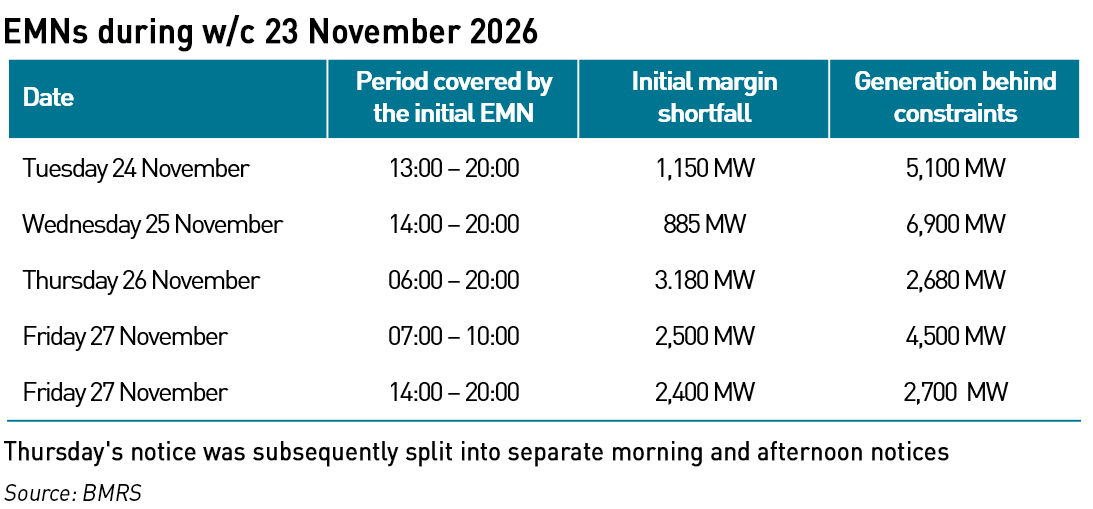
An EMN doesn’t necessarily mean there isn’t enough generation to meet demand, but it does mean there is expected to be insufficient capacity to meet demand while maintaining the required operational margin. That margin exists for good reason: power stations and interconnectors can fail without warning, wind generation can be lower than forecast and electricity demand can be higher than expected. And we know NESO is quite bad at forecasting.
The distinction between being able to meet demand and being able to meet demand securely is important – NESO’s repeated assurances that an EMN is not a warning of imminent blackouts should not be taken to mean that the erosion of safety margins is unimportant. There IS something to see here despite NESO’s assertions to the contrary.
Nor should the subsequent cancellation of an EMN be interpreted as evidence that everything was fine – the relevant questions are what actions were necessary to restore the margins, how much those actions cost, and whether the need for them could reasonably have been avoided.
This week the answer to that last question appears to be yes.
Phantom wind: selling electricity that cannot be delivered
The main problem this week was that transmission constraints between Scotland and England were exacerbated by network maintenance. But these transmission constraints were not a surprise – the maintenance was planned and announced on the NESO Portal. The extent and geographical distribution of wind generation could also have been anticipated from weather forecasts.
So why did this lead to margin warnings on four consecutive days?
The issue relates to how wind and constraints interact. When wind generation cannot be delivered it must be curtailed, however NESO does this on the delivery day which means that this phantom generation is allowed to trade in the day ahead market. The phantom wind makes the market appear better supplied than it is, and if the additional supply cannot be consumed within GB it must be exported in order for the market to clear. It also depresses the wholesale price in GB making exports financially more likely.
This week large volumes of generation were scheduled for export in Day Ahead trading – volumes which could not in fact be delivered. And because the market appeared to be well supplied, many gas generators did not self-dispatch despite actually being needed.
This fact was known ahead of time by everyone – the windfarms, the gas generators, the traders, the European system operators, and NESO.
Of course, then on the delivery day NESO curtailed the wind creating a shortfall because the market had agreed to export generation it did not have. As a result NESO was forced to buy back the exports and buy gas generation in the Balancing Mechanism at very high prices. Essentially, Britain simultaneously had too much wind and not enough generation to maintain secure system margins.
In correcting the export position, NESO had to breach the intraday trading limits over and over, at times trading 4,100 MW against the limit of 1,500 MW for hours on end. On Thursday it very much looked as if the European TSOs had agreed to let NESO have its exports back but refused any imports with the interconnectors trading at zero for several hours in the evening peak.
On Tuesday, underlying requirements for conventional generation were actually much lower than on Monday morning, when the system had operated without an EMN – it was the inability to access available generation, and the market distortions created by the failure to address this ahead of time, which created the difficulties.
There was absolutely no need for any of this drama.
Because NESO has (or should have) a good idea of how much wind generation will need to be curtailed, it should do this earlier and not allow the phantom wind to distort the day ahead market. By removing wind that cannot be delivered before day ahead trading, the market will clear based on real, deliverable generation, and exports will only be scheduled if they can be reasonably supplied.
Of course, this will increase the wholesale price, but it will reduce the costs of balancing significantly because NESO would no longer have to buy back exports which should never have been scheduled and would reduce the need to buy CCGTs in the BM as more gas generation would self-dispatch.
As far as I can see there is nothing preventing NESO from doing this – indeed NESO’s Grid Trading Master Agreements (“GTMAs”) have specific provisions for this.
It has been suggested that addressing this problem would require the introduction of zonal pricing, but I see no logical basis for this argument. NESO already has the ability to identify and curtail generation which cannot be delivered because of transmission constraints – there is no reason why doing so earlier than it does now would require a whole new market structure.
European grids are not Britain’s balancing reserve
When NESO was forced to correct the export positions this week it had to rely very heavily on the goodwill of European TSOs, and in particular RTE (France), Tennet (Netherlands) and Elia (Belgium). At one point Britned traded 2,000 MW meaning it flipped from full exports to full imports.
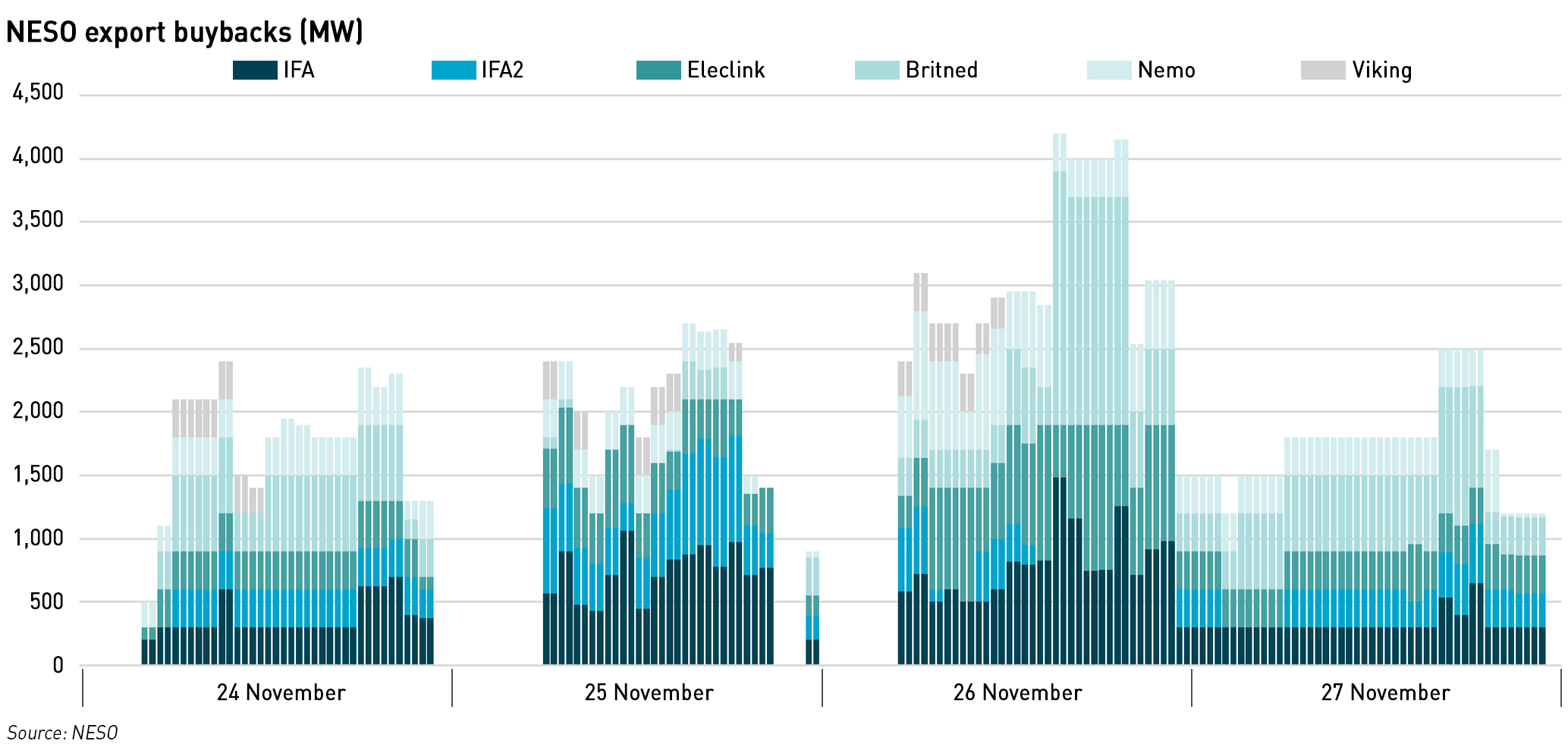
It is one thing to request assistance from a neighbouring system operator following an unexpected loss of generation or a major transmission fault, but it’s quite another to repeatedly require neighbouring system operators to accommodate the consequences of mismanagement of the British grid. I understand there is growing frustration among European TSOs at the extent and frequency of these requests – the trading limits were set for a reason and NESO has breached them time and time again.
These TSOs have their own systems to operate, their own transmission constraints to manage and their own security of supply obligations. They are under no obligation to compromise the security of their domestic electricity systems to compensate for poor operational decisions in Britain, particularly when the amount of supply being removed from their grids by these trades can be significant. A 2 GW swing on Britned represents around 15% of peak Dutch demand at this time of year.
There’s a risk that NESO is becoming used to a level of assistance that European TSOs might not always be able or willing to provide. European gas storage levels are relatively low and unevenly distributed – a prolonged cold spell, particularly with still weather, could create significant pressures across several European electricity markets simultaneously.
On top of that, Norway is experiencing its own challenges with hydro reservoir levels which are now at their lowest in NO2 for the time of year since records began in 1995.
NESO risks drawing the wrong conclusions from the fact that European TSOs have so far been willing and able to accommodate its requests to buy back exports. The circumstances in which Britain will most need help from its neighbours are also likely to be those in which its neighbours are least able to provide it, which is why Britain needs to maintain adequate domestic operational reserves and manage foreseeable transmission constraints proactively.
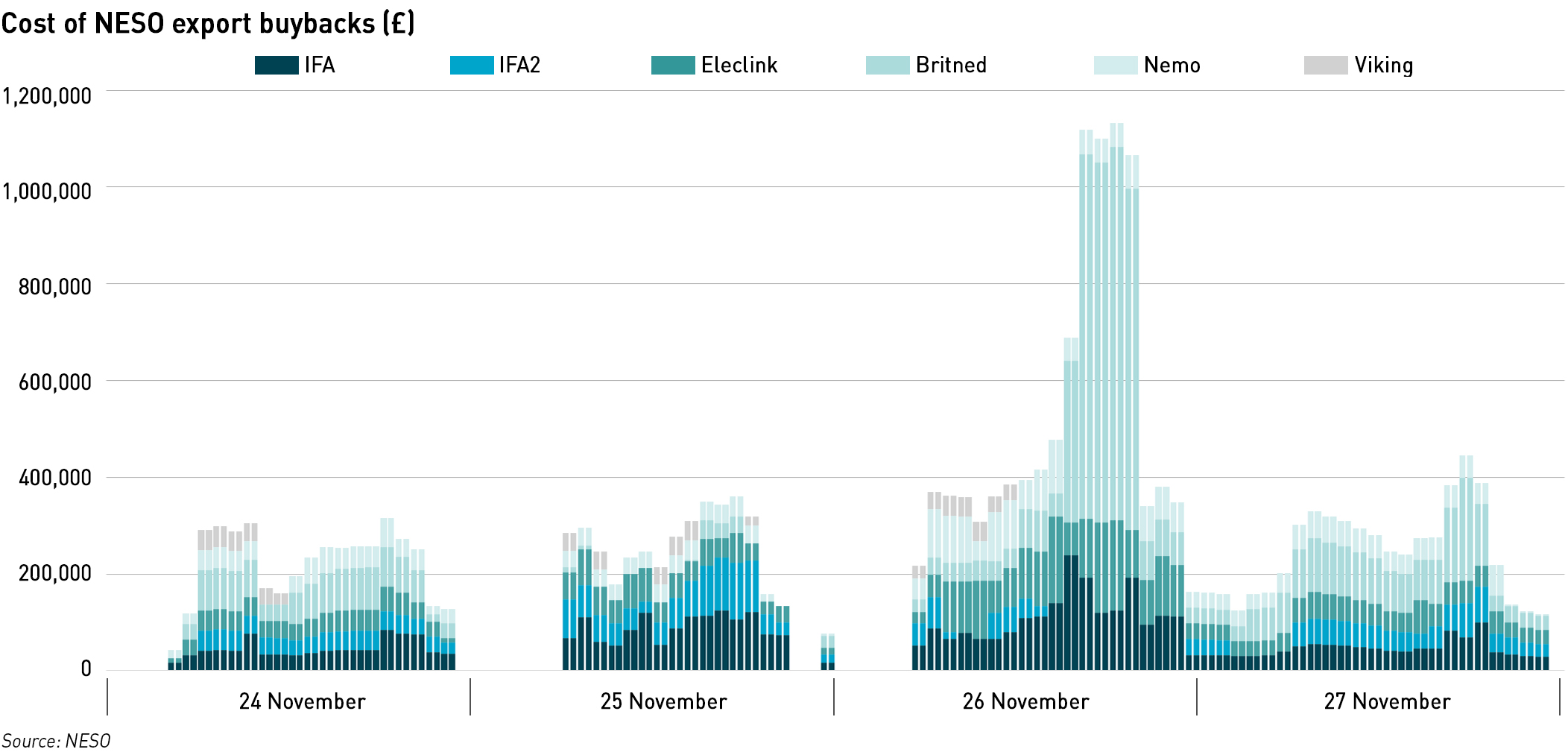
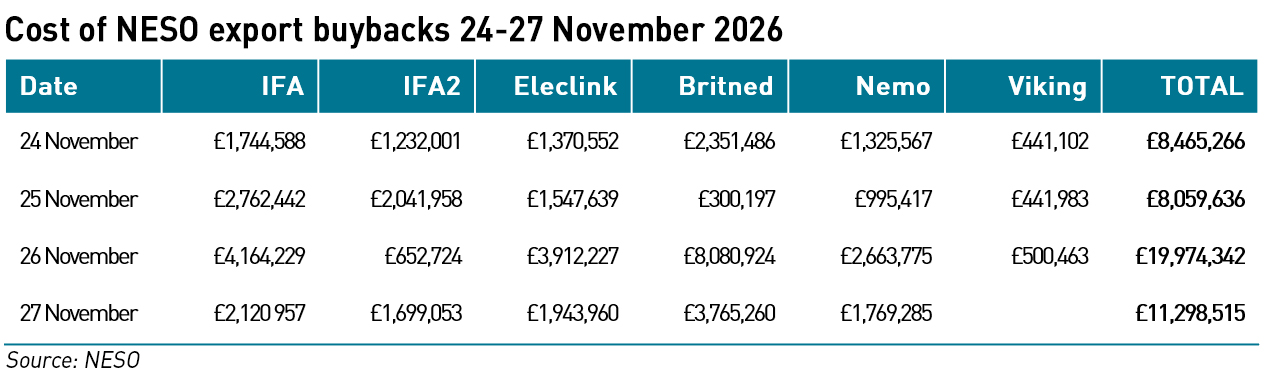
This week the European TSOs were willing to help us, but it came at a cost – at one point NESO paid over £1,300 /MWh to buy these exports back. Over the course of the four days, NESO spent £48.8 million buying back phantom wind exports.
Phantom reserve: NESO’s increasingly expensive use of gas-fired power stations
Another interesting feature of system operation this week has been the number of CCGTs being instructed to run at their Stable Export Limits (“SELs”), often through a succession of relatively short Balancing Mechanism instructions. I described this practice in a previous blog, and yet again it looks as if NESO was trying to buy informal reserves by creating CCGT headroom in BM.
I looked at some of the CCGTs earning the highest prices this week: Connah’s Quay, Coryton, Damhead Creek, Langage, Rocksavage, Rye House, Saltend, Seabank, South Humber Bank and Sutton Bridge. The chart shows their aggregate Physical Notifications (“PNs”), instructions to operate at SEL and the estimated upward headroom associated with those instructions. At times, the estimated headroom exceeded 2.5 GW. This is not an exhaustive analysis of the CCGT fleet, but it illustrates the potentially significant volumes of capacity being made available through these actions.
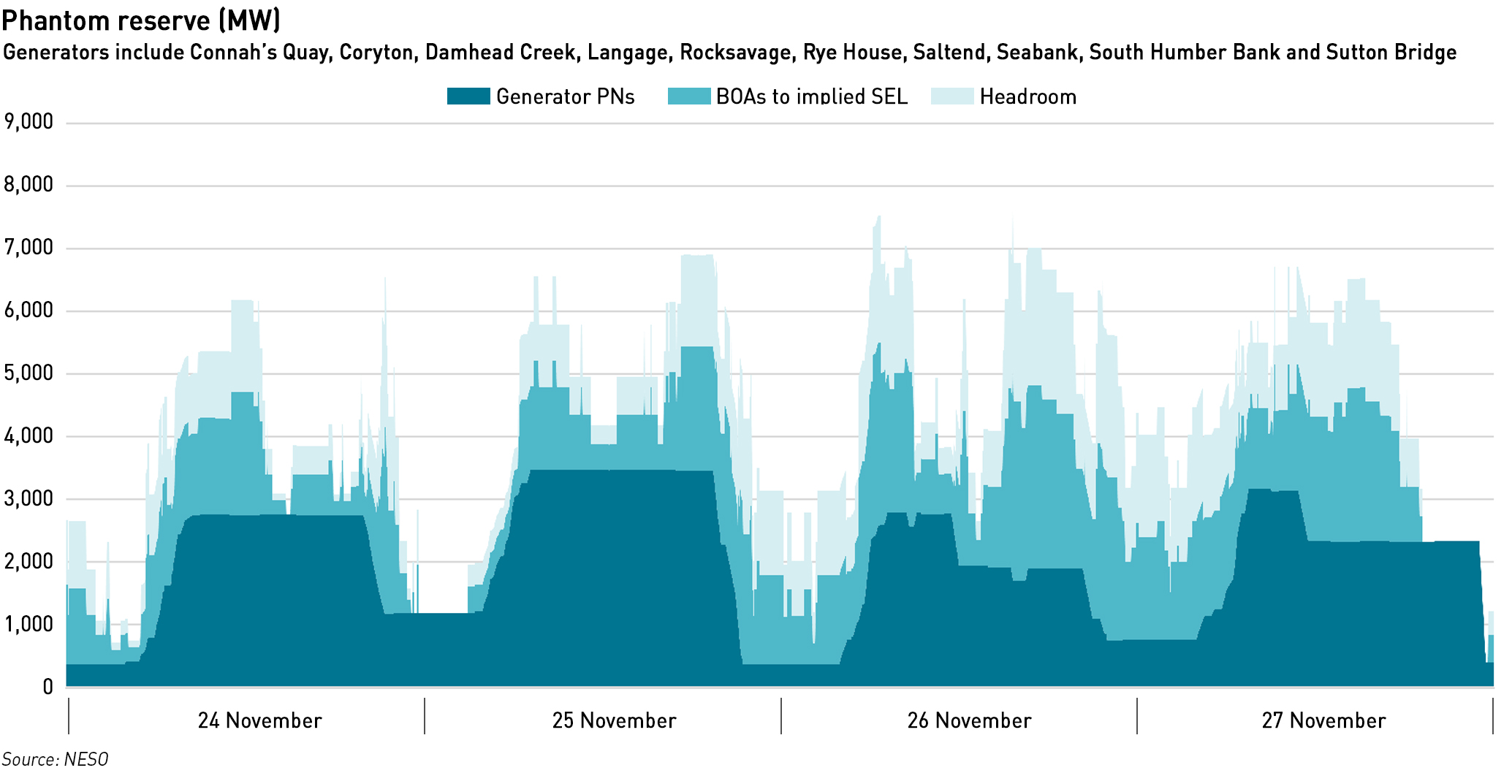
I also found that many of these instructions were to run at SEL in short increments. This is one of the most expensive ways a CCGT can run – plant efficiency is lower at SEL and last minute instructions come with a higher cost, not least because the operators will price based on an assumption that the run will be short.
The binding constraint on turbine warranties is now starts rather than operating hours. This means that maintenance must be carried out after a certain number of starts which gives each start a value – a short run will have to be paid more per MWh than a long run to make it worth running the plant and using a start for fewer hours. Committing a CCGT for an extended peak period in the day-ahead market is a very different economic proposition from asking it to start at short notice and then repeatedly extending its operating period.
Consider a hypothetical 800 MW CCGT with an SEL of 400 MW. By instructing the unit to run at SEL, NESO secures 400 MW of immediate generation and potentially another 400 MW of upward headroom. If the plant is being paid £1,500 /MWh for the initial instruction, the cost of securing this position is £600,000 per hour, before any subsequent instructions to increase output. Multiply this across several large power stations and the costs quickly mount up.
The headroom NESO is creating this way is between SEL – the minimum level at which a CCGT can operate stably, and its Maximum Export Limit (“MEL”) which is the maximum output at any time. A typical CCGT can move from SEL to MEL in around 15 minutes but in each of those minutes output will be increasing. A CCGT operating at SEL provides NESO with two things: electricity to meet current demand and upward headroom which can be accessed relatively quickly if additional generation is required.
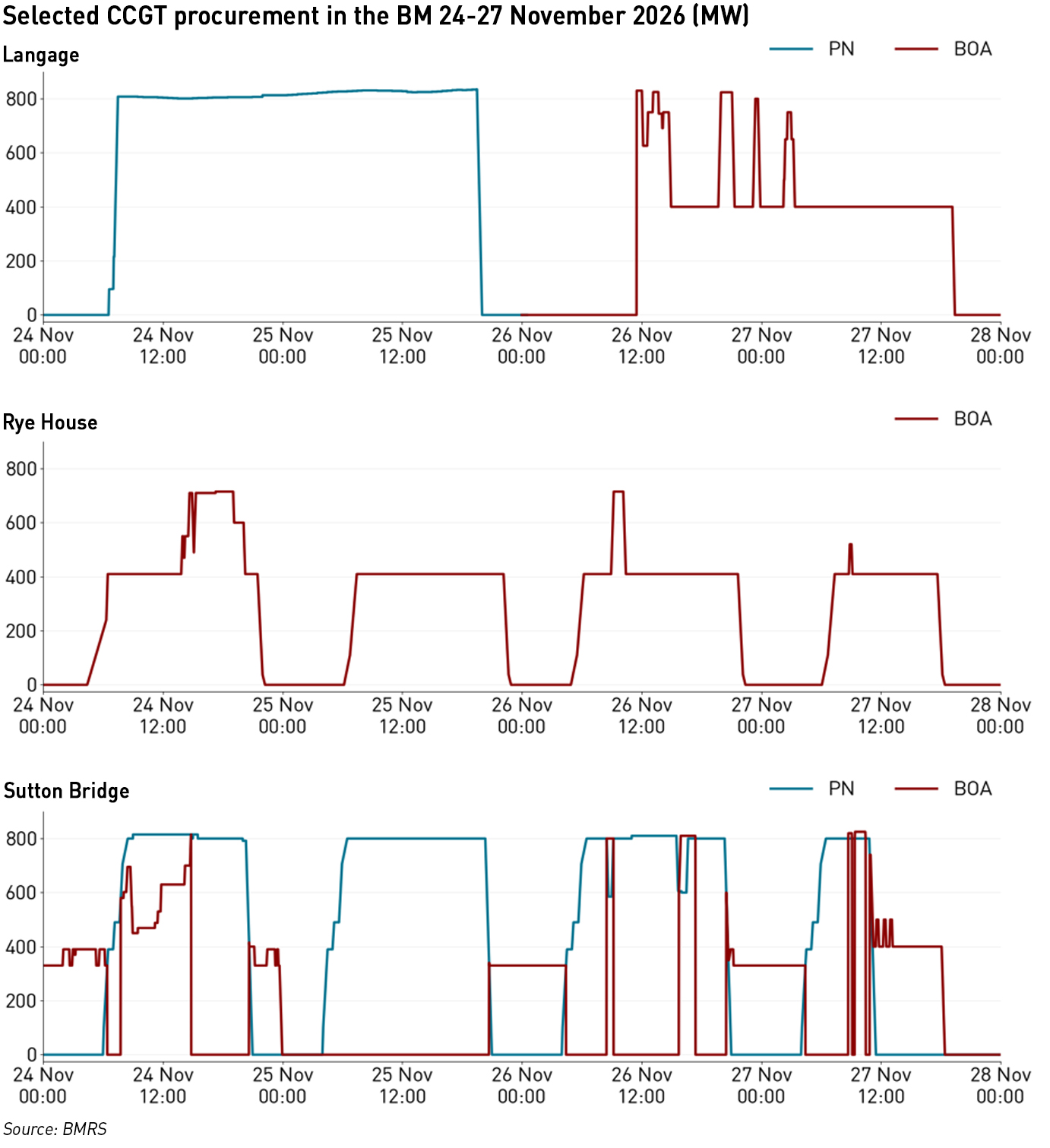
This chart shows how three of the CCGTs I looked at ran in the BM over 24-27 November.
The question is WHY is NESO buying gas capacity this way? It seems unlikely it was to do with managing constraints since the plants are geographically distributed.
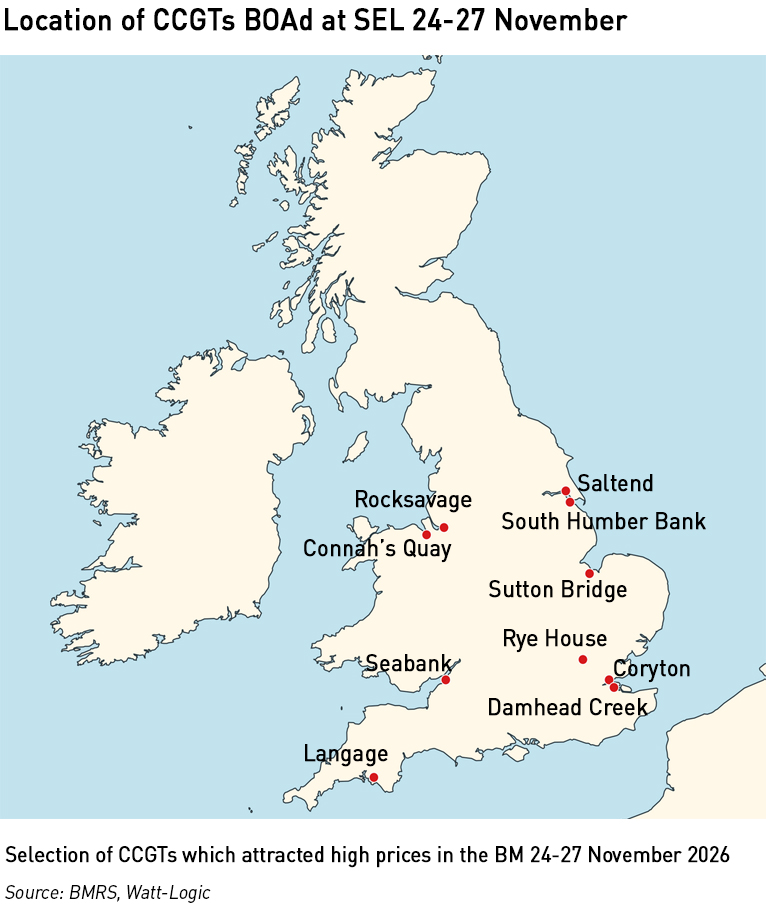
So then procuring headroom seems to be the logical explanation. But why is NESO buying headroom when it has a functioning market for reserve?
I can only think of three reasons: NESO does not believe the reserve it has bought will be delivered reliably, its forecasting and operational planning are such that it’s identifying reserve requirements too late, or it is trying to conceal the amount of reserve it actually needs.
If NESO thinks its formal reserves are unreliable, the solution is to fix the reserve market and enforce delivery obligations with strict penalties, and if it is identifying reserve requirements too late it needs to improve its forecasting.
If, on the other hand, NESO is trying to buy reserve under the radar, that raises questions about transparency. If a power station has been instructed to operate at SEL primarily to make its remaining capacity available as reserve, how is the cost of this action being categorised? Is it being recorded as a reserve cost, an energy balancing cost or a constraint cost?
How much reserve is NESO actually securing through these actions, over and above its formal reserve procurement? And how does the full cost of securing this reserve compare with the cost of alternative procurement strategies? It’s possible for the published costs of formal reserve services to look modest while significant additional expenditure is being incurred in the BM to create additional headroom. That would mean reserve procurement was effectively hidden inside other categories of balancing expenditure.
If this strategy is being executed in order to secure additional, reserve, this is another form of phantom capacity. Unlike phantom wind, this capacity is physically real, but in reserve terms it can be thought of as “phantom” because it is not recognised anywhere as actual reserve.
The events of 23 June should have prompted a fundamental reassessment of how NESO procures, measures and maintains operational reserve. Instead, the impression from recent market activity is that NESO is increasingly manufacturing reserve in real time through expensive interventions in the Balancing Mechanism.
Balancing costs are now completely out of control
The financial consequences of these operational practices are becoming increasingly apparent. NESO’s latest monthly balancing cost reports show that September and October both set new records for balancing expenditure. The most expensive month for balancing had been November 2021 at £542 million, but this record was broken in September which cost £553 million and blown away in October which cost £745 million. Together it cost £1.3 billion to balance the grid in September and October alone.
October’s balancing costs were £290 million above NESO’s benchmark of £455 million and £412 million higher than in October last year. To put these numbers into context, the total cost of balancing the grid in the whole of 2025/26 was £3.1 billion.
On a typical day the balancing cost is £2.3 million, and this autumn saw two record days at £52 million – until Thursday when NESO spent around £74 million in just one day. On Tuesday the cost was around £39 million, £33 million on Wednesday and £47 million on Friday – meaning the cost over the four days of EMNs was £193 million. November may well be another record month.
NESO typically attributes rising balancing costs to the changing generation mix, transmission constraints and higher wholesale energy prices. These are undoubtedly important factors, but they do not adequately explain why NESO is managing the electricity system in such an expensive manner.
There is a distinction between the costs imposed on the system operator by the physical characteristics of the grid, and the additional costs arising from the way in which it chooses to manage those characteristics. NESO can’t build new transmission lines but it absolutely can change when it takes balancing actions, how it procures reserve, how it commits thermal generation and how it manages predictable requirements for interconnector countertrading.
The fact that transmission constraints exist does not absolve NESO of responsibility for managing them efficiently. Indeed, NESO’s September balancing cost report acknowledges that low day-ahead electricity prices resulted in insufficient gas-fired generation being scheduled, necessitating substantially more expensive interventions in the Balancing Mechanism. If NESO understands this problem well enough to describe it in its monthly reports, why isn’t it taking steps to prevent it?
Earlier this month it emerged that NESO had secured an additional £1 billion in working capital support from the Government, increasing its existing facility from £700 million to £1.7 billion. The reason was that NESO had under-estimated what it would spend on balancing and therefore the amounts it was recovering through bills were too low. NESO is spending consumers’ money faster than it is recovering it through balancing charges.
That additional £1 billion will have to be repaid through higher balancing charges to consumers in 2027, making high bills even higher.
Has NESO lost control of the electricity grid?
It’s becoming increasingly difficult to view recent events as a series of unrelated incidents. Since the summer we have seen:
- The prolonged frequency excursions on 23 June, when the system operated outside its normal operational frequency limits and NESO had exhausted its standing reserve
- A historically unprecedented frequency of Electricity Margin Notices, including during the summer and early in the winter
- Significant discrepancies between the apparent system margin and the margin available once transmission constraints and other operational limitations are considered
- Evidence of deficiencies in the way batteries are represented in NESO’s operational models, including questions over the extent to which battery discharge schedules properly reflect their ability to deliver sustained generation
- Increasing reliance on expensive, short-duration Balancing Mechanism instructions to gas-fired power stations, apparently in part to secure informal reserve
- Growing reliance on neighbouring European system operators to help balance the GB grid
- Successive monthly records for balancing costs and the need for an additional £1 billion government working capital facility
Individually, each of these developments might be explained away, but taken together, they paint a worrying picture of an organisation which is struggling to perform its core function.
There’s also a common theme running through many of these problems – a failure to distinguish between the capacity which appears to exist in market models and the capacity which can actually be delivered when and where it is needed. Phantom wind which can’t get through transmission boundaries; battery capacity which may not be sustainable for the required duration; apparent interconnector flexibility which depends on the agreement of neighbouring TSOs; and phantom reserve informally secured in the BM. We also see some very large forecasting errors both in wind and demand, and it may well be that concerns over such errors are driving some of NESO’s balancing actions.
Electricity security depends on physical reality, not on what’s in a forecast or market model. NESO has repeatedly argued that the electricity system is becoming more complex, which is true, but that is not an excuse for poor planning. Indeed, it makes good planning and good forecasting even more important.
A key driver in the creation of NESO was to respond to the growing complexity of the energy system. If the wholesale market could reliably deliver a physically viable and secure generation schedule without intervention, there would be less need for NESO.
Ofgem and DESNZ need to intervene
There needs to be an urgent examination of NESO’s operational practices, with a particular focus on the extent to which predictable problems are being left until the last minute, creating unnecessary cost. NESO’s instructions to gas power stations should also be investigated to see if this is an informal reserve and if so, why NESO isn’t just buying more regular reserve.
Ofgem’s focus in relation to balancing costs seems to be whether generators are charging excessive prices for their actions in the BM. That’s a legitimate area for investigation, but it risks overlooking the more fundamental question of why NESO needs to take so many expensive actions in the first place. Reducing the number of unnecessary interventions would reduce balancing costs even if the prices charged for individual interventions stayed the same.
There’s also the risk that in preventing CCGTs from earning enough to cover annual costs in the BM which is paid as bid, generators seek to replace this income in the capacity market which is paid as cleared, meaning that the entire market would be paid at the level CCGTs need to remain open. In an effort to save a few £million, Ofgem could cost consumers a few £billion.
There should be an immediate requirement for NESO to develop arrangements for the management of predictable transmission constraints before day-ahead trading takes place, to review its approach to reserve procurement and thermal generation commitment, and to establish more robust arrangements for managing interconnector flows which do not depend on the repeated goodwill of European system operators.
There also needs to be greater transparency around the reasons for Balancing Mechanism instructions and the categorisation of their costs, particularly where actions serve multiple purposes.
And DESNZ, as the Government department responsible for energy security and the ultimate owner of NESO, needs to satisfy itself that the organisation has the operational capabilities necessary to manage Britain’s electricity system through the coming winter and beyond. Operational independence should not mean a lack of accountability.
In my view, NESO has been progressively losing control of the electricity system since the summer, both operationally and financially. It’s still managing to keep the lights on, but doing so at increasingly high cost, with reducing room for error and an increasing dependence on help from neighbouring countries. The fact the control room has so far managed to resolve these problems doesn’t mean the system is being operated well, nor does it guarantee that it will be able to keep getting itself out of what are often self-inflicted problems.
Given the frequency and severity of recent operational problems, Ofgem and DESNZ should commission an independent technical review of NESO’s control room practices, forecasting capabilities, reserve procurement and operational decision-making. This should not be another exercise in asking NESO to investigate itself.
This winter we have yet to see a prolonged period of genuinely cold, still winter weather. If NESO is having this much trouble managing the grid in November when wind was not low and demand was not especially high, what will happen in January when conditions can be far more hostile?


Yes indeed.
And who is responsible for this mess! Accountable? Yes that is rhetorical. It will have profound impact on UK society and economy.
Public confidence will drain away.
This NESO mess comes On Top of other power outage risks that Wes Streeting is waning every household about under his “BE Prepared” campaign. Stock piling for 3 days.
Blame shifting, plausible deniability to claim it is not NetZero induced and NESO related.
And soon we will find out about the ROTA Protocol – that NESO proposed and Ofgem singned off on in August 2026.
Electricity supply rationing – in every post-code.
As the NESO response to inevitable NetZero induced National Grid stress and balancing? . That is the heavy lifter in the “Flexible Demand” part of the CP(2030) Mission pathway they have us on “maximum “Renewables and Flexible Demand”.
France is 80% nuclear and hydro.
France already has what the UK is trying to build: a system where most power is dispatchable and low-carbon. The UK has the opposite: a system where most low-carbon power is weather-dependent.
France’s system dampens volatility.
The UK’s system amplifies it. It gets worse every year in the UK as we move into power rationing under the ROTA Protocol.
Can you talk to anyone at NESO to clarify things?