

On Sunday evening, 8 November, the National Energy System Operator (“NESO”) issued an Electricity Margin Notice (“EMN”) warning that electricity supplies could be tight between 6 am and 11 am the following morning. The initial forecast shortfall in its operating margin was 1,388 MW, which subsequently reduced to 500 MW and then 200 MW before the notice was cancelled shortly after 9 am.
There was nothing particularly surprising about an EMN being issued since Britain was experiencing four-day wind lull, with similar conditions affecting much of north-west Europe. Electricity prices had risen sharply, and NESO had already been paying extremely high prices for additional generation and imports. The timing was surprising however – it was the first time an EMN had been issued for a morning rather than evening, and on Monday, the evening looked much tighter than the morning but no margin warning was issued.
So what was happening? One possible explanation lies in the way NESO models batteries, or rather, the way it fails to model them properly. This raises wider questions about whether the system operator has the tools it needs to manage an increasingly complex system.
Why did NESO warn about the morning rather than the evening?
The chart below shows the residual electricity load, excluding Ireland, calculated by Amira Technologies alongside the availability of conventional generating capacity. The residual load represents the demand that must be met after allowing for variable renewable generation – where the lines rise above the shaded area, imports are required to meet demand.
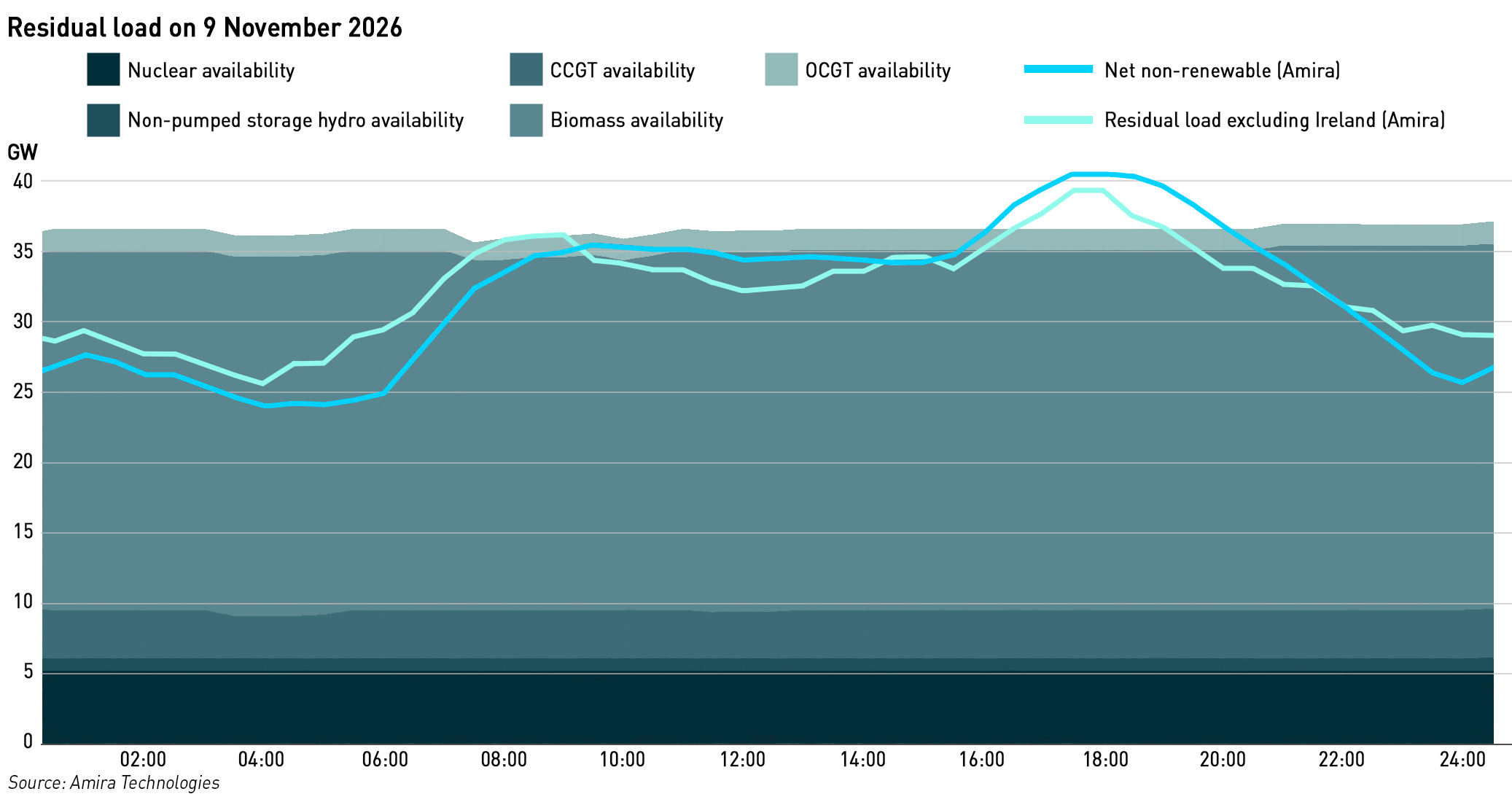
On Monday 9 November, residual load was much higher during the evening peak than during the morning peak. This isn’t an obscure modelling artefact – it can be easily calculated from publicly available data.
While residual load is not the same as NESO’s operating margin, it provides a strong indication of market tightness. NESO’s operating margin calculation also depends on expected interconnector flows, reserve requirements and other operational factors, but the discrepancy raises an obvious question – why did NESO consider the morning tight enough to issue an EMN but not the evening?
This matters because an EMN isn’t just a public announcement – it’s a formal signal to market participants that NESO requires additional capacity to maintain its operating margin. It also allows NESO additional ability to intervene in interconnector flows. Britain is increasingly dependent on imports to meet demand in periods of low renewable generation. But interconnectors are commercial assets whose owners and users trade electricity in response to market prices. NESO can arrange additional interconnector trades, but its ability to intervene is subject to commercial arrangements and operational restrictions.
In May 2026, restrictions were introduced on NESO’s ability to trade against day-ahead interconnector schedules. These were intended to limit countertrading in the opposite direction to previously scheduled flows. There are separate arrangements for system-security interventions, including restrictions on interconnector transfer capacity and requests for emergency assistance from neighbouring system operators. When a market warning is in place, NESO has greater flexibility to intervene in interconnector flows, which means that failing to issue one can unnecessarily restrict the options available to the control room.
This would make the choices made by NESO on Monday perplexing at best. An EMN was issued for the relatively less tight morning while the far tighter evening was treated as a normal operating period.
Are batteries confusing NESO’s margin calculations?
It’s hard to unpack what was behind NESO’s decisions on Monday but one possible explanation relates to batteries. Britain now has 8.7 GW of battery storage installed – more than nuclear at 5.9 GW and biomass at 3.3 GW. Batteries are becoming an increasingly important part of Britain’s electricity system, but they appear to be almost invisible – look at the official reports of generation by fuel (which includes both pumped storage and interconnectors which behave like both generation and load) and batteries are absent despite being capable of delivering significant capacity albeit for limited periods.
Batteries are not a primary energy source, but neither are interconnectors or pumped storage. There’s no obvious conceptual reason why batteries are treated differently from either of these technologies – battery discharge could be reported as positive generation and charging as negative generation in the same way that interconnector imports are treated as “generation” and exports are treated as demand or “negative generation”. That would provide a much clearer picture of how batteries are affecting the system.
Elexon’s published fuel-type methodology explains that negative values for interconnectors and pumped storage are capped at zero in that report, although the full data can be downloaded. A similar separate battery series could do the same.
NESO has previously indicated that it intends to introduce battery data into the generation-by-fuel-type reporting arrangements – the feature was supposed to go live in April 2026 – but so far has not been implemented. The absence of batteries from this widely used dataset makes it unnecessarily difficult for market participants and independent analysts to understand how the fleet is contributing to electricity supply. It also complicates attempts to establish whether batteries are being used effectively during periods of system stress.
Consider what appears to have happened on Monday.
From BMRS data we can see the 108 transmission-connected and embedded battery units that can be clearly identified in the data, with a combined declared export capability of about 4 GW.
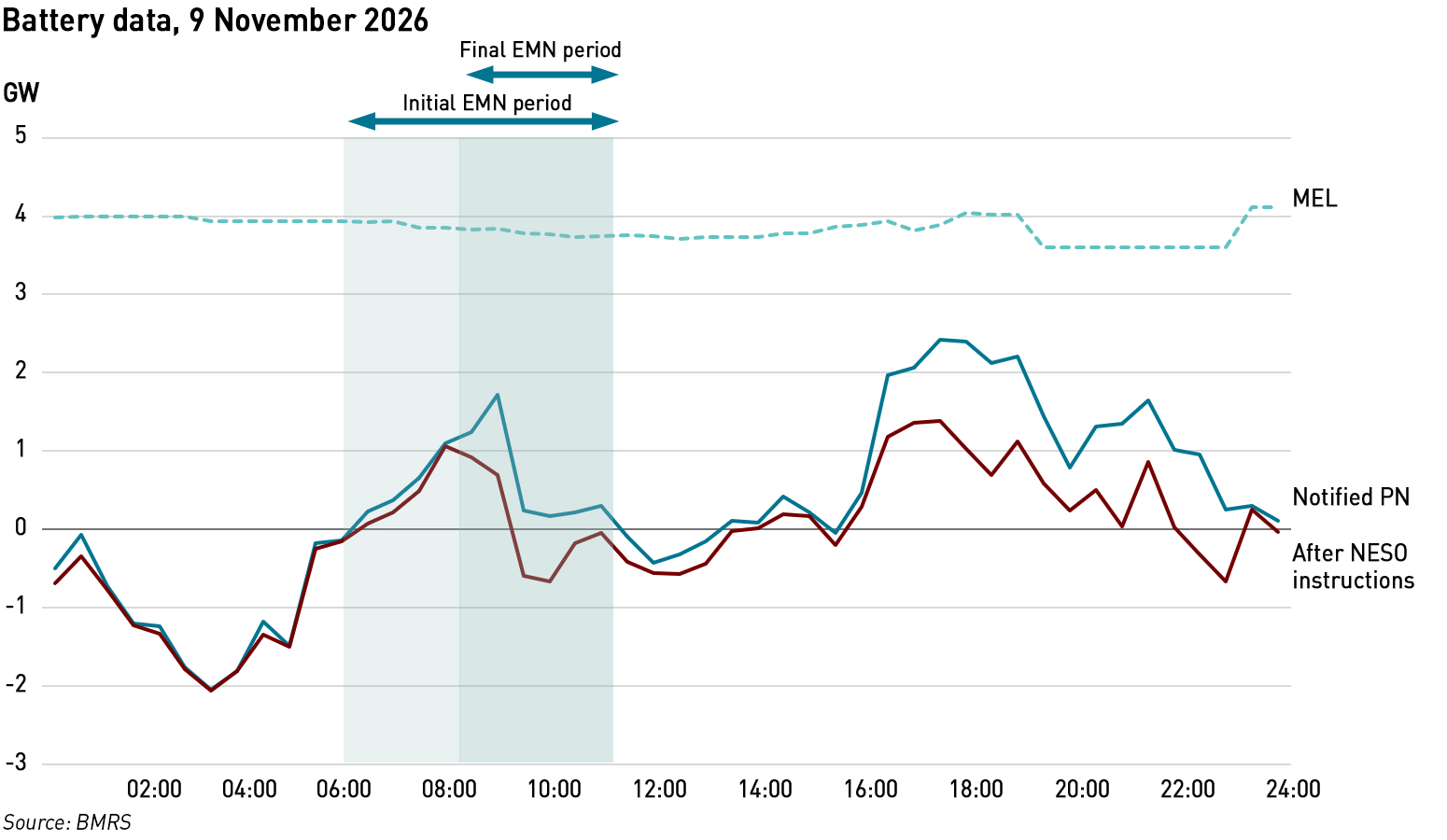
The fleet went into Monday morning well charged, having imported about 6.6 GWh overnight. When the EMN window opened at 6 am, batteries were notified to discharge, reaching 1.7 GW at 8.30 am. From 9 am, however, notified output collapsed to around 200 MW, and roughly three-quarters of the units were scheduled at zero for the remainder of the warning period. Throughout this time, the fleet continued to declare close to 3.8 GW of available export capacity. Rather than calling on that capacity, NESO’s instructions turned the fleet into a net importer between 9 am and 11 am, charging about 740 MWh during a period that was still nominally subject to an EMN.
The evening looked very different – between 4 pm and 7 pm, batteries were notified to discharge at 2.0 – 2.4 GW, with up to 87 units exporting. This was also when the market was tightest: the system price reached £755 /MWh at 4.30 pm, compared with around £310 – 340 /MWh during the morning warning period. This pattern is consistent with commercial scheduling. Operators held their energy for the evening, when prices were highest, which is exactly what they should be expected to do. The question is how that scheduling was reflected in NESO’s view of the system.
The declared export capacity of the fleet was almost the same in the morning as in the evening (about 3.80 GW against 3.95 GW). Most of the units that discharged in the evening had also been notified to export in the morning. Only 18 units exported in the evening having notified nothing between 8 am and 11 am, and they account for about 0.7 GWh of the 6.7 GWh notified for the evening peak. The fleet also recharged during the middle of the day, so the batteries were not facing a straight choice between the morning and the evening. In other words, the capacity that made the evening look comfortable was, for the most part, not unique to the evening. It was largely the same capacity, physically available in the morning, but scheduled for later in the day.
If margin calculations take battery schedules at face value, the evening would look better supplied than it really was, and the morning worse. This was a period when every available megawatt counted. On those assumptions, the shortfall would appear in the morning, and the capacity available in the evening would be counted as though it could not also have helped in the morning.
There’s a further complication – battery schedules are not a reliable guide to physical output. Across the day, the fleet’s Physical Notifications add up to a net export of about 8.2 GWh, which is not necessarily consistent with the energy limitations of the fleet. Once NESO’s instructions are included, the fleet was a net importer of about 2.3 GWh, which is consistent with charging and losses. The difference arises largely because NESO bought back notified battery output: about 3.2 GWh during the evening peak and a further 3.8 GWh later in the evening, in Scotland and in England and Wales alike. These buybacks were mostly priced at £150 – 225 /MWh, well below market prices above £400 /MWh. Any assessment that treated the evening schedules as firm capacity would have overstated how much battery output the evening peak could rely on.
The public data have limits. The state of charge of individual batteries is not published, and some units with zero scheduled output may have been holding capacity in reserve to provide frequency response or other contracted services. Even so, the data suggests that the batteries could have contributed far more in the morning than their schedules implied, and less in the evening.
NESO knows it has a battery modelling problem
The difficulty of modelling limited-duration assets is not a new discovery, and indeed, NESO has proposed a modification to the Grid Code (modification GC0166) specifically to address shortcomings in the information available to NESO about batteries and other storage assets. The changes introduce two new parameters: Maximum Delivery Offer (“MDO”) and Maximum Delivery Bid (“MDB”) to give clearer information on how much energy storage assets can deliver over time. The intended benefits of these changes are:
- Better visibility of available energy, giving NESO better understanding of the capabilities of limited duration assets
- More accurate scheduling decisions, supporting efficient system balancing and planning
- Improved use of flexible technologies including storage
- Greater system efficiency and value for consumers
Historically, NESO received information about the maximum power a battery could import or export, but had little information about how much energy it could deliver over time. GC0166 corrects this by introducing the new parameters. The modification was approved by Ofgem in October 2025, with an operational implementation deadline of 5 November 2026 – just four days before Monday’s EMN. NESO announced that the changes had gone live in its control room in June 2026, but this involved just five units. By the implementation deadline, 184 of 196 operational battery Balancing Mechanism units were submitting the new parameters, representing 7.7 GW of 8.5 GW of registered capacity, according to Modo Energy.
However, collecting data and using data effectively are two very different things. The critical question is whether NESO’s operational systems can incorporate these energy limits into forward margin assessments, allowing the control room to understand when batteries are physically available, how long they can operate and whether they can be recharged between periods of tight supply. Receiving MWh data does not mean that the systems used to calculate EMNs can optimise battery operation across the day.
Are batteries being underused in the Balancing Mechanism?
The problems extend beyond margin forecasting. Battery operators can trade electricity commercially and participate in the Balancing Mechanism, where NESO can instruct them to increase or reduce output. In principle, batteries should be particularly valuable to NESO. They respond quickly, can deliver precisely controlled quantities of power and can often provide short-duration balancing services more cheaply than conventional generators.
Yet there’s growing evidence that NESO is failing to make full use of them. Modo Energy reported this week that NESO accepted only 7% of in-merit battery offer volume in October 2026, compared with 15% a year earlier. It also found that for every MWh of battery offers priced below gas that NESO accepted, another 11 MWh of such offers went unused.
Not every apparently cheaper battery offer is necessarily a feasible substitute for a gas generator. Location, duration, state of charge, network constraints and other operational requirements all matter. Nevertheless, these figures suggest a substantial gap between the growing technical capability of the battery fleet and NESO’s ability to use it efficiently.
This raises an uncomfortable question about Monday – if batteries were physically capable of helping to cover the morning shortfall, why was NESO relying on their commercial schedules rather than using the Balancing Mechanism to obtain additional output where it was needed? And if batteries could have recharged during the day, why could they not have been used to support both peaks?
The answer may be that the control room’s systems cannot yet evaluate these options adequately. But that’s a problem, not an excuse. NESO frequently refers to the optimisation capabilities of its new Open Balancing Platform, but its own technical documents reveal significant limitations. In June 2026, NESO confirmed that legacy systems and manual processes were still being used to maintain operating margins, while its operational battery optimisation functions did not incorporate margins and reserves. More sophisticated national dispatch and longer-term battery scheduling capabilities were still being developed or tested.
Even the existing optimisation functions operate against requirements specified by control-room engineers, rather than independently determining what the electricity system needs. NESO’s public documents therefore describe a mixture of automated calculations, decision-support tools and manual interventions, rather than a fully integrated system capable of optimising battery operation throughout the day.
This distinction matters because the ability to send instructions to batteries quickly is not the same as being able to determine when they should charge and discharge to maintain electricity security at the lowest cost. Monday’s apparently misplaced EMN raises questions about whether NESO’s control-room technology can perform that more important task.
The cost of building flexibility that cannot be used
Britain is investing huge amounts in renewables and the infrastructure needed to support them. Wind and solar are intermittent so the system needs enough flexibility to manage periods when their output is low. Batteries are routinely presented as an important part of the solution, but it’s not enough to build battery capacity – that capacity has to be used effectively.
If NESO can’t adequately model batteries, it risks issuing misleading margin warnings, overlooking available flexibility and buying more expensive balancing services than necessary. It might also fail to recognise when batteries could be discharged and recharged between successive demand peaks. The consequences are not just financial – as conventional power stations retire and Britain becomes more dependent on weather-driven generation, correctly assessing the availability of storage will be an increasingly important element of electricity security.
A battery fleet can’t replace firm generation during extended periods of low wind because its energy capacity is finite, and recharging requires electricity from somewhere. That makes effective management of the available storage even more important, as well as optimisation of charging and discharging on days when margins are tight.
Monday’s EMN raises a fundamental question about whether NESO’s operational systems are keeping pace with the changing electricity system – if batteries helped make the evening look more comfortable than the morning because operators had scheduled their output for the evening, then the warning system might have been responding to commercial intentions rather than properly assessing physical capability.
And if this resulted in NESO issuing an EMN for the wrong period, potentially limiting its options for obtaining additional imports when they were most needed, the implications are even more serious.
.
On 9 November NESO issued an EMN for the morning that makes little sense when the tighter margins in the evening are considered where no EMN was issued. Inspection of battery data might provide some clues as to the reason – if NESO assumed there was more battery capacity available in the evening it might explain why it believed the evening was better supplied than the morning. But this assumption was not supported by real market data – there was broadly the same actual capacity available during both the morning and evening peaks.
We know that NESO has been trying to address battery modelling deficiencies, but there seems to be some way to go before it will be able to properly reflect their capabilities in their market models. Even something that should be relatively simple such as including batteries in the generation by fuel data is yet to be implemented, so it would not be a surprise if NESO was also unable to properly model batteries for margin purposes.
In any case, it really needs to review the EMN positions it took on Monday because by all objective measures in publicly available data, the morning was less tight than the evening, and this should have been correctly reflected in the warnings it issued. And if NESO has material information that justifies a different assessment from that suggested by publicly available data, it should explain the discrepancy and make sufficient additional information available for market participants to understand its decisions.



The jargon of electricity markets makes my head hurt. It is very different from engineering jargon about equipment, because it involves predictions of financially markets that can be manipulated by people to make lots of money, without considering the risk of the grid going dark. “What happened? Not our fault. We just sell contracts and don’t have to honor them because we have get out of jail free clauses to protect us because we are precious.”
There do not seem to be any responsible adults in charge of managing the UK grid.