

On Friday 6 November, Britain’s electricity system operator spent consumers’ money like a gold digger who just got her hands on a billionaire’s Amex, paying very high prices for additional electricity imports, with interconnector auctions recording clearing prices above £2,500 /MWh. NESO also accepted offers in the Balancing Mechanism at prices approaching £1,000 /MWh.
So why was NESO buying so much expensive electricity when there was apparently plenty of domestic generating capacity available?
Extended low wind period
Friday was forecast to be a low-wind day, and the first day of a forecast four-day wind lull ending on Monday evening. Wind is expected to fall as low as 500 MW during this period, against an installed base of around 34 GW. Electricity demand was expected to be broadly consistent with seasonal norms, peaking at around 41 GW (Fridays have lower demand than other weekdays).
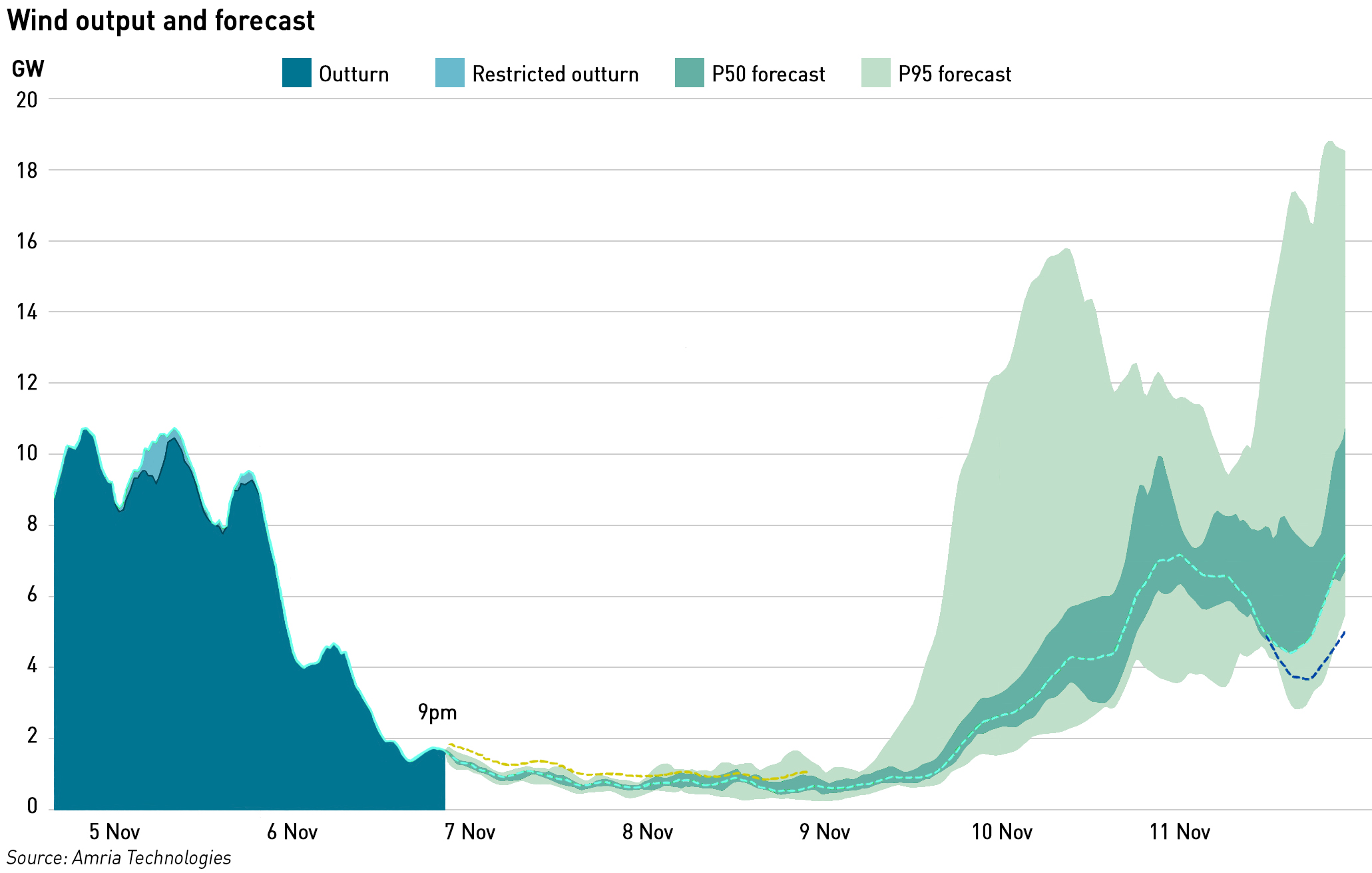
The wholesale electricity market had priced in these conditions with day-ahead prices reflecting the expected combination of demand and low renewable generation. Conventional generators and interconnector operators scheduled their positions accordingly with interconnectors nominated to import substantial volumes of electricity during the morning, reaching around 5.5 GW at 12:30pm. However, day-ahead import nominations declined from then on, dropping to 2.7 GW at 4pm rising to 3.8 GW at 8pm and then falling again later into the evening. Imports for 6pm – the expected peak – were nominated to be 3.0 GW.
However, as Friday progressed, NESO started buying. It made significant purchases on the interconnectors, buying substantial additional volumes of electricity through interconnector auctions. According to NESO’s published auction data, some of the prices were far above the Day-Ahead prices, paying up to £2,541.84 /MWh.
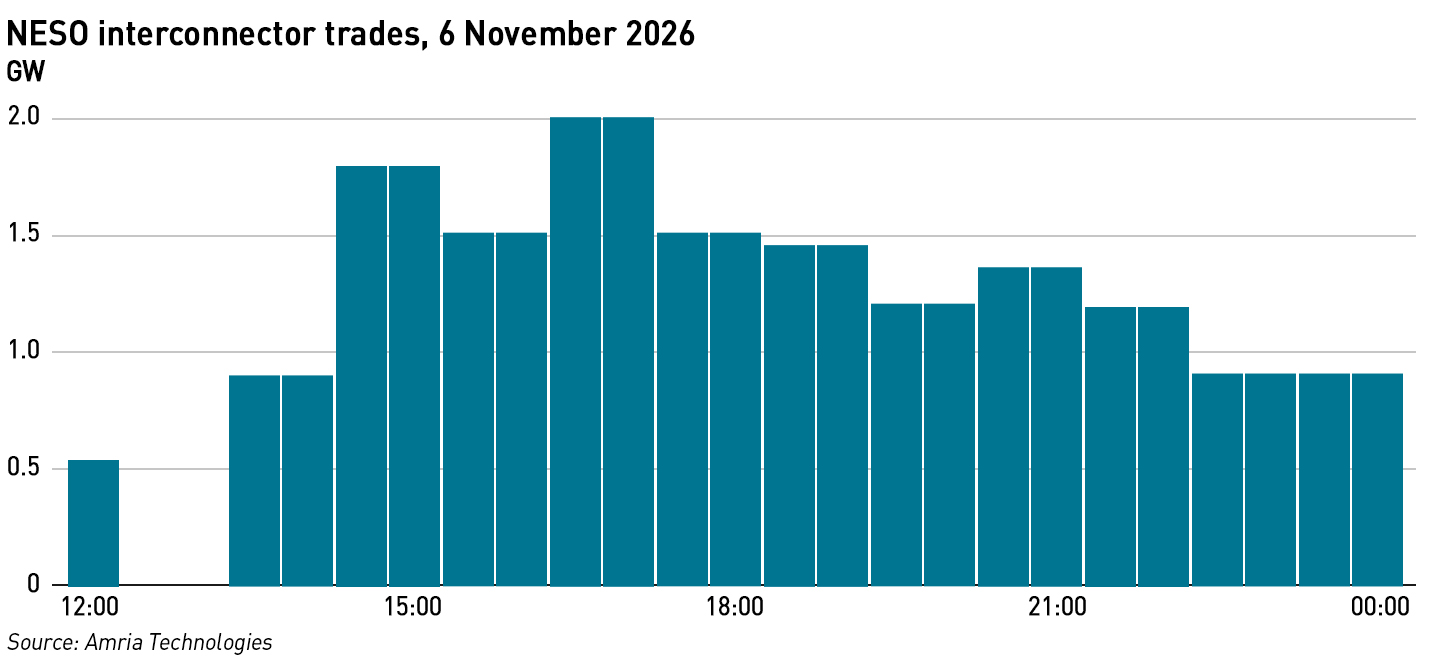
These were commercial interconnector trades, not system-operator-to-system-operator trades – NESO bought from market counterparties through established interconnector trading arrangements.
At the same time, NESO was also accepting expensive offers in the domestic Balancing Mechanism, with prices approaching £1,000 /MWh. From just after midday until 9:35pm, NESO began accepting high prices for CCGTs in the Balancing Mechanism, including Seabank, Rye House, Connah’s Quay, Cottam and Rocksavage. Several of these trades were done at £998 /MWh.
In other words, NESO was paying substantial premiums to secure additional electricity both from overseas and from generators already participating in the British market.
Was there actually a shortage?
The wholesale market had scheduled generation and imports to meet expected demand, and there was significant additional domestic generating capacity available through the Balancing Mechanism, including gas-fired power stations that had not been scheduled to run at full output. This raises an obvious question: if capacity was available, why hadn’t more of it self-dispatched through the wholesale market?
The likely explanation is that generators scheduled themselves against expected market prices and were not expecting NESO to need so much more electricity than the market had already arranged. Sometimes these behaviours reflect the impact of constraints for example on high wind days the Day-Ahead price is low, meaning CCGTs don’t self-dispatch and interconnectors can be traded for export, only for the situation to be reversed once NESO curtails wind that is constrained during the delivery day (NESO should curtail constrained wind before the Day Ahead auctions so that the market trades based on physically deliverable wind and not some theoretical volume that cannot be delivered in practice).
These constraint issues can be particularly relevant in the south-east where most of the interconnectors to Europe land – if they have been nominated to export against large amounts of undeliverable Scottish wind production, not only does NESO need to replace constrained wind with gas, it often has to reverse the exports if the gas generation can’t be transmitted into the south-east in order to satisfy those exports. This autumn significant volumes of gas generation in the south-east has been offline for maintenance, exacerbating this problem.
However, the geographical spread of the power stations receiving the highest prices in the BM on 6 November does not support the idea that these actions were primarily driven by grid constraints in the south-east (with the Scottish constraints being less relevant on a low wind day). The expensive offers came from power stations across England and Wales, rather than being concentrated in the areas where additional generation would relieve those constraints.
There’s another interesting feature of Friday’s balancing activity – despite NESO buying substantial additional electricity through the interconnectors and accepting expensive upward offers in the BM, the system’s Net Imbalance Volume (“NIV”) was mainly negative during the afternoon. NESO was taking more downward than upward balancing actions overall which suggests the expensive purchases weren’t just a response to an immediate shortage of electricity.
The balancing activity in settlement period 35 (5:00 – 5:30pm) is particularly interesting. NESO paid almost £486,000 to just four CCGTs (Seabank, Connah’s Quay, Rocksavage and Rye House) for around 491 MWh of additional generation, at prices between £978 and £998/MWh – the highest BM prices of the day. At the same time, it was accepting downward bids from numerous other units, particularly batteries, but also from another CCGT, VPI Immingham, which paid NESO around £24,000 to reduce its output.
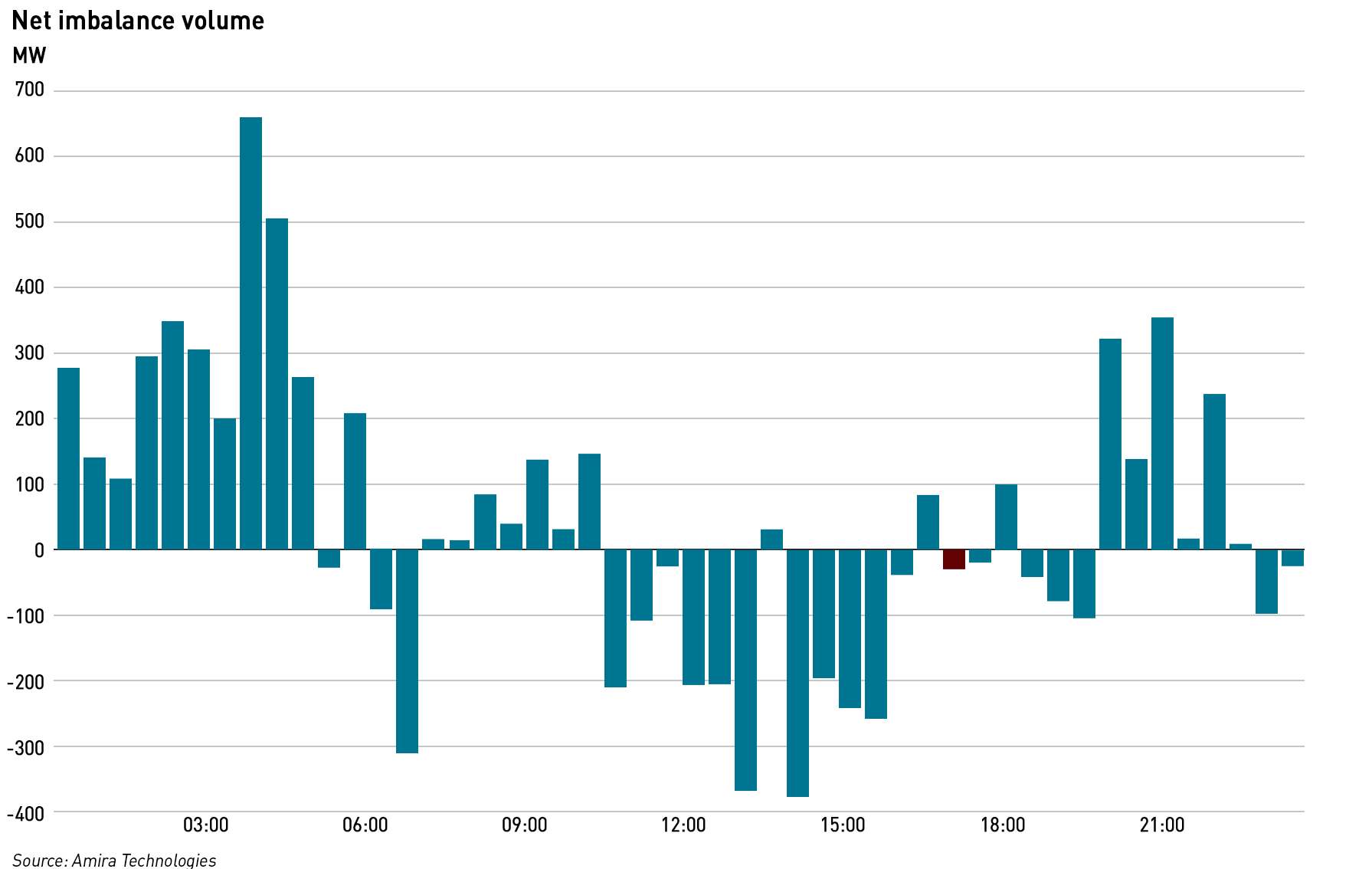
Downward bids from Immingham and four groups of batteries alone generated almost £125,000 in offsetting cashflows, with further receipts from other units. Yet the Net Imbalance Volume was just −26.74 MWh, equivalent to a net downward balancing volume averaging about 53 MW over the half-hour. NESO executed significant and expensive two-way balancing activity despite the net imbalance volume being very small relative to the gross balancing activity, while at the same time buying 2 GW of additional imports over the interconnectors.
This raises obvious questions about what operational requirements justified these interventions, and whether they could have been met more cheaply.
Was NESO worried about forecast errors?
One possible explanation is that NESO has become concerned about the accuracy of its forecasts and was trying to build margin against them. Recent days have seen significant discrepancies between forecast and actual wind generation and electricity demand. For example on Thursday 5 November, the combined demand and wind forecast error at one point reached around 2,600 MW. Luckily on that occasion both errors were in NESO’s favour: demand was lower and wind generation higher than forecast but it could easily have gone the other way.
For context, the largest-loss NESO must cover in respect of the largest infeed loss is currently 1,400 MW. If NESO is buying reserve sized to the largest loss, a forecast error that is larger than this could easily erode the reserve without any loss occurring. On a day with low wind output a large demand forecast error could present real problems. As I have described before, these errors can be almost 6 GW on a Day-Ahead, half hourly average basis.
However, today’s trades on the interconnectors and the BM were delivered, not reserve. Additional electricity from these trades was actually delivered to the market.
This is an important difference – buying reserve capacity provides insurance against a potential future shortfall, whereas accepting Balancing Mechanism offers and buying electricity through interconnector auctions changes the amount of electricity actually being delivered. Since system frequency remained broadly stable throughout the day, (there were brief excursions both above and below the operational limits, but they were minimal) the additional purchases must have been accommodated within the overall supply-demand balance.
One possibility is that NESO was deliberately changing the generation mix to improve operational flexibility – bringing additional CCGTs online, or increasing their output, could provide more sustained generation and potentially more upward reserve, while reducing output elsewhere would prevent the system becoming over-supplied. That could explain the simultaneous upward and downward balancing actions, although increasing a CCGT’s output does not automatically increase its remaining upward headroom.
The operating data for the CCGTs receiving the highest Balancing Mechanism prices in SP35 provides a possible explanation. NESO appears to have been positioning several gas-fired power stations at or near their Stable Export Limits (“SELs”), rather than running them at maximum output. This leaves the capacity between SEL and the Maximum Export Limit (“MEL”) available to increase generation quickly if required – CCGTs can move from SEL to MEL in around 15 minutes.
Across Seabank, Connah’s Quay, Rocksavage and Rye House, this amounted to potentially more than 1 GW of upward flexibility. In other words, NESO may have been paying extraordinary prices not simply for the electricity these power stations were generating, but to ensure they were running and capable of providing additional output if forecasts deteriorated. The electricity was delivered, but the real objective may have been to create additional operating reserve.
At the same time, NESO was turning down batteries, preserving their charge for later use if needed. This complemented the CCGT actions: bringing gas-fired generators online created additional upward flexibility, while reducing battery discharge preserved short-duration flexibility. Together, these actions suggest NESO might have been deliberately increasing the system’s ability to respond to an unexpected shortfall, rather than simply buying electricity to meet immediate demand.
This doesn’t explain the interconnector purchases which were both large and expensive (although the prices in SP35 were lower, they were still over £500 /MWh). NESO was paying substantial premia for additional imported electricity that was actually delivered, rather than simply securing the option to import if conditions deteriorated. The fact that NIV was generally negative during the afternoon makes this particularly interesting.
It’s possible NESO was so concerned about a large demand forecast error during a period of low wind that it took an unusually conservative approach, buying additional electricity and adjusting domestic generation to maintain a greater margin of security. But the publicly available data don’t confirm one way or the other if this was the reason for its actions.
The question is whether NESO was responding to an operational requirement that wasn’t visible to the wholesale market, or whether it was paying huge premia to protect against forecasting uncertainty. Either way, consumers deserve an explanation of why so much expensive intervention was necessary when significant domestic generating capacity was available and the system’s net imbalance was often small or negative.


Again, difficult for a non-expert to comment on the detail, but for me it raises some questions.
1. Does NESO have the knowledge and expertise to manage the grid both to prevent power cuts and minimise cost?
2. Is there data on how accurate weather forecasts are? As a layman, adjusting the input on my Nightstor 100 thermal storage boiler, I find it almost a pointless excercise. It is just easier to store more heat than I will ever need rather than adjusting the input based on weather predictions.
3. Are heat pumps yet having a noticeable impact on the daily demand curve for electricity use? I assume at some point in the future this will happen.
4. What happens when demand accross Europe exceeds supply? Do individual countries hunker down and prevent exports?
5. Are there people or groups of people making massive fortunes from electricity trading? I assume that so called AI could do a lot of the planning and that in an idealised world we could just leave the bartering up to machines.
6. Has hydrogen storage for providing, in effect, a replacement for gas made any headway? It does seem well suited to the UK.
Maybe these questions are either irrelevant or unanswerable, but they do cause me probably more concern that they should.
Wouldn’t it be better for NESO to have invested in a number of “small” gas generators of its own adjacent to known grid supply-demand problem locations that it can turn on and off by itself when required? It would need a pre-arranged variable gas supply agreement.
NESO is not allowed to do that. Unbundling requires separation of network ownership /operation and generation
The problem these days is not lack of generation in the UK, but limits on the transmission network getting that generation to where it’s supplied, particularly on the B7, B6 and LE1 London routes. Hence sometimes generation in the north had to wind down because there isn’t the ability to transmit it south, whereas imports from Europe can be transmitted directly to the south without the grid bottlenecks. There are lots of capacity upgrades ongoing to rectify this, but many of the new and upgraded circuits won’t be online until around 2030.
Sir even if you could snap your fingers and have all the transmission needed today, here now. The cost to consumer would be exactly as it is today. The auction market pay-as-cleared structure guarantees that. Cfd charge will just turn into an energy charge and as electrification increases, the market structure guarantees that the per Kw-hr the consumer pays will go up.
Getting to the Truth as to whether or not NESO really know what they are doing and just how serious the ramifications are for failure to maintain a steady grid is an uphill battle. It is obvious that the obfuscation and misinformation that NESO so readily uses are well rehearsed and fully backed up by the Government, Whitehall and Civil Servants- the staff are cowed into submission regardless of the alleged “protections” offered by weak “Whistleblower” protections- potential whistleblowers know that their futures are finished should they tell the truth- sidelined, overlooked, demoted and blackmail-marked to future employers who may want Government contracts- silence is the only possible solution. Meanwhile the UK is heading for a serious power shortage and grid shutdown………and we are told to hold three days of food!.
Electrical power drives everything that modern life expects to be available- water, sewage, light, heat, refrigeration to name just a few- Power is Everything and without it anarchy will take over.
Ever since May pushed the madness thru a less than quarter full Parliament, with no meaningful scrutiny the disaster that awaits us has been looming, the debt is over due and when the day of reckoning arrives, which could be as soon as within the next six months, absolutely no politician, Civil Servants, member of the CCC or Eco Zealot will have a meaningful answer.
Wind and Solar despite being intermittent have a role to play, gas, oil and nuclear have a critical role to play as baseload providers, hydro, tidal have their role- combined they give security of supply- foolishness is to just state that on a sunny day we had a high contribution to the grid from solar…….a year last 365/366 days, the UK sunny days peak at around 100 and decline very quickly, ditto wind, we need a system that understands the role that using every possible source of energy is the minimum requirement and that Solar and Wind cannot do it alone.
NESO is going to bring the Country to a standstill unless someone who is not a political appointee is not only running it but is also the Minister for Energy Security.
I guess NESO is paying with somebidy else’s money, and paying well over the odds to prevent blackouts is worth it…
They had only 100MW of PBR less than 50MW of PQR and virtually no PSR but looks like they didn’t secure volumes requested in the auction.
Another brilliant and pertinent analysis, which given previous issues this year, points to the fragility of the UK grid system. Given that the Balancing market is set to increase by more than a factor of 2 in years ahead ( Fintan Sly evidence to parliament) this increase in grid costs is only going to get worse.
Are there any incentives to pay large sums via kickbacks or corruption?
The entire pay-as-cleared with increased and multiple bid frequencies and reduced durations are pure giveaways to the wind/solar industries. Removes most of the value in being reliably dispatchable. Places the burden on NESO and the market instead of on the generators.
If the low wind conditions are directly related to the SSW event and reversal of the polar vortex – which most commentary seems to suggest it is ….then surely, NESO must have been prepared for this well in advance?
After all, we’ve all been buying torches, baked beans and wind up radios for the govt forecasted Armageddon event but when it actually happens, NESO seem unprepared.
Is this yet another example of their failure in office? Is politicisation still in control ???
I am just learning the answer to that myself. Apparently, the answers is that these are recent changes and in my view largely unpublicized. Appears they have a day advance to make these decisions. Apparently, prior to the insertion of intermittents in the grid they had weeks to make decisions as all generation was dispatchable over weeks/months whereas as the wind/solar has difficulty meeting anything more than 24hrs and even that is a challenge at times:
1. PQR (Positive Quick Reserve) & NQR
The daily auction framework for Quick Reserve rolled out in late 2024. Assets must respond and deliver full requirements within one minute of an instruction from NESO
• Auction Timeline: Procured on a Day-Ahead (D-1) basis.
• Delivery Windows: Procured in EFA blocks (6 blocks of 4 hours each)
2. PSR (Positive Slow Reserve) & NSR
Slow Reserve is designed to fully replace the legacy Short-Term Operating Reserve (STOR). Due to complex system rollouts, its official launch was shifted to early 2026. Requires units to respond within 15 minutes. However, they must be capable of sustaining delivery for a minimum of two hours.
• Auction Timeline: Aligned exactly to the Quick Reserve structure to allow co-optimization.
3. PBR (Positive Balancing Reserve)
Balancing Reserve represents a massive shift in how the NESO control room secures “headroom” to manage broader, system-wide volume imbalances.
• Auction Timeline: Procured Day-Ahead (D-1), but inside an earlier window than the response services.
Stability of the grid with ageing infrastructure and the reserve energy capacity will always be a problem. The UK needs to be self sufficient in its own energy capacity.
An up to date published plan is needed to start a serious replacement of much of the ageing plant.
The “so called modern cheap energy” from renewables is a self made modern instability problem.
Renewables require a stable back up supply due to their inherent natural variables which introduce grid instability problems.
It has never been a good idea to tie renewables to the grid in my opinion.
Renewables are more suited to rural applications in my opinion where there can be some leeway utilising some form of energy storage e.g. hydro schemes utilising pumped water storage.
Serious thinking and costing is needed in regards to renewable energy, it has potential but it will never replace the stable heavy machinery used in the old grid.
The so called Climate Crisis” will be governed by Mother Nature and not by politicians with a Net Zero Fantasy!
A planned nuclear energy program utilising multiple factory built SMR’s is urgently needed.
You may be right that NESO took fright because of interconnector outages and Dunkelflaute conditions: it is quite something to pay over £2,500/MWh.. BritNed was unavailable all day, and IFA1 is down to 500MW on top of the outage into December that will limit flow to 1GW. Coupled to ongoing maintenance at Damhead Creek, Grain, Marchwo9d etc. available supply in the SE was quite tight in high demand hours, so interconnector trades were needed to keep tte lights on in London. Rye House appears to have cancelled work on one turbine to provide more output.
Ireland has several CCGT plants under maintenance, including Whitegate, Dublin and Coolkeeragh, which has led to the Irish importing almost 1.4GW as baseload. Supply has come from Pembroke, Connah’s Quay and other NW CCGT, and probably via imports over Western Link HVDC, since Scotland had little wind and even with Peterhead CCGT and Torness nuclear would have needed 2GW+ of imports.
Prices were generally high across the Europe wide Dunkelflaute area, once again exposing the dangers of relying on interconnector. Following the shenanigans in the summer you have to wonder whether some of the unavailability isn’t political payback rather than operational necessity.
I am old enough to remember January 1963 following the post Christmas snow fall. Have checked online to find out how long the high pressure dominated the UK weather – until at least March 4th depending on what part of UK – for some it was longer. So for at least 2 months there would have been next to no wind and so cold that the snow froze where it was and stayed there for a very long time. Apparently we won’t need gas in the future………..ha flipping ha – ignorance of the highest magnitude.
That was my understanding of the article. It seems that they called up CCGTs to run at level that could be increased if needed, leaving batteries for a possible short term spike. Expensive, but it keeps the lights on if the weather doesn’t play ball.
I have some sympathy for NESO: trying to schedule the duration of our home battery’s overnight charge in anticipation of the next day’s solar PV input and our consumption is hard enough, and I only have those two variables play with. It is easy to see the next day what the optimum strategy would have been but doing this the night before, even with a range of solar forecasts, is difficult in late autumn and early spring.
There is an interesting description at https://dispatches.kilowatts.io/p/britain-paid-a-gas-plant-1m-not-to which describes the experience of one CCGT that day (I believe, it carefully doesn’t say where or when), together with a plausible explanation of why CCGT plant owners adopt this “threaten to turn off, get paid to continue to run” strategy.
Thanks to Net Zero policies, NESO only calls on CCGT plant after exhausting every other available source. CCGT plant owners have to cover a year’s worth of overheads from the revenue they obtain from the equivalent of 6 days’ worth of generating.
Exactly! Why do people have such a problem understanding this. Is it because they have been sold the cost of fuel is the only thing a generator pays for?
Two (linked) reasons:
1. A person of average intelligence is dumber than a box of frogs, and
2. Half the population is, by definition, below average intelligence.
You could make NESO and the grid into a “reality” show and a few more people might grasp the basics.
All the usual rubbish that comes with non economic support. God help us this winter
These types of seemingly illogical actions indicate management and operations are on very different wavelengths. I’m confident there are highly skilled people at NESO but they are more than likely chasing constantly changing direction from management and the politicians pulling their strings. When optics become the primary driver and people who don’t understand the details are calling the shots on a nilly willy thrown together system, you get something like we got.
Hello, thank you for your various ‘Blogs,, I enjoy reading the good information you supply.
At this time we and the French are short of Wind, and only Gas is keeping us running so well.
If we had a Winter demand of another 10GW I think we would be scratching?
Friday & Saturday, 7th November 2026.
Why are we not investing in large scale Geothermal generation? If we had assigned all the investment in Solar and Wind to Geothermal instead (how many billions has it been?) then how much capacity would that have provided? Geothermal energy would be steady, stable and reliable and not disfigure our landscape nor harm wildlife. Why not invest entirely in Geothermal and not have all the pain and costs of Wind, Solar, Nuclear and even carbon fuels? Geothermal seems to me to be the answer we’re all looking for, unlimited smooth and regular generation without anxiety.
The US has significantly more geothermal resources than the UK. Yet, after several projects in 80’s and early 90’s, there have been no such projects in US in almost three decades for a reason. They are generally uneconomic. They are limited in output and difficult to keep online.
Time all this Nut Zero madness was stopped.
By all means use wind and solar to help, but we need a big increase in base load provision from steady reliable sources, i.e. small nuclear reactors, and some contracts with gas powered plants that can run at SEL for most of the day over winter, so providing a large guaranteed supply at a sensible negotiated rate. Obviously I don’t buy into all this CO2 is killing the planet crap, it is in fact greening it, crop yields are increasing.
Any requirements above that this level should be filled using negotiated interconnectors with wind and solar being purchased on the basis of cheapest first, leaving battery and hydro to keep the system steady.
Constraint payments and guarantees should not be paid, if a company wants enter the market and supply wind or solar power they have to carry the risk that their output is too expensive and they cannot sell it, or they have too much and again no market for their output, the tax payer / consumers should not have to carry the risk.
The alternative is all solar and wind suppliers have to guaranteed a minimum supply level for each month of the year and if they cannot meet it they should have contracts with backup suppliers to cover any shortfall, with the price to the Grid being based on whatever price the guaranteed supply is negotiated at.
The current system is simply gambling with our money.
The risk is always carried by the consumer.
Let me get this right – NESO were choosing to or having to buy electricity at £2,500/MW/Hr when the average price this year has been £109/MW/Hr – that’s sheer incompetence either way. They may not care as it’s our money not theirs, but they should be held publicly accountable and made to explain.
Right now – 9.15pm 8th November 2026 – wind and solar generating facilities are providing 0.65GW, this from a combined installed capacity of 59.03GW (solar 24.82Gw and wind 34.21GW assuming 95% mechanical availability . . . being generous). And this means they’re operating at a Capacity Factor – efficiency – of . . . 1.1%.
Covering for this is gas and biomass – CO2 emitters (with biomass emitting more CO2 per kWh than coal, not forgetting that global forests are being reduced by about twice the area of Switzerland annually).
So there are two parallel systems required – gas and biomass must be kept on line to cover for the fantastically expensive intermittency and infrastructure of so-called renewables.
You’ve been saying this for years now, Kathryn, but surely a stark example such as this means that stupid people have to take notice and accountability of this utter lunacy.
Geothermal is used to heat the domes of The Eden Project in Cornwall, but possibly, few locations are suitable for this technology, despite it’s advantages…
Renewables certainly should pay to firm their output to the same level as any despatchable source, and should not be paid to produce power where it cannot be used…
What is actually needed, at some stage in the future, when fossil fuels begin to run out and price volatility is a everyday thing, is something to replace gas as it is used now. The UK has to look first to what it has in abundance – wind. The ideal scenario is to use that wind fed directly into the grid whenever possible, but to use excess wind to produce energy that can be stored long term. The choices generally depend on what resources each country has in terms of production, geographical storage capability and mineral resources. You can look at pumped hydro, flow batteries, hydrogen produced by electrolysis or any other system which can provide long term storage at a reasonable cost, at a capacity of around 20% of annual energy demand and which is instantly dispachable.
How to enable this is the problem we have now. There needs to be a competitive market in providing the long term storage.
As a thought experiment, I would propose that any new renewable developments must include a means of storing and supplying say 20% of energy produced as electricity to the grid. In the early days this would have to be funded, in part, by the government (us). Some large scaleable projects are required to test the waters.
Timescales are an issue. It just might be easier, cheaper and more practical to keep using fossil fuels as long as we can. The cost and infrastructure requirements for any long term storage will mean higher energy costs. If local supplies exist, free “stuff” from the ground will always be cheaper.
That doesnt mean that other storage technologies should not be investigated with the markets being the primary movers.
The risk though is always carried by the consumer
Ed,
Just looked at GridWatch at 17:45 on Monday 9th Nov.
Wind is contributing just 2%, obviously no solar.
That is the problem with renewables – completely unreliable, and the need for two sources to backup this type of situation doubles the cost of supply.
How many consumers voted to make themselves poor in pursuit of a dream. We need a source that is consistent, and available when required.
Thank you for that explanation. On the face of it, it seems that NESO were being over cautious about the forecast error and could afford to do this because it is not their money. A commercial enterprise would be less cautious if they had to justify their expenses to shareholders and this is what you appear to be asking for – better reporting to justify their decisions to the tax payers who pay the bills.
It would be different if there really had been a significant supply shortfall and the excess capacity had actually been needed. Then I am sure NESO would have been sending out press releases to show how clever they were.
It seems to me that in addition to the transparency, they really should look at better forecasting models. There is (or should be) plenty of data now on how the wind (and solar) production can vary such that sensible ranges can be applied and fed into their forecast. A transparent model with an announcement of the range which NESO is required to cover (95th percentile, 99th percentile?) would go a long way to providing confidence.
Of course, such a model could then be run with various levels of intermittent generation sources and very probably reveal the real costs of having so much wind and solar in the generation mix, so the cynic in me is not holding out much hope!