
Is NESO struggling to manage the grid this summer? In addition to multiple market warnings in the past couple of weeks, there was a significant low frequency event that went largely unreported although has been the subject of much discussion within the industry;.
Over the past week GB system operator NESO has issued two Electricity Margin Notices (“EMNs”), something that has never been done in summer before. These were issued on 24th and 26th June. On both days, and the following Monday (29th) NESO was required to seek permission from the EU to breach intraday interconnector trading limits in order to balance the grid.
These limits were imposed on 20 May and NESO to a maximum of 1,500 MW per settlement period across all interconnectors. This places a volume restriction on NESO’s ability to buy or sell interconnector capacity within day when the market trades are against the interests of system margins.
However, the bigger issue is what happened on 23 June, when no EMN was issued, but a prolonged low frequency period in the evening suggests that it should have.
Low frequency observed over the evening
Unfortunately, granular data are not published to the NESO Portal until after the month end (usually around a week after for frequency data) so I can only use the 15 second data from BMRS. These indicate that grid frequency was below the safe operational limit of 49.8 Hz multiple times between 18:30 and 20:30:
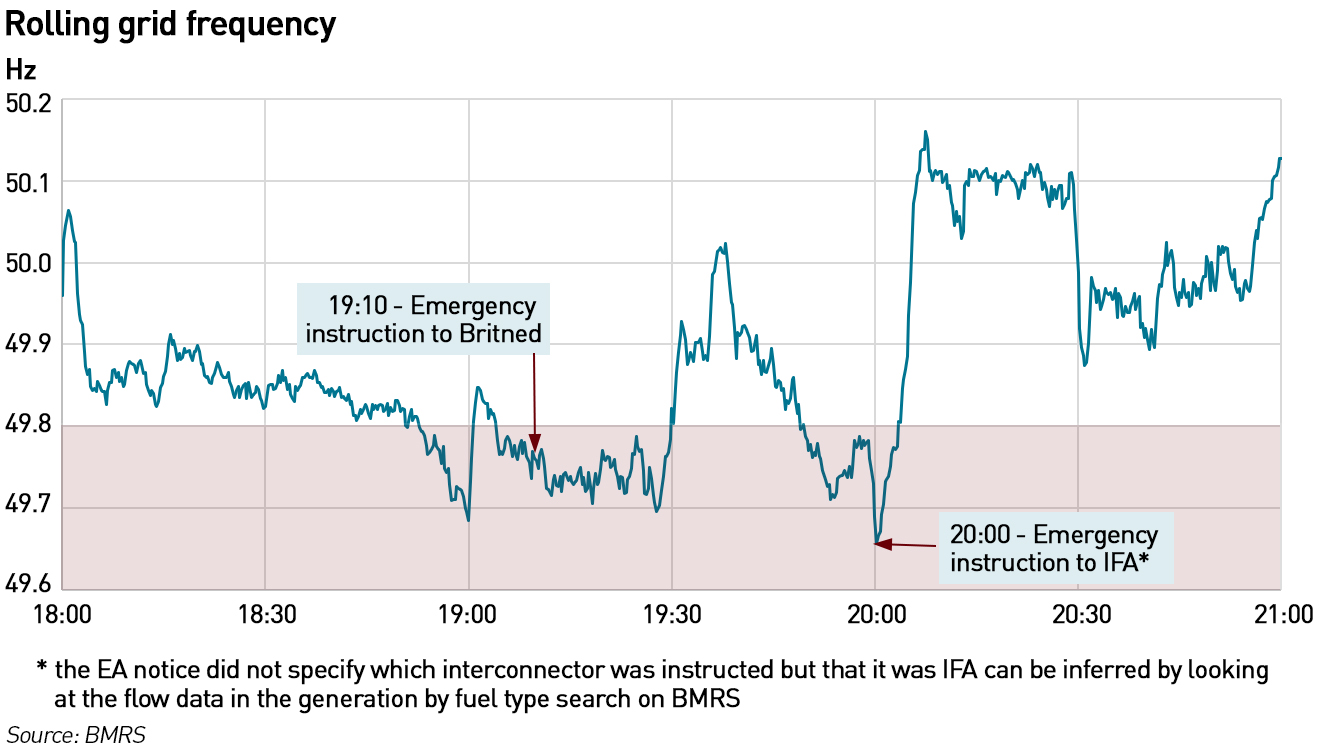
So what caused the frequency to fall so low and why was an EMN not issued for 23 June? Frequency falls when demand exceeds supply, so this period of low frequency indicates that demand was higher or generation lower than expected. Wind output was certainly low on 23 June, and solar generation falls dramatically through the early evening despite sunset not being until 9:35pm.
NESO is bad at forecasting demand
The key is likely to be found in the demand forecast, as this is a known weakness for NESO as I have previously described here and here. I have shown that between 1 November 2024 and 1 December 2025, the average error of the NESO forecast vs NESO version of INDO was 675 MW (679 MW vs BMRS INDO) and the maximum error was 4,931 MW (5,712 MW vs BMRS INDO).
For some reason some of the NESO outturn figures did not match the Initial Demand Outturn (“INDO”) value reported by BMRS. INDO takes into account transmission losses but does not include station transformer load, pumped storage demand or interconnector demand and is the metric NESO uses for demand forecasting.
These are really significant errors – the average demand per BMRS which ought to be the official record, was 26,422 MW, so the average error was 2.6% of demand and the maximum error was 12.5% of maximum demand.
When comparing the error in any given settlement period with the demand in that period, the errors are up to 22.7% of demand. These errors are very significant. An error of 5.7 GW is more than 4 times higher than the SQSS – the amount of reserves NESO is required to hold to protect against the loss of the largest infeed to the grid. This means that a forecast error of this size on a tight day would overwhelm the system. (A forecast error isn’t an SQSS event, but if there were such a large error on a tight day the reserves held against an SQSS event wouldn’t be enough to cover it meaning the system could be short even without the loss of a large infeed.)
The real problem could be even worse – NESO does not balance the grid in half-hourly intervals, it balances it from moment to moment. If the average error over 30-minutes is so large, the 5-minute or 1-minute error could be even larger, which poses a real threat to the grid.
“Unless its forecasting improves, NESO might just run out of luck one day, triggering a blackout. Plus, NESO should benchmark its forecasting performance against actual final outturn rather than INDO which is the initial outturn,”
– Watt-Logic: 2025: the year energy security threats began to manifest
So what did the forecast error look like on 23 June? The answer is not good. From 8am onwards, realised demand was higher than forecast demand and was over 1,500 MW late afternoon. The SQSS requires NESO to hold reserves against the single largest infeed which is 1,400 MW, so the actual demand forecast error on 23 June was larger than the amount of reserves NESO had in hand under its system security obligations.
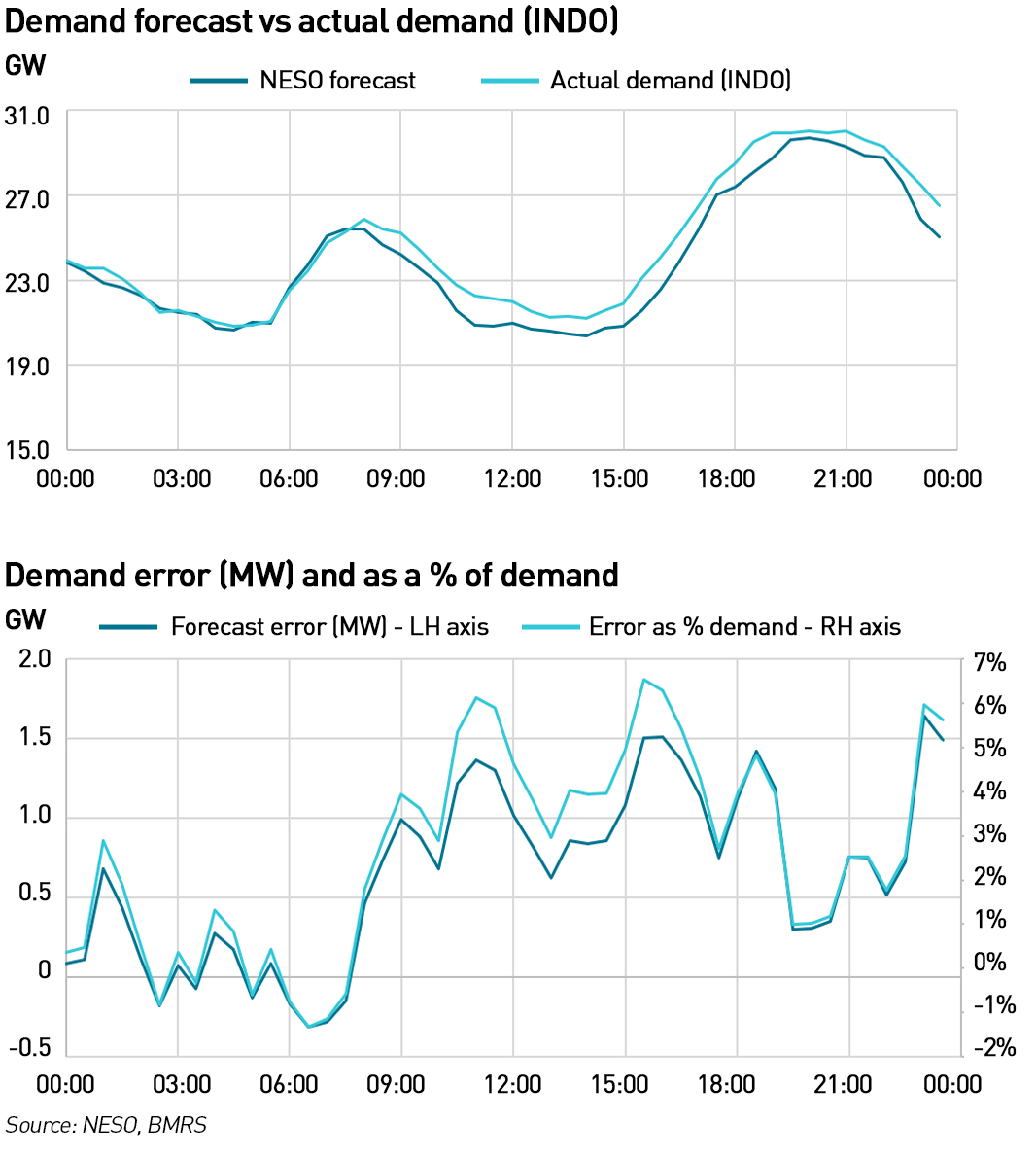
Although the error during the evening was smaller, these are average half hourly errors which could significantly under-state the moment-to-moment error. NESO balances the grid in real time, not simply across each half-hourly settlement period. These are also the Day-Ahead forecasts – NESO updates demand forecasts within day but does not publish these figures.
Stepping back, I took a look at the forecast errors since 1 April 2021 and 1 January 2026. The average error was 640 MW since 2021 and 800 MW this year, with the maximum error being 5.5 GW in each case. The maximum error as a percentage of demand was 27% in each case. The maximum error was on 29 March 2026, and the maximum percentage error occurred on 13 June 2026 which is why these figures are the same for each period.
In general, forecasting errors have increased over time, with average day-ahead forecast errors rising from around 600 MW in the early years of the dataset to 800 MW in the first half of 2026. This likely reflects the growing complexity of the electricity system as increasing volumes of embedded solar generation, battery storage, EV charging, demand-side flexibility and other inverter-based resources make net demand more difficult to predict accurately.
What tools does NESO have to support the grid?
NESO has a number of tools it can draw on – turning up generation in the Balancing Mechanism and buying additional imports via SO-SO trades (trades between system operators) being the main ones. Beyond that it can restrict exports using Emergency Assistance requests – these can be rejected by the connected country but ultimately NESO can simply turn off the flow at the outgoing substation without the consent of the other TSO – and after that the next step is demand control. The first levels of demand control are to lower voltage, and after that demand is disconnected.
Demand disconnection is more difficult when an EMN hasn’t been issued since typically under an EMN suppliers are asked to indicate expected demand at different grid supply points (points where the distribution networks connect to the transmission system). This enables NESO to evaluate which regions can be disconnected to protect the entire system – for example if the margin shortfall is projected at 3 GW, and suppliers indicate that expected demand is 4.0 GW in Scotland, 1.7 GW in Wales, 6.3 GW in Ireland, 4.5 GW in NW England, 3.2 GW in NE England, 2.1 GW in SW England, and 7.6 GW in SE England then the obvious step would be to disconnect NE England as this would restore a positive margin. Then if the shortage persists for longer than 4 hours, the emergency rules apply with rotating regional blackouts.
(This isn’t quite how it works – it’s more granular. DNOs will be instructed to turn off consumers from primary substations based on blocks (A = domestic, shops and offices, B = mixed residential, C = industrial /residential, D = residential). So disconnections are spread around the country rather than all happening in one region at the same time and will rotate around the blocks as necessary. But within each block connected to any substation, everyone is disconnected unless they have a dedicated feeder or are on an exempt circuit eg hospitals, airports, major telecoms sites, railway signalling and so on.)
Checking to see how much generation NESO instructed in the BM is a time-consuming task (as I’m still catching up on work I missed during my illness, I don’t have the time for that right now). However, I’m told by various industry sources that NESO had instructed all available generation and there was no spare slack in the system. I have submitted an FOI request to NESO to verify these claims and will update this blog with the response. If anyone else has the time to dig into the BM data for this period I’d be interested in the results.
NESO traded up to the 1,500 MW limit at the start of the evening, but did not request additional capacity. However it did curtail exports, initially by requesting Emergence Assistance on Britned to cut exports to the Netherlands, and then by making a similar request to cut exports on IFA to France as indicated in the chart above.
That the frequency continued to track below the safe operating limit despite these actions suggest that the system was not secure. I have also asked NESO in the FOI whether any thermal or stability grid constraints were violated, because it does not appear that any demand control actions were initiated.
The first steps in demand control are not to disconnect consumers, but to lower voltage. Most consumers don’t require exactly 230 V (the UK statutory supply voltage is 230 V +10%/-6% (216.2 – 253 V)) but in practice many customers receive around 240 – 245 V as a matter of course. This gives NESO room to reduce voltage while remaining within statutory limits. Lower voltage lowers demand but the impact depends on the equipment in use.
Power = (Voltage)2/Resistance
A 5% reduction in voltage will give roughly a 10% reduction in instantaneous power for resistive devices, but power may be needed for longer to compensate eg boiling a kettle will take longer at lower voltage. Constant power devices such as electronics and heat pumps will draw more current to compensate for a reduction in voltage, so the load remains broadly the same. With induction motors, some will run less hard so there is a load reduction while others will compensate by drawing more current.
NESO has historically assumed stage 1 demand control will cut demand by 3% and stage 2 will cut 6%. I have asked NESO to confirm whether these figures have been recently updated to reflect the increasing prevalence of constant power devices on the grid now compared with in the past.
NESO was eventually able to stabilise frequency by curtailing exports to the Netherlands and France. But the low frequency persisted for several hours on and off, so I’m curious to know if all of the grid constraints were met during this time. There are two broad types of network constraint that may have been relevant during the event: thermal constraints and stability constraints.
A thermal constraint arises where too much power is being pushed through a circuit, transformer or other item of equipment, creating a risk of overheating. In simple terms, even if there is generation available somewhere on the system, NESO may not be able to use it if doing so would overload part of the transmission network. This is why the location of generation matters: a MW in the wrong place can make a constraint worse rather than helping the system.
Stability constraints are not primarily about overheating equipment, but about whether the system would remain secure following a credible fault, such as the sudden loss of a generator, interconnector or transmission circuit. These constraints are designed to ensure the system can withstand faults without losing synchronism, suffering unacceptable voltage collapse, or splitting into islands.
If all available generation had already been instructed but frequency remained persistently low, it’s possible NESO was unable to instruct further generation without breaching thermal or stability limits. Another, more serious, possibility is that some constraints were already being exceeded and NESO chose to accept that risk rather than initiating demand control. I have submitted an FOI request asking NESO to confirm whether any thermal, voltage or stability constraints were breached during the incident, and if so why demand control was not used instead.
Is NESO failing to keep pace with an increasingly complex system?
The data indicate that NESO’s demand forecasts are getting less accurate with very large errors now evident – the average error this year so far is a huge 800 MW (57% of the SQSS) with the maximum error per the NESO version of INDO of 5.5 GW, just under 4 times the reserve NESO is required to hold in respect of the single largest infeed loss. I struggle to see how NESO can demonstrate it is operating the system securely on this basis and would encourage Ofgem to ask this question: can NESO evidence that it is operating the grid securely rather than simply being lucky that it hasn’t been caught out yet?
I get the feeling that in NESO’s view the absence of a blackout is “proof” the system is secure – this is not the case. Faulty wiring in your house are not “safe” simply because your house hasn’t burned down yet, nor is running out into traffic “safe” just because you don’t get run over every time you do it.
Over the course of a week we had two summer EMNs – never been seen before – and three instances of EU interconnector trading limits being breached. But most worrying is that the grid appears to have been unstable on 23 June and there were no warnings from NESO at all which suggests it simply didn’t see the problem coming. What’s also worrying is that NESO normalised export curtailment as a regular operational tool – after all, as no system warnings were issued, the 23 June was treated as a “normal” day, and so Emergence Assistance on interconnectors was added to the normal operational toolkit.
This came within a week of NESO publishing the Early Winter Outlook in which it confirmed a significant reliance on imports. Of course, export curtailment isn’t just something NESO can do – all the countries which export to us could do the same. And NESO just made cutting off previously agreed flows unexpectedly part of the normal operational toolkit, so perhaps we will see other system operators doing the same and restricting our access to imports even when their grids are not notionally under stress. This puts our winter system security at greater risk, undermining the winter margin NESO claims to have (of 5.5 GW, which is coincidentally the same as the maximum DA demand forecast error so far this year…).
I’d like to see an explanation from NESO about the events of 23 June:
- Why did the frequency keep falling below the safe operational limit?
- Why were exports to other countries abruptly cut without there being any systems warnings issued within GB, such as a High Risk of Demand Control notice?
- Why was cutting exports preferred to voltage reductions, particularly given GB’s high reliance on imports in the winter?
- Were any grid constraints violated?
However I’m not holding my breath – NESO’s attitude towards transparency leaves a lot to be desired. Nothing to see here…until there is.
Thanks Kathryn. I think NESO are also proposing widening the frequency tolerance band before they issue emergency notices? If so, I guess that must mean that they are confident that they have things under control?
I think it means the opposite. However I’m not sure that Ofgem will allow it – last year they asked to cut the minimum inertia holding and Ofgem has said no until various improvements are made
OFGEM did agree to lowering the minimum inertia on May 28th from 120GVAs to an initial 110GVAs for at least 10 weeks, with a review before a further step down to 102GVAs if the review sees no obstacles after NESO made further submissions in response to being refused permission in December.
It is notable that in mid May NESO outturn inertia data started to go missing almost every other day, and continued every other day throughout June: data updates have now been suspended with no reason given other than “review”.
Following the investigation into inertia we did last year which showed that NESO were apparently frequently breaching the inertia minimum mandate, NESO suddenly decided that “Outturn” doesn’t mean that (as records at Wayback confirm), because supposedly it excludes inertia provided under Pathfinder project contracts for synchronous condensers that report directly to the Control Room. As some inertia measurement is done by observing grid response to tiny injections of power they would need to actually subtract the Pathfinder inertia covered by such measurements to exclude it from their outturn number
https://watt-logic.com/2025/06/18/should-neso-be-allowed-to-lower-its-minimum-inertia-requirement/
The Reactive Technologies inertia measurement is discussed here
https://watt-logic.com/2021/11/05/measuring-grid-inertia/
I have subsequently checked back on the year from April 2025 and found 18 days where 120GVAs was breached with Pathfinders added (back) in to NESOs Outturn numbers. In the period starting this April they were initially scrupulous after they submitted their updated their submission, but since permission was granted for lower inertia the available data suggest they have driven a coach and four through what is meant to be a key element of the Security and Quality of Supply Standard (SQSS). Moreover, the Pathfinder data show frequent experiments with cutting provision during June.
This is an aspect that was skirted around during the Urgent Question in Parliament. Donald Lumsden, the new MP for Aberdeen South, asked whether inertia provision had been sufficient and was given a handwaving answer by Michael Shanks, the Miliband deputy. Although it appears inertia was sufficient on 23rd June itself (there was heavy dependence on CCGT) there are already 4 days with clear breaches of the interim 110GVAs standard with half the data missing, with levels as low as 91GVAs recorded including Pathfinders.
This needs serious investigation by OFGEM.
Thank you, Kathryn. I get the feeling that the first large scale blackout will set the Net Zero dominos tumbling in popular opinion.
NESO, EMN, BMRS, INDO, SQSS,TSO, DNO, BM and IFA. For those of us who are not “in the know” all these abbreviations are baffling and make reading the article difficult; I wonder how many give up. Far too many authors use far too many abbreviations that are not understood by people outside the particular specialist field. It is jargon and should be avoided when writing or speaking to the wider public. It is unreasonable for an author to expect readers to have to understand their abbreviations to make sense of their article.
This blog is not aimed at the wider public. I have defined some of these terms, but my blog is intended to promote discussion between energy professionals
Came to say the same thing, but nicely 😉
A glossary or whatever at the front would be much appreciated.
I think most of them are defined the first time they are used, which is pretty normal. But it is hard for us non-industry folk to keep them all in mind, and it is slow to back reference them in the text.
My favourite is SQSS, which clearly must be “slightly questionable sum of the squares”….
I do get what you’re saying and I try to at least explain them, but terms like NESO, DNO, TSO and IFA shouldn’t need explaining. I really don’t have the time to write glossaries, particularly when I have a work backlog after having so much time off for illness recently
Understood Kathryn, and I hope your recovery is going well.
I think, and this is a compliment, that you’re both underestimating (the breadth) and overestimating (the technical level) of your audience. I’m a stupid American in California for example…..
Also, I am impressed with the technical quality of many of the comments here….some could even use their own glossary (ahem, Mr. Lewis…). Do you filter many out?
So I have a suggestion, this is a task that is tailor made for AI….the list below took 25 seconds to generate, mostly because I made it triple check everything and then exclude EU, GB, UK, etc., and all the units. The full formatted version also has explanations and links. It would be simple enough to set it loose on all your blogs and generate a master glossary. Happy to send that to you.
Appreciate all your hard work.
BM – Balancing Mechanism
BMRS – Balancing Mechanism Reporting Service
DA – day-ahead
DNO – distribution network operator
EMN – Electricity Margin Notice
EV – electric vehicle
FOI – Freedom of Information
IFA – Interconnexion France-Angleterre
INDO – Initial National Demand Out-Turn
NESO – National Energy System Operator
Ofgem – Office of Gas and Electricity Markets
SO-SO – system-operator-to-system-operator
SQSS – Security and Quality of Supply Standard
TSO – transmission system operator
Thanks Mark.
I have software that filters out junk comments created by bots. There’s a surprisingly large number that fall into 3 categories: selling stuff, random meaningless words and “this blog has changed my life” messages. The last one baffles me. When I remember I have a look to make sure there are no real posts caught up, but I rarely remember.
I also filter out anything involving words that have no place on any professional blog. I leave that to your imagination.
Otherwise I approve everything that ends up in moderation and only rarely remove or edit any. So once or twice I removed links to a site that writes borderline defamatory things about me and anything rude or offensive will be removed. But I won’t interfere with simple disagreements whether they are with me or between commentors.
It’s a good idea to get AI to write glossaries – I’ll try to remember to do that.
“This came within a week of NESO publishing the Early Winter Outlook in which it confirmed a significant reliance on imports”
Thank you, Kathryn, for yet another excellent posting only power engineers would understand.
I recall your comments last year that interconnections should not be considered as essential backup.
“Chickens come home to roost springs to mind”
I’m signed up with Axle VPP so that my home battery supports ghe grid during “events”. Only a paltry 3.5kW but, as Tesco says, every little helps.
I got notified at about 4pm on June 23rd of an event between 7 and 8pm the next day. So they must have been doing *some* sort of forecasting, but having read this I imagine that there were some brown pants later that day!
I enjoy your blogs (especially about the Spanish blackout) and I wish I could be a fly on the wall when you attempt to educate the governing classes. I’m sorry you’ve been ill, I hope you are recovering well. Please keep going.
That was for the following day which was covered by an EMN – clearly NESO saw the problems on the 24th coming, possibly because it got caught out on 23rd and then looked harder at the data
Each and every time I read your blog, I become a littly lees assured that we all know where we are going with this total madness, the smart meter roll out appears full of problems and given the lack of supply the use of the local cut off switch looks to be the sure way to control the lack of the spinning wheel, possibly!.
Brilliant article. Thank you.
Could their predictions have factored in the load from commercial air conditioning during the heatwave? It’s quite common for Building Management Systems to turn this off at the end of the working day, and this typically will be programmed in at 6PM, 6:30PM, 7PM etc. so a large drop in demand can be expected at those times in hot weather making dropping the frequency before necessary,
To be fair to NESO they were hardly the only European TSO that was struggling. In the Netherlands balancing prices ran as high as €4,000/MWh, and across wide swathes of Northern Europe day ahead prices zoomed over €400/MWh, and as high as €1,038/MWh in Belgium at one point. Slovenia saw prices of €935/MWh, drawing power from Polsnd via Austria , Czechia and Slovakia.
It seems that handling the rapid ramp rates associated with all the extra solar that has been installed is proving highly problematic. It tends to have high geographic concentration, not necessarily where offsetting generation or storage is located. Not much use having a big BESS at Blackhillock, Scotland when it’s Cleve Hill solar that is dropping rapidly in Kent next to the BritNed terminus that is also trying to switch from dumping Dutch solar to sucking in support as the sun goes down across Europe. Numerical balance is useless when the whole grid has to reconfigure power flows to use it. Even absent transmission constraints radical reconfiguration is a risky business that can result in temporary spikes or dropouts that can cascade to bigger problems unless executed perfectly.
On the 23rd the maximum ramp rate on the interconnectors was a loss/rising export of 1.3GW in just 5 minutes. That’s almost the SQSS limit on its own. For once battery capacity showed up as inadequate. A fair amount had been committed to providing Dynamic Containment and reserve – yet it failed to contain the frequency for 40 minutes, perhaps because the DC contract ramps power injection too gradually: they are only required to deliver 5% of max output at 49.8Hz, rising to 100% at 49.5Hz. Many batteries held back supply to take advantage of higher propices later in the evening peak, which they had probably already sold into. But even the 2 hour batteries ran out of puff before the peak was over.
Part of the problem us that these were niche events, only likely to occur in midsummer, which makes providing tailored solutions expensive, as they would otherwise sit idle much of the year. Re-reading yhe NESO Summef Outlook there appears to be no reference to these kinds of problens, with only a limited discussion of how to manage low summer demand. Across Europe itseems that available dispatchable capacity was too low, partly the result of summer maintenance, but also one suspects underprocurement on the assumption that the wind would be blowing somewhere. It wasn’t.
Sommer Dunkelflaute.
England played Ghana in the World Cup last Tuesday 23rd at 10pm, the timing isn’t quite right, but I expect there’d be a spike in demand associated with that?
I’m not an energy professional but I know enough to understand your blog most of the time. One can always look up the acronyms.
Hope you’re are recovering from illness, best wishes
Nothing to see here…until there is. sums it all up as in, crew- Captain the water is almost up to the boat deck, Capt. yeah but the bar is still open
They were running with about 750MW of wind constraint that evening so had some CCGTs already turned up to cover that so several plants could respond for energy turnup instructions quickly. Various other gas units had capped output due to ambient conditions but most had reflected that in their FPNs.
Connahs Quay 2 was unplanned outage from evening before but clearly known about albeit planned back at 2030 but at 1946 CNQS issued new REMIT putting it back 24hrs – would they not see that as a risk?. Cottam dropped 400MW at 1830 according to REMIT but was still receiving BOALs after this time?
In terms of ancillary services im surmising DRL would have been primary energy provider as frequency drifting lower as opposed to plunging, which DCL would be used for. and they had 475MW procured for EFA6 at £60/MWh. Minimum duration of this service is 60m so they could easily exhausted it before 1900. They also had 222MW of DML procured for EFA6 to assist.
For completeness they had 1375MW of DCL procured for EFA 6 and nearly 1500MW of positive quick/slow/balancing reserve but how much is used will take some unpicking.
So did they exhaust all energy injection from ancillary services and thus had to reach for the hotline to Europe?
Thank you yet again for a thought-provoking article, Kathryn.
As a layman, I find your blogs extremely interesting, even if I don’t fully understand everything you write. They add to the feeling that most politicians don’t have any clue about the very fragile state of the UK’s energy generation and distribution system, especially when many are still pushing for more wind, solar, battery storage and data centre projects, as well as promoting greater sales of EVs. That cannot end well.
I also suspect that it will only be a matter of time before certain countries decide not to renew interconnection contracts (I’m thinking of the Nordic countries, in particular), especially with the UK, in view of the cavalier attitude of NESO instanced above. I think that you have previously mentioned disparities between parts of certain countries, when electricity exports push up costs for some internal users. If that is correct, I feel that there may be a push back from electors in those countries to end interconnections.
I hope that you are able to continue with your vital work, and wish you well, both with your health and in your attempts to educate our political classes.
Excellent summary as usual Kathryn, this must get into wider discourse!
You can see we are heading for an electricity supply calamity.
Please look after your health!
Thanks Kathryn
You say “…limits were imposed on 20 May and NESO to a maximum of 1,500 MW per settlement period across all interconnectors.”
Is that a maximum of 1500MW for EACH interconnection
Elexon data shows INTFR has exceeded 1500MW import over recent days
https://rpubs.com/DavidHawkins/1445881
The limjit applies to SO-SO trades not market trades, so the total flows can be higher than this but NESO cannot reverse market trades by trading with other system operators by more than 1.5 GW across all interconnectors in any settlement period
Seems NESO is being criticised on many fronts. How about missing in action CEO Ed Miliband taking the lead & showing leadership.
Hes arse crawling up Burnham to get the Chancellors job
It would be interesting to know if David Silliband was made aware or the problem. If they can’t get it right in the summer when the demand is ‘light’ , how will they fare in the depths of a cold winter.
It won’t be long until the grid falls over. Its no longer a question of if but when.
Well NESO was formed and took over the grid because UK Population believed government ownership would be more efficient and transparent than a public/private company. Not a surprise to anyone who follows history but NESO does not seem to be meeting those expectations.
Andy Burnham has recently stated that he supports re nationalisation of the super-grid network National Grid, the company responsible for the operation & maintenance to the detriment I fear of knowledgeable deep thinkers like Kathryn & shadow energy secretary Claire Coutinho v CEO Ed Miliband & the naive westminster herd. God help us all.
Since this blog was written there have been revelations that NESO is trying to cover up when the grid’s frequency is falling below the strict operating limit. Its control staff have been told not to record such occurences so that outside experts will not find out. NESO PR staff (media and government relations) allegedly interfered in the control room, telling operators what to do in an attempt to protect the organisation’s reputation. Opposition Shadow Energy Secretary Clare Coutinho described this in a Commons debate on Tuesday 7 July. See article by Jonathan Leake, the Daily Telegraph’s Energy Editor:
7 July: https://www.telegraph.co.uk/business/2026/07/07/grid-operator-accused-of-cover-up-over-blackout-threat
He reported further on 9 July that NESO has issued another Electricity Margin Notice, and has included Kathryn’s comment on this news. See: https://www.telegraph.co.uk/business/2026/07/09/grid-operator-warns-of-energy-crunch/
Hi Kathryn, i just wanted to say thanks for being a voice of sanity (at least energy industry wise) in an otherwise chaotic world of spin, lies, misdirection and utter idiocy.
Keep up the good work.
It has taken me a bit of time to put a detailed analysis of 23 June together but it’s now published on Substack. In a nutshell –
On the evening of 23 June, the GB electricity system came under severe stress in southern England as:
– Wind was low across the whole of GB
– Some available power stations failed or derated (reduced power)
– North–south transmission constraints prevented available generation in Scotland and northern England from reaching the area of shortage
– Batteries were heavily deployed until their stored energy was largely exhausted
– NESO invoked an emergency arrangement to temporarily reduce contractually agreed exports to the Netherlands to near zero.
– NESO then requested emergency assistance from France, which redirected roughly 2 GW through the interconnectors for about two hours—approximately 4 GWh
These measures stabilised the system. But it is pertinent to note that one pole of the French interconnector involved in the rescue failed for about two hours the following evening.
If interested in the detail then read my Substack post here: https://open.substack.com/pub/preau/p/gb-electricity-grid-near-miss-23rd?r=51aelu&utm_campaign=post&utm_medium=web&showWelcomeOnShare=true