
On the same day that Rachel Reeves was announcing her Autumn Budget, the National Energy System Operator, NESO, quietly issued a bombshell warning about the risks the UK might start running out of gas on cold winter days as a result of the possible closure of offshore pipeline infrastructure. National Gas has been warning about these risks for some time, saying privately they may manifest as early as next winter. NESO is more optimistic. I sit somewhere in between.
Britain’s gas pipelines are at risk
The gas system in GB today depends on four main supply routes into the National Transmission System (“NTS”):
- The UK Continental Shelf (“UKCS”): gas from North Sea and East Irish Sea fields enters the NTS via onshore terminals at St Fergus, Teesside, Bacton, Easington, and Barrow. UKCS production has fallen from around 100 bcm /year in 2000 to around 30 bcm more recently – roughly 35–40% of GB annual demand
- LNG imports: Milford Haven (South Hook, Dragon) and Isle of Grain can deliver a combined 130–150 mcm /day, equivalent to around half of GB’s theoretical peak-day demand, but only if tanks are full and send-out is not constrained by regas capacity, shipping delays or NTS constraints
- Norwegian pipelines: Langeled, Vesterled, and the Tampen Link bring Norwegian gas mainly to Easington and St Fergus. Combined they can supply roughly 80–100 mcm /day, though actual flows vary with continental nominations
- Interconnectors: the Bacton–Zeebrugge (“IUK”) and Bacton–Balgzand (“BBL”) pipelines connect GB to northwest Europe. In theory they allow imports of 60–70 mcm /day. They typically export gas to Europe in the summer and import in the winter (effectively using European gas storage facilities although there are no explicit contracts behind that)
The North Sea Transition Authority’s (“NSTA’s”) latest projections show accelerating UKCS decline through the 2020s, and 2025 was the worst year for exploration on the UKCS since the basin began to be developed. According to Wood Mackenzie, no exploration wells were drilled in UK waters this year, the first time there has been no fresh exploration activity in the basin since oil and gas was found there in the 1960s.
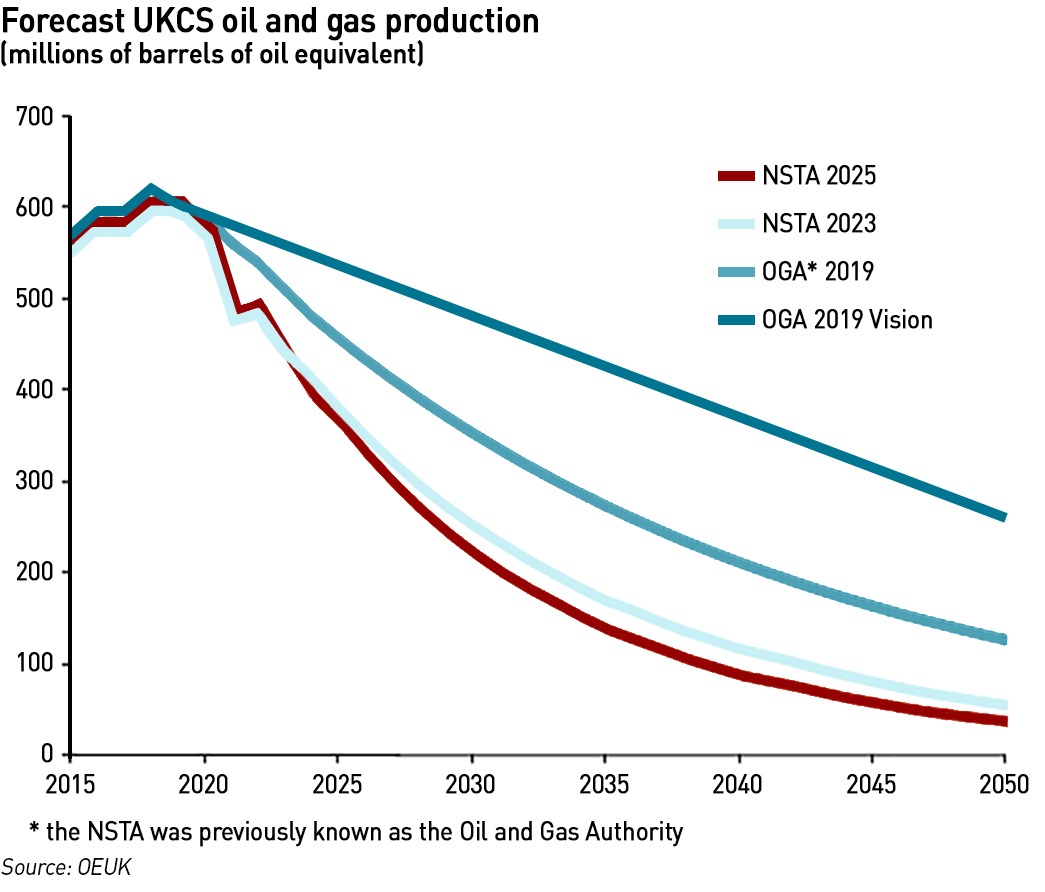
The UKCS is in a much sharper decline than had previously been expected, primarily as a result of a punitive fiscal regime and current Government policy against new exploration. This not only threatens energy security in terms of access to molecules, it also threatens the viability of offshore pipeline infrastructure. The key issue isn’t simply that UKCS output is declining, but that the offshore gathering and transmission system has fixed costs and physical interdependencies – as throughput falls, it becomes progressively harder to maintain and justify these assets.
These pipelines were designed for high throughput and depend on tariffs from producers for their economic viability. As volumes decline, unit tariffs rise to recover fixed costs. At some point, remaining producers face uncompetitive transportation tariffs which accelerates field decommissioning, leading to a “death spiral” where loss of one anchor field undermines the economics of the whole system.
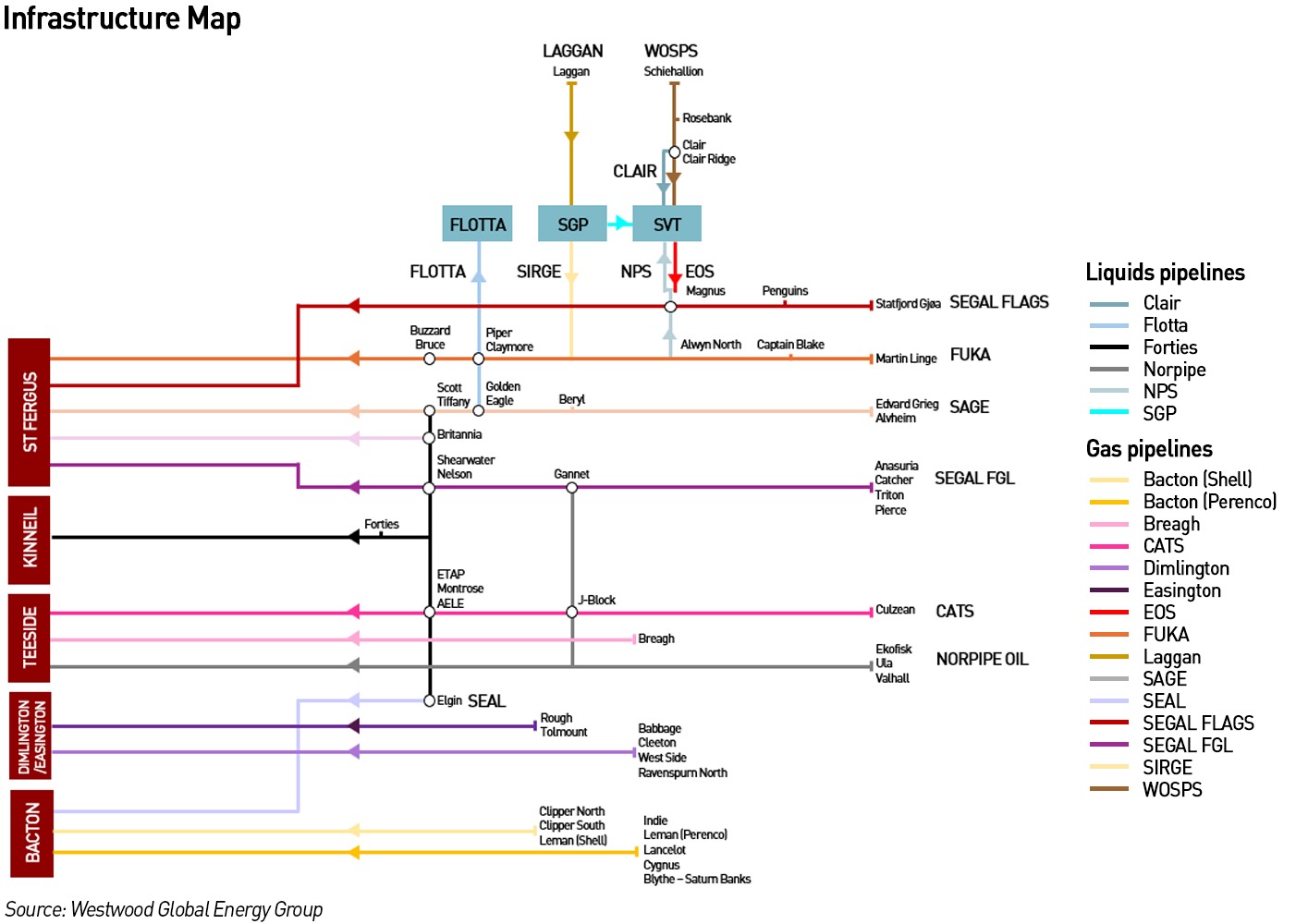
According to Westwood Global Energy Group, the Reserves/Production (R/P) ratio, a measure of how long an asset could continue to produce at current rates, given remaining reserves and 2025 production estimates, for four pipeline systems is <6, two of these are critical for the UK with a high number of field entrants.
Flotta Pipeline System: relies on production throughput from three hubs (seven producing fields). Although infill drilling and workover activity is ongoing at the hubs, the R/P ratio is 5.5. The progression of the Marigold discovery as a tieback to the Piper hub would change the current outlook. Roughly 40% of the resource upside within 50 km is unlicensed.
Forties Pipeline System: a critical liquids pipeline system for the UK, with 71 field entrants via 17 hubs, accounting for around 23% of UK liquids throughput in 2025. Seven hubs, could cease before 2030, including the namesake Forties putting the system at risk. There is one tieback under development and infill drilling at some hubs, but due to the relatively high current throughput rates versus the reserves replacement the R/P ratio is 5.5. Three hubs are expected to contribute 45% of 2025 throughput. Delivery of upside opportunities, such as an infill well at Elgin, additional drilling at ETAP and progression of new developments such as Birgitta, Fotla and Leverett, would improve the outlook for this system. Over half of the resource upside within 50 km is unlicensed.
CATS Pipeline System: a critical gas pipeline system for the UK, with around 42 field entrants via nine hubs, contributing roughly 25% of UK gas throughput in 2025 but due to the relatively high current throughput rates compared with the reserves replacement, the R/P ratio is 5.0. Two hub entrants account for 68% of 2025 forecast throughput. Strong performance from a development well being drilled at Culzean (largest entrant), the progression of ongoing drilling opportunities at J-Block and ETAP, and development of tieback opportunities at Birgitta will be important to the outlook. There is high upside potential within proximity of the hub entrants.
Ninian Pipeline System: the most northerly pipeline system in the UK feeds liquids production from three hubs via 12 fields. The Ninian hub has commenced decommissioning activities, with only one of the three original platforms still operating. The pipeline, however, feeds into the Sullom Voe terminal which also receives oil from Clair and Clair Ridge and therefore supports economics. Over 80% of the resource upside within 50 km of the Ninian Pipeline System is unlicensed.
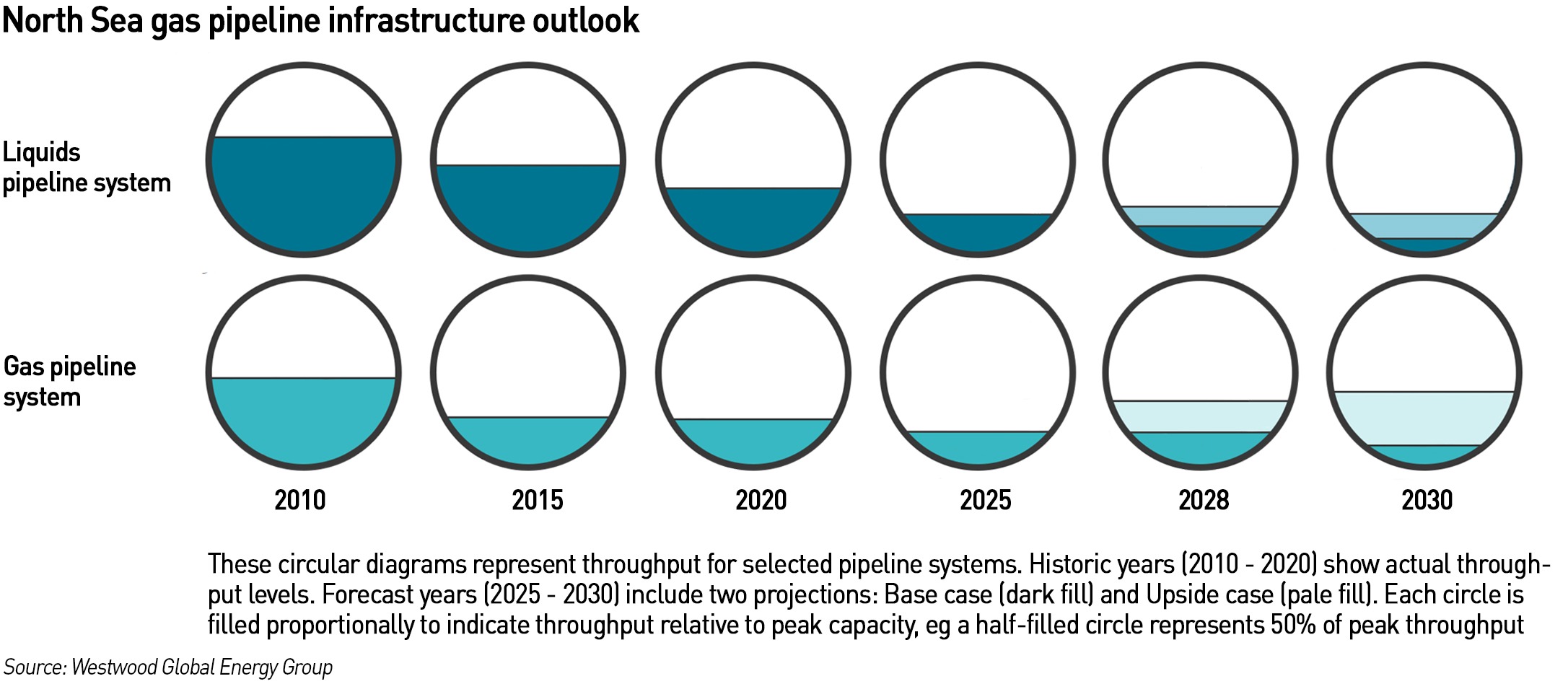
Liquids and gas export routes are intrinsically linked: changes to one export route can impact many other export routes. This interdependency means that if one system becomes uneconomic, it could lead to a cascading effect forcing the closure of other systems, stranding potentially viable fields and leaving some areas of the North Sea inaccessible for future development.
When an offshore trunkline is decommissioned, all connected satellites lose evacuation routes. For example, closure of the SAGE or FLAGS system would strand several smaller tiebacks. Once a trunk is gone, re-establishing offshore transport to shore would require new infrastructure which would be uneconomic for tail-end volumes. With each major offshore system that shuts down, the steady baseload flow into the NTS diminishes, which has several system-level implications:
- Reduced baseline inflow capacity: St Fergus, historically a high-pressure feed point, is already seeing declining flows. As these terminals wind down, the NTS loses one of its few north-to-south supply anchors, increasing reliance on southern entry points (Easington, Bacton, LNG). This complicates linepack management and reduces network flexibility under high demand
- Greater dependence on LNG: LNG can physically fill the gap on paper, but it is price sensitive as cargoes may divert to Asia, and vulnerable to weather and shipping delays. They are also logistically constrained due to availability of shipping and regas throughput limitations. This means that during cold snaps or high continental demand, the GB system may struggle to ramp LNG send-out quickly enough to cover both power station and heating loads (which are higher in cold weather)
- Interconnector reversal uncertainty: Continental gas systems are structurally net importers, especially after the closure of the Groningen field in the Netherlands. During European cold spells, they are unlikely to export to GB. Recent investments in IUK /BBL reversibility help, but molecule availability is the limiting factor
- Power-sector rationing: Gas-fired power plants are classified as interruptible customers under the emergency supply hierarchy. If total inflows (UKCS + LNG + Norway + IUK/BBL) cannot meet domestic heating and firm industrial loads, supplies of gas to power generators may be curtailed to preserve household supply (although this is not necessarily rational since most heating systems require power to operate, so supplying gas but not electricity to households would be counterproductive)
In an orderly decline, UKCS production would fall predictably, pipelines would be rationalised, and alternative import capacity scaled up. Although most production forecasts indicate a smooth decline profile over the coming years, this is unlikely in practice because forced decommissioning of offshore pipeline infrastructure would lead to a cliff-edge loss of capacity. This would reduce maximum NTS entry capacity by tens of mcm /day overnight, and shift pressure management southwards changing the utilisation of key compressor stations such as that at Peterborough.
It would also force higher LNG and interconnector reliance without time to build redundancy, or sufficient NTS entry and other pipeline capacity – there are currently constraints that limit the volumes of gas that can be transported from Dragon and South Hook eastwards to consumers in England. Because offshore decommissioning is irreversible, the risk is asymmetric – once a trunkline or compressor is removed, it cannot be reinstated in winter emergency conditions.
Mitigating the risk and impact of pipeline closures
There are several mitigation strategies that could be employed.
The best option would be to remove the fiscal headwinds that are making North Sea gas production uncompetitive, and to allow new drilling to optimise the gas resources owned by the UK. The Government should also consider providing financial support to key pipelines that would support their economics even under lower throughput conditions, essentially removing the economic drivers for decommissioning. This would be analogous to the Capacity Market that ensures lower utilisation of gas power stations due to the use of wind and solar generation does not force their premature closure.
A more expensive, and less viable option would be to develop a gas storage policy. The UK very little gas storage capacity, and while the key facility, Rough, has re-opened, it is not very useful since deliverability rates are far lower than before it closed, and there are few other sites that could be developed for gas storage. Following the closure, Centrica removed the cushion gas and the produced a significant amount of the tail reserves, materially reducing the reservoir pressure and hence the speed with which gas can be extracted.
To make Rough a meaningful source of gas during cold snaps, it would be necessary to either drill new wells and re-inject cushion gas to raise the reservoir pressure – which would require a significant investment – or to install pumps on the production wells. Either option would require new capital expenditure, but the result would not solve the problems caused by a decline in gas from the UKCS.
Finally, Britain could install floating regasification terminals which would increase the amount of LNG GB could accept. Spare NTS entry capacity at Easington and St Fergus would make these the most likely sites, but ship docking facilities as well as storage tanks would need to be built. Depending on the extent of works needed to accommodate large LNG tankers, this is likely to be part of the solution to the eventual decline of the UKCS.
“We think Neso forecasts are too optimistic. We forecast gas production to decline by 70pc by 2030 due to the impact of the windfall tax. That suggests the UK will run out of LNG import capacity as early as 2031, as the current import terminals reach the maximum rate they can deliver gas into the UK grid during winter. The best way to ensure security of gas supply is to maximise domestic gas production,”
– Chris Wheaton, analyst at Stifel
At current decline rates, UKCS inflows to the NTS could fall from around 30 bcm in 2024 to 20 bcm by 2030, with much of the loss concentrated in the north and east coast terminals. This progressively reduces the steady baseload inflow that underpins pressure and linepack flexibility in winter. This will lead to rising import dependence, as GB will rely more on LNG (up to half of peak-day supply) and Norwegian imports (Langeled, Vesterled). From 2028 risks of structural reduction in Norwegian deliveries will also begin to manifest – before then, Norwegian offshore pipeline operator, Gassco, projects stable or slightly higher export capability, although maintenance outages will present some short-term risk.
As UKCS production falls, even if overall gas availability remains adequate on paper, North Sea gas flows will reduce baseload pressure support, increase reliance on LNG logistics, and heighten the risk of generator curtailment on extreme-demand days, beginning as early as winter 2026/27, and increasing year-on-year into the 2030s unless policy change reverses the accelerating decline in UKCS production.
An infrastructure blind spot that represents a serious security of supply risk
Almost all published analysis of GB gas security focuses on the onshore system – the NTS, LNG terminals, storage and interconnectors. Far less attention has been paid to the offshore pipeline infrastructure that delivers gas to the beach in the first place. This is a serious blind spot. Offshore trunklines do not decline smoothly with production, they fail economically once throughput drops below a viability threshold. When that happens, multiple connected fields are stranded simultaneously and entry capacity can fall abruptly.
Because offshore decommissioning is irreversible on winter timescales, this creates a cliff-edge risk to cold-snap gas adequacy that is not captured in current security-of-supply models. Once these pipelines close they will be hard if not impossible to restore, and their closure will push fields that could keep producing into early closure. None of this is captured in the production models.
This Labour Government is not just sleepwalking into disaster by forcing the UKCS into premature decline, it is racing towards it. And for what? Because we’re not reducing gas consumption by reducing North Sea output, we’re simply replacing domestic production with more carbon intensive imports. Irrational ideology is putting our energy security at risk, undermining affordability, increasing real world emissions, and hard-wiring vulnerability into a system that already operates close to its physical limits.

Excellent piece! The UK remains extremely dependent on natural gas for home heating, cooking and indeed electricity. What is happening at present is that a major increase in the demand for electricity through data bases, internet and modern communications is colliding with political pressures to reduce fossil fuel use. Indeed the need to manufacture the wind and solar capacity to replace fossil fuel use is greatly increasing the demand for energy generally. Climate change activists need to understand that it will take a considerable period to make the shift. In any case, the use of natural gas in the UK is pretty marginal in the addition of carbon dioxide to the atmosphere compared with say, China and India.
Dr Chris Cragg formerly editor of FT Energy Economist.
Thanks.
Actually at the moment deindustrialisation is a bigger driver than electrification but if we do achieve electrification plus AI data centres there would be a very large increase in electricity demand and one we would be unable to meet, particularly on low wind days in winter when renewable generation can be close to zero
Great paper Kathryn. So we have aging gas fired power stations, aging nuclear stations set to decommission, home grown gas production declining and a push toward more reliance on more unreliable and costly renewables., vastly increased reliance on foreign sources for our NG and electricity via inter-connectors and LNG (and for LNG at least 10% increased carbon emissions impact), no viable storage for renewable output etc. Sounds like this governments net zero strategy will “cost the earth” after all. Time for me to install the third Tesla powerwall 3 so we can at least survive (for 2-3 days) the power outages that will undoubtedly occur. Maybe I’ll add a wood burning stove (oh, these will be banned also). After 40 years in the energy industries domestically and abroad, I have never seen a more incompetent government (or maybe I have after 10 years in Nigeria where diesel generators were the norm)
Get a diesel generator. Less likely to catch fire than a battery and diesel keeps pretty well unlike petrol!
A good analysis and evaluation of UK plc’s situation and future problems. I would add to this for clarity and further articulation.
The reason ROUGH has diminished as a storage facility is down to fluid in the reservoir around the well stock. Relative permeabilises and skin effect are detrimentally affected by fluid in the near wellbore formation. This creates a doughnut of reduced permeability to gas flow. Correcting this is difficult, expensive nad time consuming if indeed it can be achieved, new wells are a more certain remedy however new wells on an old platform are no5 without issue. Rough should have been retained as a working storage facility – failure that vests with both Labour and Conservative governments.
Offshore process and transportation moves to OPEX sharing pro rata to volume when the operators volume production is a minority. Typical tariffs then escalates and pushes fields uneconomic to produce. Solution is to nationalise the pipes or subsidise transport where it makes sense to UK plc rather than the operator – a change of mindset needed.
We assume infrastructure will operate as designed however it only takes one supply system to suffer an event and go offline causing stress on the remaining supply and ultimately undersupply forcing curtailment and possibly blackouts. This infrastructure is aged and due to the EPL companies have reduced headcount and maintenance to a bare minimum, problems compound.
AI data centres will accelerate the draw down of gas in summer months at night when there is no wind. The worst scenario for accelerated gas consumption is data centres that discharge massive heat blooms when cooling, not ideal, a compounding problem. AI is for energy rich countries – not UK plc. A logical issue lost on our leaders.
There’s also the vulnerability of these pipelines to attack.
It won’t just be fibre-optic cables that the Russians are surveying and possibly fitting with remotely detonated sabotage devices as I saw suggested somewhere recently although I doubt it personally.
Thanks. As usual, a most convincing and frightening analysis. Perhaps the only upside is that a disaster of this potential gets rid of this government which seems to be so obsessed with impoverishing the UK.
I wonder if Zealot Miliband will do less or more damage if he becomes leader of Labour.
A very good analysis, I voiced my personal concerns to friends when some of the infrastructure was marked for closure this summer. This is a clear analysis of the situation with the correct caveats. Any economic enterprise requires a certain volume to maintain infrastructure and with tax rises you can see the retreat of the oil companies is happening now and likely will accelerate. Its clear the UK government is clueless and thought a few percent would not make a difference, but it does. Attitude is at least as important, and, energy companies other than renewables, know they are just cash cows now. There must be quite a few looking at the costs of closure and the government rewriting the tax rules and thinking a tax write off for those decommissioning costs now may be better than delaying and getting nothing.
Mean while Norway is happily drilling away.
A change of government may help but that’s three or four years away.
Kathryn,
Thanks for this excellent analysis of the emerging crisis in our gas supply.
The government’s behaviour confirms Ayn Rand’s saying: “You can ignore reality but you cannot ignore the consequences of ignoring reality”.
One small additional wrinkle is what will happen when the Fife ethylene cracker shuts down in February, leaving a lot of ethane from the Forties system with nowhere to go?
Miliband plots £13bn solar panel blitz to create ‘zero bill’ properties
DT
Tomorrows DT now suggest anyone with a gas boiler is going to be charged more to subsidise heat pumps. That man is a complete menace and i thought HMT would keep a lid on his adventures but with Starmer/Reeves holed below the waterline there now appears no check on him.
I note on the National Gas website ( https://data.nationalgas.com/gas-system-status – storage tab – click on it before last year’s data disappears! ):
At the beginning of last year we had 27 TWh of gas in storage. At the beginning of this year: 21 TWh of gas, and at the beginning of next year, looks like only 14 TWh.
Meanwhile three sites, Easington, St Fergus, and Milford Haven (LNG) handle about 80% of our gas. Teesside is apparently not doing much despite being ranked as the largest by the Westwood report.
I’d be surprised if we can meet the N-1 requirement with so few terminals handling so much of our supply. Never mind N-2, and for a country contemplating being at war we need at least N-3.
Ed Milliwatt should be bricking it, if he weren’t so completely ignorant.
We are in this mess because Mrs T privatised all the utilities, which disincentivised investment in infrastructure and actually gave new ways to exploit inadequate infrastructure to manipulate the so-called free market and fraudulently make money (remember this: https://www.ft.com/content/fa17f1dd-892e-40a4-872c-c585b866a0c9 ). NESO is a step in the right direction, but National Gas (owned by the infamous Macquarie!) is a disaster waiting to happen.
Kathryn an excellent article to end the year on and shines a spotlight on an area I never considered was a risk. DENZ if populated with thousands of civil servants and you would expect they would have this as a national risk and thus adopt policies to at least avoid any cliff edge but seemingly not.
Thank you again Kathryn …… Thinking ahead to future problems is not on their agenda ….. total madness that we are not using our own home grown Gas …… As you mention time to look into a back up system ……. All the best from a Brit in Arizona USA
Some of the Scndanavian couintries have been threatening to pull the plug on connections to Britain and Germany to avoid the disruption of their grids caused by the problems elsewhere.
It is way past time to admit that wind and solar power do not belong on the grid because the paramount requirements are continuity and stability which wind and solar do not provide.
Look out for the crash of the net-zero Ponzi scheme to transition to intermittent wind and solar inputs.
The wind industry must be the only enterprise that ever survived without caring about the reliability of the supply chain for the major input.
The meteorologists didn’t do wind drought reports and the sponsors of the industry didn’t bother to check. Now Trillions have been spent to get more expensive and less reliable power with catastrophic damage to forests and farmlands.
The combination of wind droughts and the cost of grid-scale storage guarantees that there will never be a transition to wind and solar because these “unreliables” are not fit for purpose to power a post-industrial society.
Dirt farmers are alert to the threat of rain droughts, but meteorologists never issued wind drought warnings and the wind farmers never checked the reliability of the wind supply.
https://rafechampion.substack.com/p/the-sinister-threat-of-wind-droughts
Why did nobody take any notice of the Dunkelflautes observed for 60 years on the North Sea oil and gas rigs? And Britain and Germany bet the farm on wind, especially offshore wind!
https://www.conservativewoman.co.uk/a-curious-tale-of-the-north-sea-winds/
The Australian pioneer wind watchers sounded an alarm but not even the Australian authorities and journalists took any notice.
https://rafechampion.substack.com/p/watching-the-wind-watchers
I hope Miliband sees a copy of this.
But I’m not sure he’d understand it.
Thank you Kathryn, and happy New year
Excellent if troubling post, thank you; sadly, the people who should be reading this … won’t.
Even if we have a bad winter (like 1947, 1963), long blackouts & 1,000s die, hypocritical Zealots like Miliband & his crew won’t stop this race to the bottom.
Excellent if troubling post, thank you; sadly, the people who should be reading this … won’t.
Even if we have a bad winter (like 1947, 1963), long blackouts & 1,000s die, hypocritical Zealots like Miliband & his crew won’t stop this race to the bottom.
Excellent if troubling post, thank you; sadly, the people who should be reading this … won’t.
Even if we have a bad winter (like 1947, 1963), long blackouts & 1,000s die, hypocritical Zealots like Miliband & his crew won’t stop this race to the bottom.
Excellent if troubling post, thank you; sadly, the people who should be reading this … won’t.
Even if we have a bad winter (like 1947, 1963), long blackouts & 1,000s die, hypocritical Zealots like Miliband & his crew won’t stop this race to the bottom.
Don’t know what happened there ???
Don’t know what happened there ???
Getting
Error Details:
Error Code: HTTP 504
Error Message: Backend or gateway connection timeout.
Server ID: 21007
Sorry – there are gremlins in the back end. A fairly important plugin isn’t being updated and isn’t compatible with the most up to date php. I have a developer working on a replacement but because it’s quite important to the architecture of the site, we need to do a fair bit of testing to make sure the new version works properly. I’m hoping we’ll be able to go live with the fix soon. Please bear with us in the meantime.
A brilliant summary.
Completely agree with everything in the article, but would also add the deliberate threats we now face to our under sea connections (gas, electricity and Internet). We know that Russia and China are already active in mapping and not uncommonly deliberately damaging such under sea connections (there are many such cases well documented in the last few years). If and when things did get nasty in that sphere, it would be all too easy for such adversaries to severely disrupt such undersea connections, potentially cutting the UK off from the US and Europe. Although very difficult to protect against completely, such a scenario should also be part of our planning and investment considerations.
I spent the early years of my career working as a Gas Engineer with North Thames Gas and then as Project Analyst with rhe Development Department at the Gas Council working on LNG storage at the ends of the grid (then Canvey Island, Hirwan, Avonmouth, Altrincham and Scotland) – mainly for system security if the pipeline from Bacton was ploughed up. I was also involved in making the case for salt cavity storage in North Yorkshire.
I have two questions- why are we not fracking (my understanding is that this is the main source of gas from USA) and why are we not using the abundant coal under our feet to generate electricity?
Surely the most secure supply is under our feet?
We’re not fracking because Ed Miliband is firmly against it to the extent of capping the test wells to prevent them ever being re-opened. He’s trying to salt the earth. However, we don’t have proven frackable resources, so shouldn’t assume that even if it were allowed, we would be able to produce a lot of gas from onshore.
Re coal – we don’t have any coal power stations left. We may have to build some because at the moment they’re faster to build than gas and we’re running out of firm capacity. Again, Miliband is against it.
I spent 40 years working in the offshore oil industry. The last 25 tears i was a drilling supervisor or company man. The UK oil industry was the most technically advanced in the world with the best safety record. I feel it a terrible thing this industry gas been thrown away along with its people due to political expediency. This is much worse than the decline of the coal industry. At its height there were up to 60,000 people offshore or supporting. Plus another similar amount who made and serviced valves as well as many other industrial items. If you remwmber it was Anthony Wedgewoid Benn who started the dash for cash forcing companies to produce too fast thereby destroying reservoirs. He and many other ministers over the years were warned. As a result there is still 40% oil lefta behind in the Brent Field. Governments are the problem because they use politics. I think i rest my case. They just dont care about industry or people. In the words of the Who ‘wont get fooled again….
I spent 46 years working in the gas industry and have always been saddened by the lack of knowledge at top levels in the UK Civil Service. A couple of basic facts; Five time more energy is transmitted around the UK in winter by the gas grid than the electricity grid. So 80% of UK energy is at risk if the gas grid loses pressure. As 50% of UK electricity is provided by gas in winter, that is pretty desperate. Also, if the population and industry lose gas, they will switch to electricity where possible and the electicity grid cannot handle it. So the country will in effect be shut down..
The gas grid, all 120,000 miles of it, is a national tressure that has taken some 80 years to establish. It works on pressure. Every meter (19million) has a gas governor so that every premise gets the same pressure. Lose the pressure and the flames go out. I have handled a lost pressure situation in a small town, all be it many years ago, but the same principles apply. You must turn off every gas meter and appliance and the gas supply. You must then, when supply is to resume, purge and relight all the pipelines and appliances. Sounds simple but having done it, it is a nightmare. TV and radio announcements, loud speaker vans around streets, teams of police and lock smiths breaking into empty properties and gangs digging up the road to cut off premises that could not be entered. The town was flooded with operatives and it took about 3 weeks to get it back on line. Also many of the appliances did not comply to gas safety refulations so could not be re-lit and had to be cut off. That was a small town of 12,000 inhabitants. On a larger or national scale, it would take months.
The Nordsea 2 pipline destruction should be a warning. A boat, some frogmen, explsives, and you don’t even know who’s done it and hundreds of miles of pipeline to go at.
For goodness sake. It is a matter of national security to swiftly restore more gas supplies and fracking. We survived the second world war because of the coal mines.
Peter Marsden BSc CEng MIChemE FIGasE Former Editor for 13 years of International Gas Engineering and Management.